
Introduction
Buying or renting property in Dubai is an exciting step. But when the bills start arriving, one number often catches people off guard: the real estate agent commissions.

Here is a fact that surprises most newcomers. In Dubai, the standard residential sales commission is 2% of the property price, and tenants usually pay 5% of the annual rent to their agent. That is a big chunk of money on any transaction. A 2% fee on a AED 2 million property means AED 40,000 goes to the agent. On a AED 120,000 annual rental, that is AED 6,000 in commission.
The tricky part? Information about how these fees work is all over the place. Some sources say buyers always pay. Others say sellers pay too. Rental fees range from 5% to 10% depending on the property type. Off-plan deals follow completely different rules. And commercial properties? The numbers shift again.
This lack of clarity makes it hard to compare costs or negotiate a better deal. You might end up paying more than you expected simply because you did not know the standard rates.
That is where this guide comes in. We break down exactly how real estate agent commissions work in Dubai in 2026. You will learn the standard rates for every transaction type, who pays what, how to negotiate, and what is changing in the market. Whether you need a real estate agent for rental purposes, are looking for a renting real estate agent for a commercial lease, or need a property broker Dubai for a multimillion dirham purchase, this guide gives you the facts you need to make smart decisions.
Let us start with the basics: the standard commission rates across different property types.
How Real Estate Agent Commissions Work in Dubai
So what are the actual numbers? Let us break them down by transaction type.
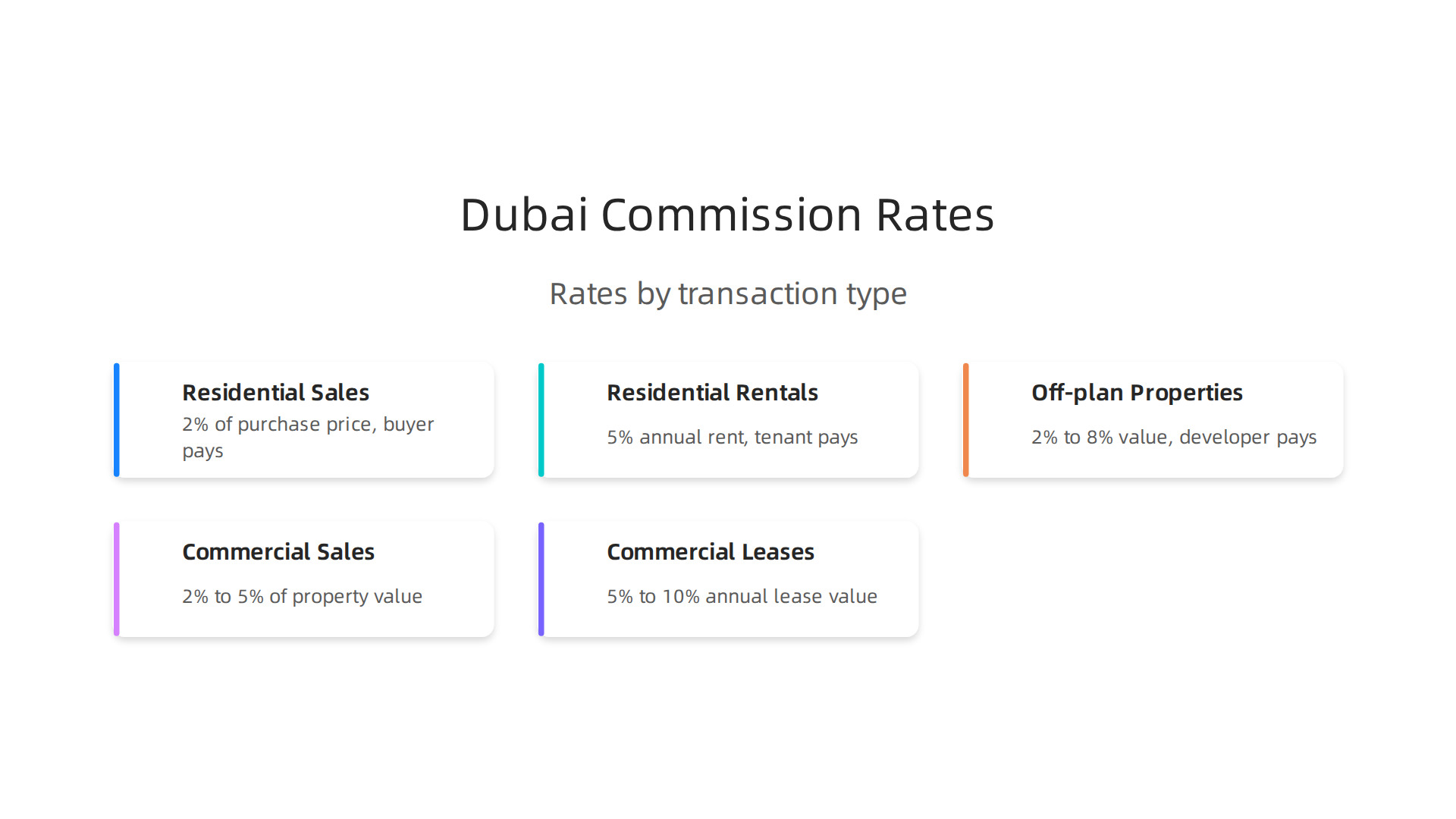
Residential sales follow a straightforward rule. The standard commission is 2% of the purchase price, paid by the buyer. If you buy a AED 2 million apartment, you owe your agent AED 40,000 plus 5% VAT. The seller also pays their own agent 2% if they used one. Both commissions are paid only after the sale is complete and ownership transfers. No deal, no fee.
Residential rentals work a bit differently. The tenant pays the agent 5% of the annual rent when signing the lease. On a AED 120,000 per year property, that is AED 6,000. Landlords may pay their own listing agent separately, but that fee ranges from 0% to 8% depending on the agreement.
Here is something many people miss: the commission is not one lump sum for one person. When a buyer works with one agent and the seller works with another, the total 4% (2% + 2%) gets split between the two agencies. Each agency then splits its share with the individual agent. The standard split between company and agent is often 50:50, meaning your agent personally takes home about 1% of the total transaction value.
This structure applies to resale properties, also called the secondary market. For a complete look at how much agents actually keep from each deal, check out this detailed guide on how real estate agents earn commissions in Dubai.
Off-plan properties are a different story. Developers usually pay the agent commission directly, and the buyer pays nothing. Those commissions range from 2% to 8% of the property value, depending on the project and the agreement between developer and brokerage.
Commercial properties also use different rates. For commercial sales, expect 2% to 5%. For commercial leases, tenants typically pay 5% to 10% of the annual lease value.
All these rates are market norms set by RERA, not hard legal limits. That means you can negotiate, especially on higher-value deals or if you are a repeat client. Understanding the numbers is the first step. Knowing how to negotiate them is the next.
Ready to find the right real estate agent for rental or purchase with clear commission terms? Get a free Dubai real estate consultation with Ayaz Salman to discuss your specific needs and get expert guidance on fees and negotiations.
Who Pays the Commission? Buyer, Seller, and Landlord Roles Explained
Knowing the rate is only half the picture. The other half is understanding whose bank account that money actually comes from.
And in Dubai, the answer depends on what kind of deal you are doing.
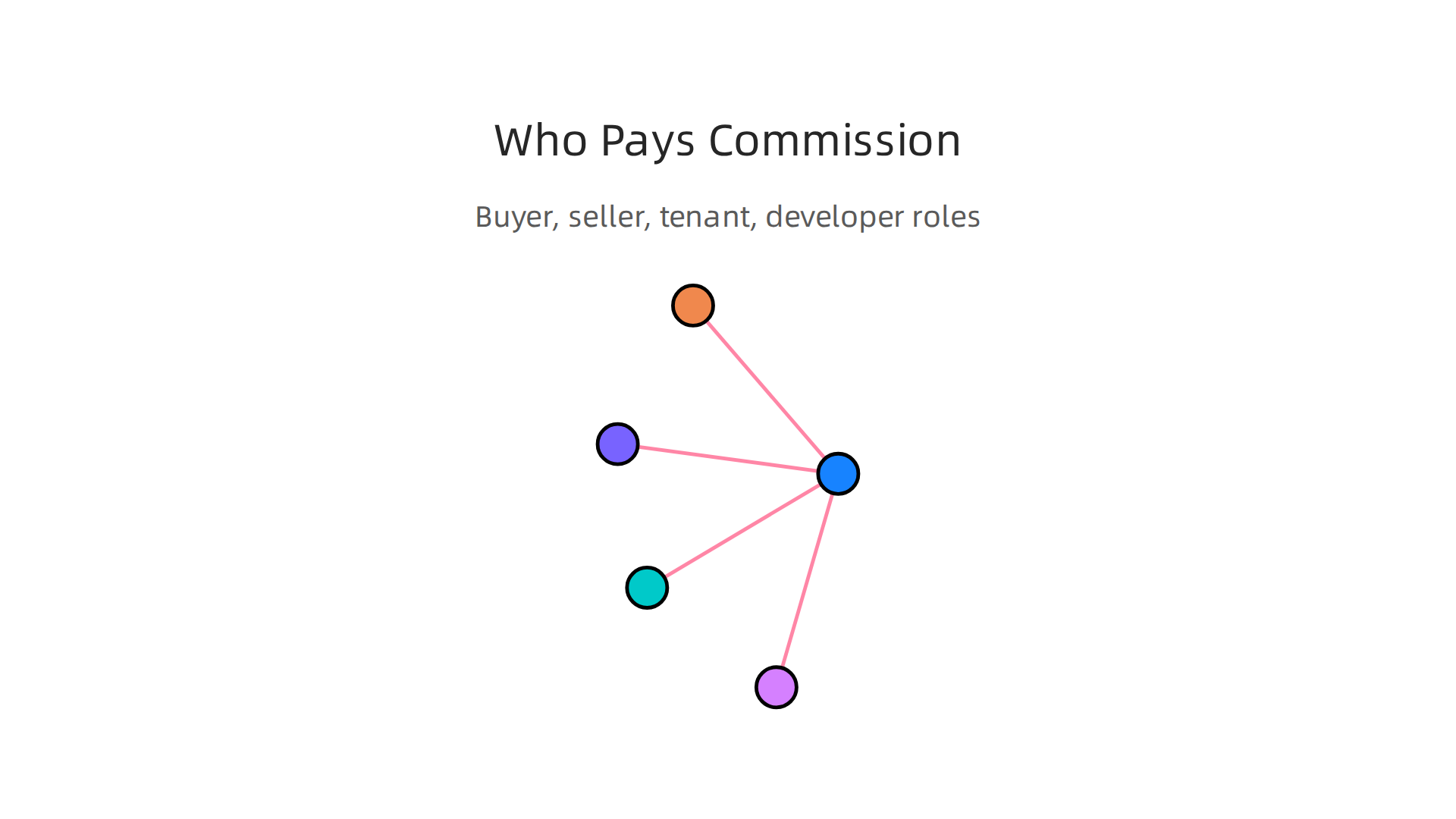
For resale homes (properties already owned by another person), the rule is simple: each side pays for their own agent. The buyer pays 2% to their agent. The seller pays 2% to their agent if they hired one. So if both sides use agents, the total commission is 4%, split between two agencies. This matches the market standard explained in the Real Estate Commission in Dubai: The Complete 2026 Guide. If you are planning to buy, it helps to know this upfront so you can budget for that extra 2% on top of your down payment and closing costs.
For rental properties, the tenant pays the letting agent 5% of the annual rent. That is the fee for finding and securing the home. The landlord may also pay a separate agent to list and market the property, but that fee usually comes out of their own pocket it can range from 0% to 8% depending on the services agreed. So in most cases, tenants pay one commission, landlords may pay another.
For off-plan properties bought directly from a developer, things flip entirely. The developer pays the agent commission, and the buyer pays nothing. That is one big reason why off-plan can feel cheaper upfront.
Understanding who pays helps you avoid surprises. If you are a buyer, you know you need to set aside 2% for your agent.

If you are a tenant, you plan for that 5% fee when you sign the lease. And if you are a seller or landlord, you may need to budget for your own agent’s fee as well.
For a full walkthrough of what the buying process looks like from start to finish, check out this step by step guide on how to buy a house in Dubai. It covers everything from budgeting for commissions to signing the final contract.
Commission Structures: Fixed Fee, Percentage, and Hybrid Models
Once you know who pays, the next big question is how the real estate agent commissions are actually calculated. In Dubai, you will mostly see three types: a straight percentage, a flat fixed fee, or a combination of both.
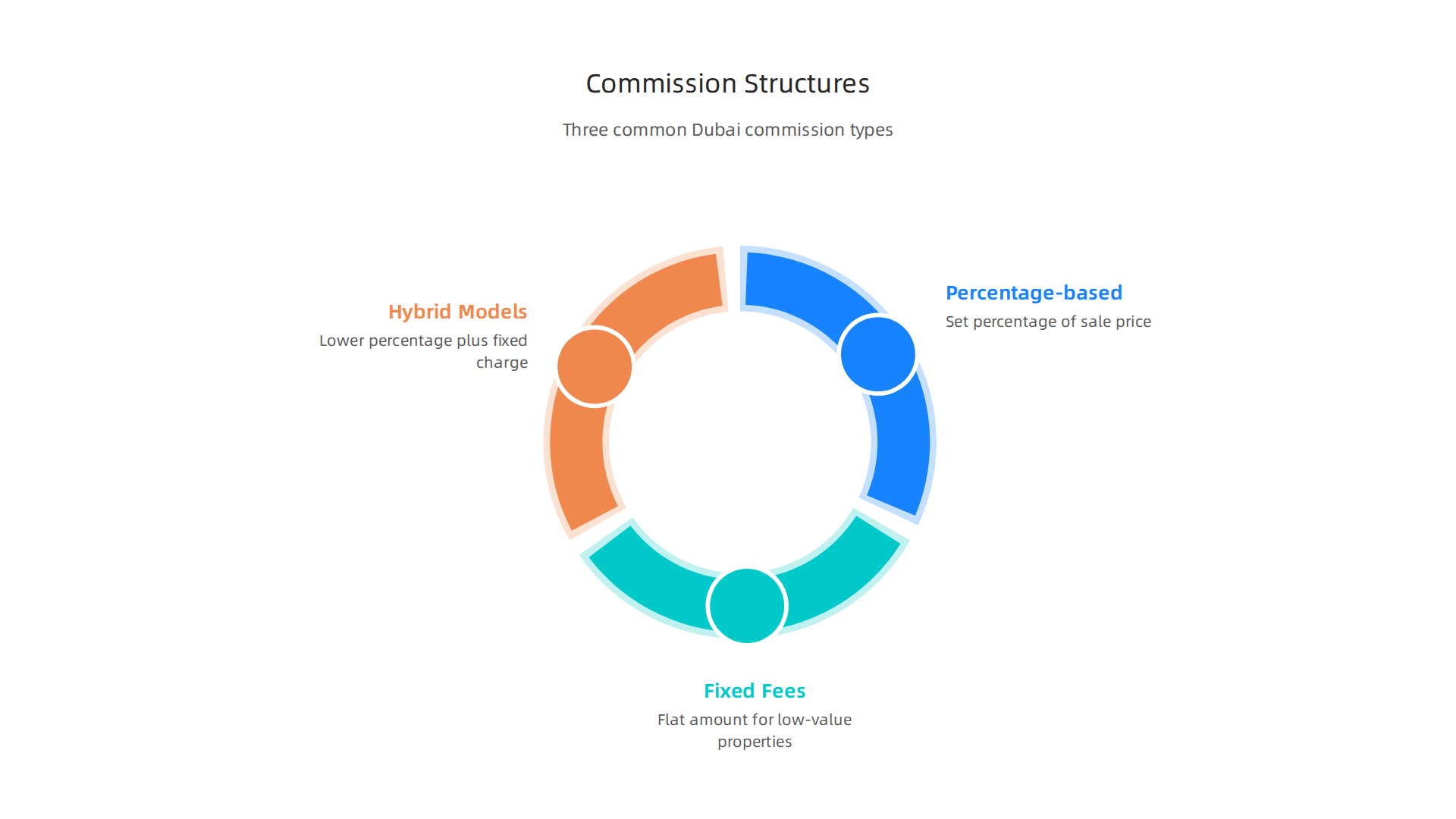
Each model works best for different deals.
Percentage-based commissions are the standard for most property sales. You pay a set percentage of the sale price. For a AED 2 million home, a 2% commission means AED 40,000 to your agent. This model is simple and scales with the deal size. For rentals, the common rate is 5% of the annual rent. But that percentage can feel high on a cheap unit. That is why fixed fees exist.
Fixed fees are more common for low-value rental properties. Many agencies charge a flat AED 5,000 instead of 5% when the percentage would be lower. For a AED 50,000 per year studio, 5% is AED 2,500 but a fixed fee gives the agent a fair minimum. It also gives the tenant a clear number upfront. According to a guide from Engel & Völkers Dubai, this flat amount is applied when the percentage falls below a certain threshold. If you are a real estate agent for rental properties, the fixed fee model can make your offer more attractive to cost-conscious tenants.
Hybrid models mix a lower percentage with a fixed administrative charge. For example, an agency might charge 1.5% of the sale price plus a AED 5,000 flat fee. This saves the client money on a high-value property while covering the agent’s basic costs. It is a flexible option that feels fairer to both sides. Many property broker Dubai firms now offer hybrid plans to stand out.
Understanding these structures helps you pick the right deal for your situation. As a renting real estate agent, you might recommend a fixed fee for budget apartments and a percentage model for luxury villas. As a buyer, you can negotiate based on the value of the property.
For a detailed comparison of all the rates and what different agencies charge, check this real estate agent commission breakdown in Dubai. It covers everything from discount brokers to premium services.
Still unsure which model fits your transaction? Connect with Ayaz Salman for a free consultation to discuss your buying, selling, or renting needs in Dubai.
Legal Framework: RERA and Dubai Real Estate Commission Regulations
So now you know the different ways real estate agent commissions get calculated. But who makes sure everything stays fair? In Dubai, that job belongs to the Real Estate Regulatory Agency, or RERA for short. RERA is the government body that sets the rules for every property broker Dubai professional and every transaction in the city.
First, every agent must hold a valid RERA registration number. You can check an agent’s license before working with them. This rule keeps unqualified people out of the market. According to a 2026 guide from Oliva, every broker operating in Dubai must have a valid RERA broker registration number and follow all agency regulations. It is your right to ask for that ID before signing anything.
Second, the commission amount must be clearly written in the agency agreement before any work starts. You cannot agree to a fee verbally and then have the agent change it later. If either side wants to adjust the fee, both must give written consent. This protects you from surprise charges. When you work with a real estate agent for rental or a buyer’s agent, make sure the contract states the exact percentage or fixed fee.
Third, RERA’s code of ethics bans undisclosed fees. Agents cannot hide charges in the fine print. They must treat all parties fairly and transparently. If an agent breaks these rules, they can face fines or lose their license. The same rules apply whether you are a tenant, buyer, or seller. For a full breakdown of RERA’s buyer protections, check this RERA Dubai rules and regulations guide.
These laws exist to make your experience safer. A licensed renting real estate agent follows the same code as a top sales agent. If you ever feel an agent is not playing by the rules, you can report them to RERA.
Understanding the legal side helps you feel confident. And if you want to know how to pick a trustworthy agency that follows these rules, this guide on how to choose real estate brokerage companies in Dubai walks you through the key steps.
How Commissions Are Split Between Agents and Agencies (Broker-Split Agreements)
You now know that RERA sets the rules for all real estate agent commissions. But have you ever wondered how the money actually gets shared once it is paid? When a sale closes, the commission rarely goes to just one person. Usually, it gets split between several parties.
Here is how it works. When you work with a property broker Dubai agency, the total commission gets divided between the agent who listed the property, the agent who found the buyer, and their respective brokerages. This division is called a broker-split agreement.
Most broker-split agreements in Dubai fall within a common range. Typical splits land somewhere between 50/50 and 70/30. The exact split depends on a few things. An experienced agent with a strong track record might keep a bigger share, like 70 percent. A newer agent might only get 50 percent. The split also changes based on who brought the lead. If an agent found the client through their own hard work, they often get a bigger cut. If the agency provided the lead, the agency keeps a larger portion.
Why does this matter to you as a client? It affects the service you receive. When an agent knows they will only keep part of the commission, they may be less motivated to go the extra mile. On the other hand, an agent who gets a larger split has more incentive to work hard for you. This is why it helps to ask your agent how their agency handles splits. A clear answer tells you they are transparent.
According to a detailed legal article on real estate broker commission rules from a leading UAE law firm, only the broker who successfully concludes the transaction is entitled to the full commission. This means if multiple agents are involved, only one gets paid, and they have to handle their own internal split with their agency.
So when you are choosing a real estate agent for rental or a buying agent, do not be shy. Ask about their commission structure. It shows you are a smart client. And if you want a full breakdown of who pays what and how much agents earn, check out this guide on real estate agent commission in Dubai: rates, who pays, and how agents earn.
Still feeling unsure about your own situation? A quick conversation can clear everything up. If you are thinking about buying or renting and want to know what you will really pay in commissions, get in touch for a FREE Dubai Real Estate Consultation. An expert can walk you through the numbers and help you find a trustworthy agent who fits your needs.
Hidden Costs and Additional Fees to Watch For
The commission you pay to your agent is just one part of the picture. When you buy or rent property in Dubai, several other costs can sneak up on you if you are not prepared.
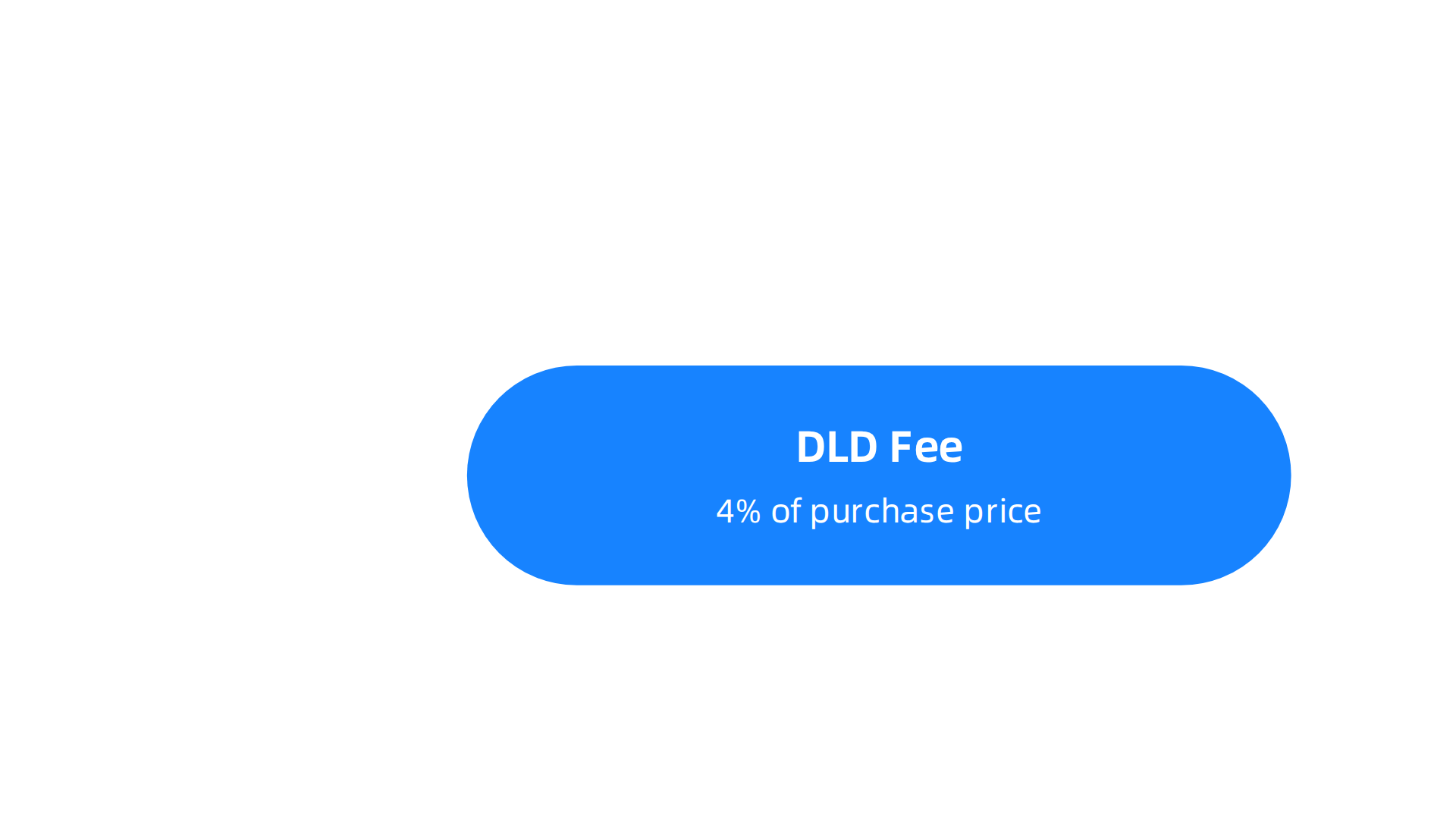
Knowing what they are before you sign any agreement will save you from unpleasant surprises.
The biggest hidden cost is the Dubai Land Department (DLD) registration fee. This fee is 4 percent of the property’s purchase price. It is usually paid by the buyer, though in some deals it gets split between buyer and seller. On top of that, you will also pay trustee office fees of around AED 4,000 and an admin fee of about AED 4,200. These fees are mandatory and nonnegotiable.
Another cost that many people forget is VAT. In Dubai, real estate agent commissions are subject to 5 percent VAT. So if your commission is AED 20,000, you actually pay AED 21,000. Plus, trustee fees and some service charges also carry VAT. As one detailed 2026 guide explains, the total of these hidden fees can add 8 to 12 percent to your purchase price beyond the down payment.
Some agents also try to add extra charges for things like property photography, marketing brochures, or arranging viewings. You should never pay these fees. The standard commission of 2 percent (or 5 percent for rentals) is supposed to cover all of the agent’s services. If an agent asks for an "admin fee" or "processing fee," it is usually not a real cost. A smart move is to ask your agent upfront whether there are any additional charges beyond the commission and VAT. Get everything in writing.
If you are a renter, the standard real estate agent commission is 5 percent of the annual rent plus VAT. But some agents may try to charge you extra for things like "tenancy contract fees" or "ejari registration." These are usually part of the service. Always check the total amount you will pay before you agree to work with an agent.
To avoid surprises, compare the total cost of service from different agents. Some may charge a higher commission but include all the extras. Others may offer a lower commission but add fees later. For a complete breakdown of what you should expect to pay, read our guide on how to choose a real estate brokerage company in Dubai. It walks you through exactly what questions to ask before you commit to an agency.
Negotiating Commissions: Tips for Buyers, Sellers, and Investors
Now that you know which fees are real and which ones are not, let’s talk about something even more important: negotiating the commission itself.

Many people think the standard rate is set in stone. But the truth is, you often have room to discuss it, especially if you have a strong position.
First, remember that commissions are not a fixed law. They are a starting point for discussion. If you are buying a high-value property, working with the same agent on multiple deals, or referring other clients, you have leverage. Some guides confirm that you may be able to negotiate the rate, especially for higher-value properties. Check out this breakdown of commission negotiation for high-value properties for more details.
Second, do your homework before you sit down to negotiate. Talk to at least two or three different agents and ask each one for a full fee breakdown. Compare what they include. Some agents might offer a lower rate but charge extra for things like marketing or viewings. Others might stick to 2 percent but provide better service. Knowing the market rates helps you push back if an agent tries to charge above the standard. For a deeper look at what to expect from a good agency, read our guide on how a commercial real estate agent in Dubai saves you money and headaches.
Third, consider performance-based models. Instead of a flat percentage, some agents are open to a deal where they earn a bonus if they sell your property above the asking price or within a very short time. This aligns their incentive with yours. For investors planning multiple purchases, offering a package deal with a lower commission per property can also work well.
At the end of the day, negotiating is about knowing your value and being willing to ask. If you are unsure how to approach these conversations or want a second opinion on a specific deal, reach out for a free consultation. FREE Dubai Real Estate Consultation with Ayaz Salman can help you review your situation and make a confident decision.
The Future of Real Estate Agent Compensation in Dubai (2026 Trends)
If you’ve been watching the Dubai property market, you might have noticed something shifting. The old way of paying agents a straight 2% for sales and 5% for rentals is no longer the only option. In 2026, several trends are changing how real estate agent commissions work, and that affects everyone.
One big driver is technology. New proptech platforms let buyers and sellers compare fees and connect with agents more easily. This competition is pushing down rates. Some brokerages now offer flat fees instead of a percentage. Others operate as discount brokerages with lower upfront costs. A recent industry report highlights these changes, including the rise of digital platforms that offer lower fees and more transparency. Check out the full breakdown in the 2026 Real Estate Commission in Dubai: Expert Guide from Gaj Properties.
Another trend is data-driven pricing. Instead of guessing what a property is worth, agents can use real market data to justify their commission. That makes the whole process more transparent. For rentals, this means you might see more flexible rates from your renting real estate agent instead of a flat 5%. Some property broker Dubai firms are even experimenting with performance bonuses: lower base commission but a cut if the agent gets you above asking price.
Regulatory changes are also on the horizon. The Dubai Land Department and RERA may push for clearer disclosure rules. That would force agents to spell out every fee in writing before you sign. That kind of transparency protects you from surprise charges.
What does this mean for you? You have more choices than ever. You can pick a traditional agent or try a newer model. But you still need someone who knows the market well. If you want to compare options and find the best fit for your situation, our guide on real estate agent commission in Dubai rates and who pays can help you understand the numbers.
The market is moving fast. If you are buying, selling, or renting and feel unsure about which commission model works best, it helps to talk to someone neutral. Reach out for a free consultation. FREE Dubai Real Estate Consultation with Ayaz Salman can help you review your specific deal and choose the right path forward.
Summary
This guide explains how real estate agent commissions work in Dubai in 2026, breaking down the standard rates, who pays them, and how the money is split between agents and brokerages. It covers residential sales (typically 2% paid by buyers), residential rentals (typically 5% paid by tenants), off‑plan deals (commissions paid by developers, usually 2–8%), and commercial transactions (rates vary by deal). The article also explains commission models—percentage, fixed, and hybrid—how internal broker splits commonly work, and the legal protections enforced by RERA. You will learn which additional costs to expect (DLD registration, trustee and admin fees, and 5% VAT on commissions), when and how you can negotiate fees, and the market trends pushing more transparent and tech‑driven pricing. After reading, you’ll be able to budget accurately for commissions, spot hidden charges, verify an agent’s RERA registration, and negotiate smarter with brokers or choose alternative fee models.