
Introduction: Why Industrial Real Estate in Dubai is a Hot Investment in 2026
You have probably noticed a shift happening in Dubai. Residential towers get all the headlines, but the real action in 2026 is happening in a different corner of the market. More investors are turning their attention to commercial industrial real estate listings than ever before.

Why the sudden interest? Let us look at what is driving this trend.
Dubai sits at a global crossroads. The city has positioned itself as a top logistics hub connecting Asia, Africa, and Europe. That means goods flow through Dubai at massive scale. And where goods flow, you need space to store, package, and distribute them. This demand pushes warehouse occupancy rates to new highs. As a result, commercial property and land for sale in industrial zones are becoming harder to find.
E-commerce is a huge factor. Online shopping keeps growing. Cold chain logistics, the stuff that keeps food and medicine fresh during transport, is also booming. Both need specialized industrial space. If you look at any list of for sale commercial real estate options, you will notice that warehouses and cold storage units are getting snapped up fast.
The Dubai government is cheering this on. Two big plans, the Dubai Industrial Strategy 2030 and Operation 300bn, are designed to boost manufacturing and exports. These initiatives create a friendly environment for industrial property owners. That is a solid tailwind for anyone searching commercial property near me for sale in Dubai’s industrial districts.
So where do you start? The buying process has clear steps. According to a detailed guide on [buying commercial property in Dubai](https://wis e.com/us/blog/how-to-buy-commercial-property-in-dubai), you need to define your investment goals and budget first.

Doing that homework early saves headaches later.
This guide will walk you through everything you need to know about finding, evaluating, and purchasing industrial real estate in Dubai in 2026. Let us get into the details.
If you want a broader view of the local market landscape first, check out our overview of Dubai commercial real estate in 2026.
1. Why Dubai’s Industrial Property Market is Thriving in 2026
You have seen the headlines about Dubai’s residential market. The numbers for early 2026 show strong activity there too. But the real story that deserves a closer look is happening in the industrial sector. The UAE real estate market is expected to grow from USD 38.05 Billion in 2025 to USD 51.43 Billion by 2034 (IMARC Group). A big chunk of that growth comes from industrial space. Here is why this market is on fire right now.
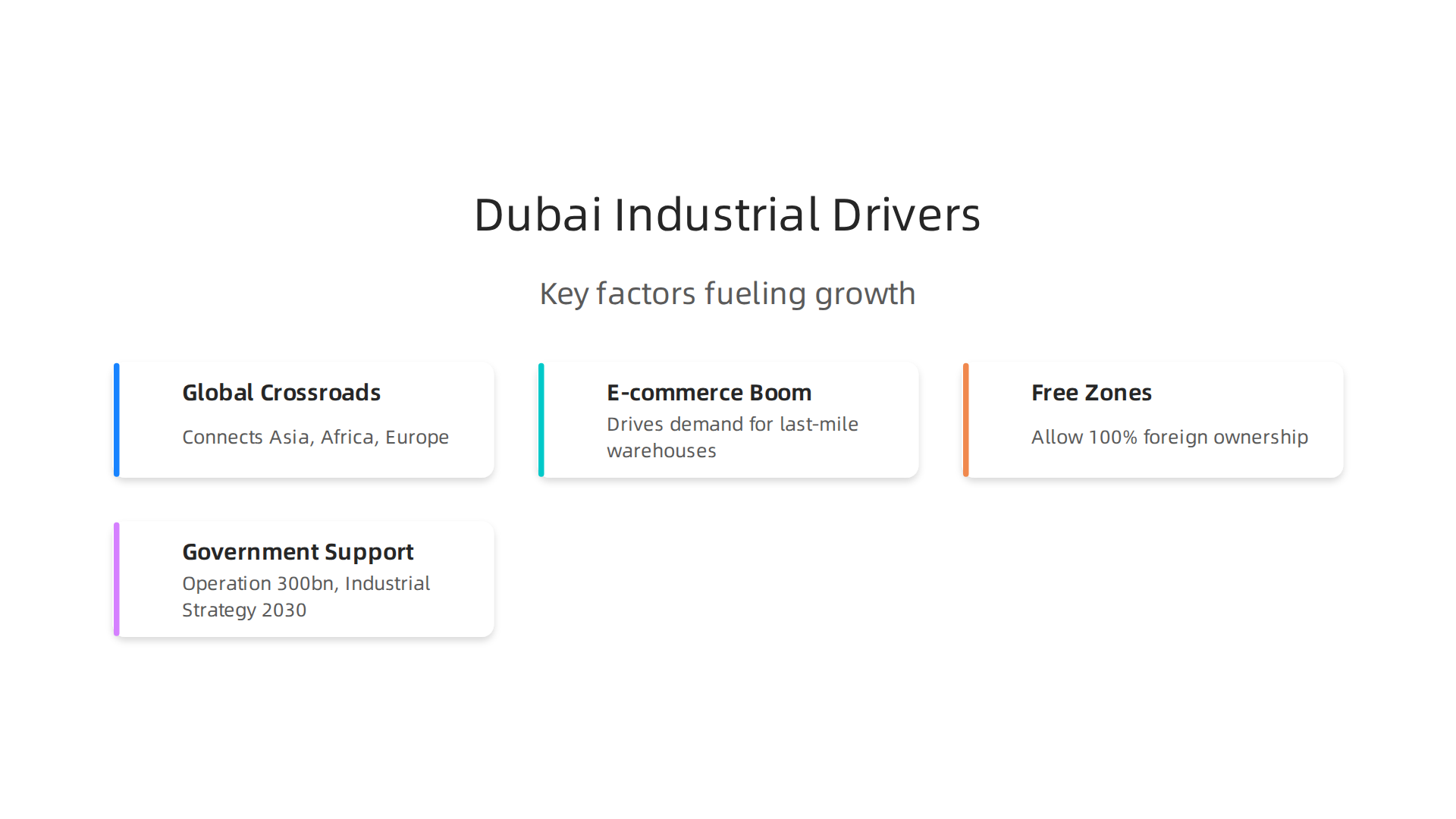
Dubai sits at the world’s trading crossroads. The city connects Asia, Africa, and Europe in a way few places can.

Goods arrive at Jebel Ali Port, one of the busiest ports on the planet. They get sorted, stored, and shipped out again. All of that takes physical space. Warehouses, cold storage units, and logistics centers are in high demand. According to JLL’s market analysis, industrial real estate continues to show strong fundamentals across Dubai in 2026 (JLL UAE). That is good news for anyone browsing commercial industrial real estate listings.
E-commerce changed the game for good. Same-day delivery is no longer a luxury. It is what people expect. That puts pressure on businesses to have warehouses closer to where customers live. These are called last-mile warehouses. They need to be near city centers. And in Dubai, that means industrial zones close to residential areas are becoming prime real estate. If you search commercial property near me for sale in 2026, you will notice that properties near neighborhoods get snapped up fast. They also hold their value better over time.
Free zones take the stress out of foreign ownership. Dubai’s government wants businesses to set up here. Free zones allow 100% foreign ownership. That means you do not need a local partner. You can also take all your profits out of the country with zero restrictions. That is a massive advantage. For anyone looking at commercial property and land for sale, free zone locations offer security and flexibility. You get the tax benefits and full ownership rights at the same time.
The government has your back. Two big plans are driving this growth. Operation 300bn and the Dubai Industrial Strategy 2030 are designed to boost manufacturing and exports. These initiatives create a friendly environment for industrial property owners. They also attract more businesses to Dubai, which keeps demand high for for sale commercial real estate. When the government is actively supporting a sector, it is a strong signal for investors.
So where should you focus in 2026? Look for properties near Al Maktoum International Airport, Jebel Ali Port, or along major highway routes. These locations will grow fastest as logistics and distribution expand. If you want a step-by-step guide on how the buying process works, read our full guide on how to buy or lease office and industrial property in Dubai. It covers everything from choosing the right zone to closing the deal.
2. Types of Industrial Properties for Sale in Dubai
Now that you know why the industrial market is booming, let’s talk about what you can actually buy. If you are browsing commercial industrial real estate listings in 2026, you will find several different types of properties. Each one serves a different purpose. Knowing the difference helps you pick the right one for your business or investment.
Warehouses and distribution centers make up the biggest part of the market. These are the workhorses of Dubai’s logistics sector. Sizes range from small units of around 5,000 square feet all the way up to massive spaces over 100,000 square feet. You will find most of them in areas near Jebel Ali Port and Al Maktoum International Airport. These locations are perfect because goods move from ships to planes quickly. For example, a typical warehouse in the Dubai World Central area gives you high ceilings, loading docks, and easy truck access. The JLL market update shows that demand for these spaces stayed strong through early 2026 (JLL UAE). If you need a space to store and ship products, a warehouse is your best bet.
Light and heavy manufacturing facilities fill a different need. These are not just storage spaces. They are built for making things. Light manufacturing units are smaller and cleaner. Think of electronics assembly, food packaging, or textile production. Heavy manufacturing facilities are bigger and built for tougher work like metal fabrication or chemical processing. You will find these in designated zones like Dubai Investments Park and Dubai Industrial City. These areas have the right infrastructure for factories. Power supply, waste management, and road networks are all set up for industrial use. If you are looking at commercial property and land for sale, these zones offer some of the best value per square foot.
Cold storage and special-purpose properties serve niche but growing demand. Cold storage units keep things frozen or chilled. This is huge for the food industry, pharmaceutical companies, and even flower importers. These properties have special insulation and refrigeration systems. They cost more to build but also earn higher rents. Other special-purpose properties include showrooms, workshops, and service centers. A showroom is part retail and part warehouse. You display your products in the front and store them in the back. Workshops are for trades like car repair or woodworking. According to guides on commercial property types in Dubai, these niches are often overlooked by new investors (Westgate Dubai). But they can be very profitable if you understand the market.
Here is a quick summary to help you compare:
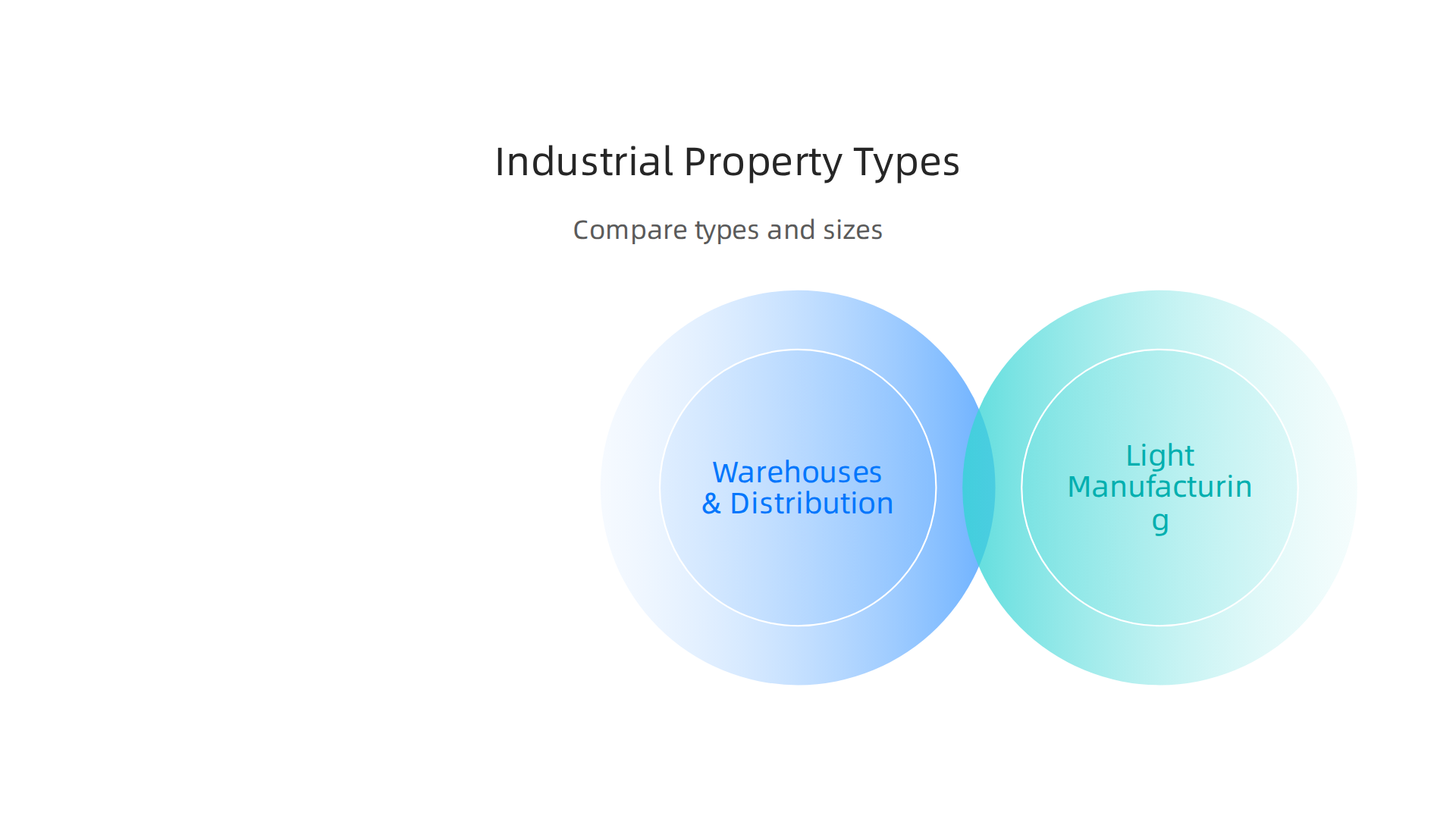
| Property Type | Typical Size Range | Best Location |
|---|---|---|
| Warehouses & Distribution | 5,000 to 100,000+ sq ft | Near Jebel Ali Port, DWC, Al Quoz |
| Light Manufacturing | 10,000 to 50,000 sq ft | Dubai Investments Park, Al Quoz |
| Heavy Manufacturing | 50,000+ sq ft | Dubai Industrial City, JAFZA |
| Cold Storage | 10,000 to 40,000 sq ft | Food zone areas, Al Furjan |
| Showrooms & Workshops | 2,000 to 20,000 sq ft | Ras Al Khor, Al Qusais |
So which one fits your needs? If you are an e-commerce business, go for a warehouse near a residential area. If you are a manufacturer, look at the designated industrial zones. And if you want a unique asset that pays well, explore cold storage or a showroom. Each type has its own rules, costs, and potential returns. To learn more about how to evaluate and buy these properties, read our full guide on how to buy or lease office and industrial property in Dubai. It walks you through the entire process from start to finish.
Remember, the right property depends on your business plan. Do not buy a cold storage unit if you need a simple warehouse for dry goods. Do not buy a showroom if you only need storage. Match the property type to your actual needs. That is how you make a smart purchase in the Dubai industrial market.
3. How to Evaluate a Commercial Industrial Real Estate Listing
You found a listing that looks good on paper. The price seems right. The square footage matches what you need. But here is the thing. Buying a warehouse or factory is different from buying an office. You cannot just look at the photos and say yes. You need to dig deeper. Let me show you what to check before you make an offer.
Location is not just about the address. For industrial properties, location means how fast you can move goods in and out. Look at access to major highways. Can trucks get to and from the property without traffic jams? Check the distance to Jebel Ali Port and Al Maktoum International Airport. These are the key hubs. A warehouse near Sheikh Mohammed Bin Zayed Road is worth more than one tucked away in a narrow lane. Experts say that proximity to transportation hubs is a primary factor for industrial real estate value (Redubai). Also think about the labor supply. Is there a workforce nearby? If you truck drivers cannot get to the site easily, your operations will suffer.
Utility capacity can make or break your operation. Many buyers forget to check this. You need to know if the property has enough power, water, and gas for what you plan to do. A light assembly unit might be fine with a standard connection. But a heavy manufacturing plant needs three-phase power and high voltage. Some older industrial units in Dubai have outdated electrical systems. Ask the seller for recent utility bills and load letters from DEWA. Also check if there have been any recent upgrades to the infrastructure. If you need a lot of water for cleaning or processing, confirm the water line size. Missing this step can cost you thousands in upgrades later. Guides on selecting industrial properties recommend checking these utility specifications upfront (My Industrial Specialist).
Zoning compliance is the silent deal breaker. Every industrial area in Dubai has specific zoning rules. You cannot run a chemical factory in a light industrial zone meant for warehousing. The Dubai Municipality approves the land use. If you buy a property that is not zoned for your activity, you could face fines or even closure. Also check that the property has a valid occupancy permit. This permit proves the building is safe and legal to use. Lenders and insurance companies require it. If the seller does not have one, walk away or negotiate a big discount. You can verify zoning by visiting the Dubai Municipality website or asking a licensed real estate agent.
For a full overview of what to look for in industrial properties, read our guide on how to buy or lease office and industrial property in Dubai. It breaks down each step.
Here is a quick checklist to take with you when you view a listing:
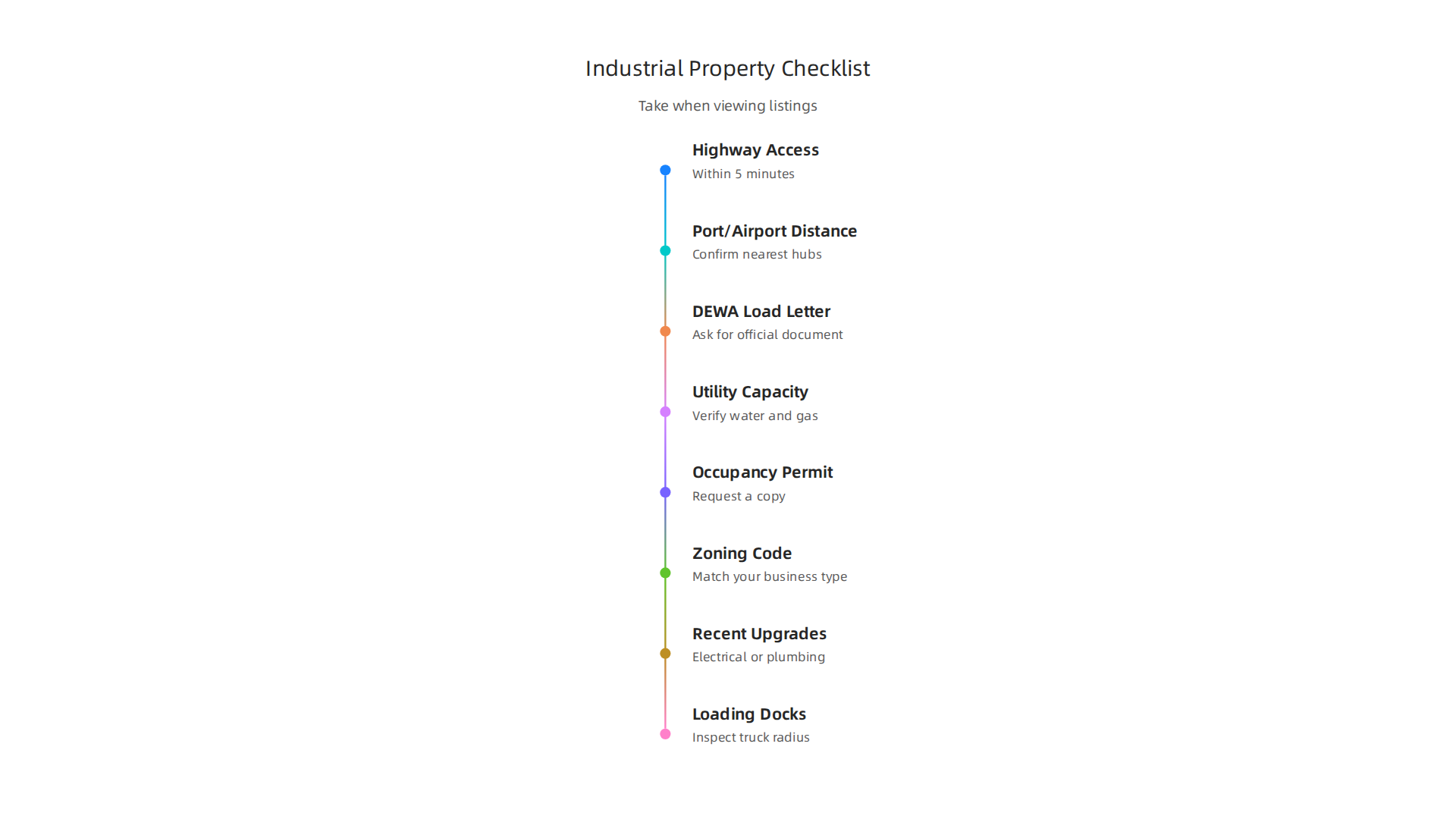
- Check highway access within 5 minutes
- Confirm distance to nearest port or airport
- Ask for DEWA load letter
- Verify water and gas supply capacity
- Request a copy of the occupancy permit
- Confirm zoning code matches your business type
- Look for recent upgrades to electrical or plumbing
- Inspect loading docks and truck turning radius
When you are searching through commercial industrial real estate listings, keep these three factors in mind. Location, utilities, and zoning. Skip any one of them and you could end up with a property that does not work for your business. Take your time. Do your homework. And when you find the right match, you will know because all three boxes will be checked. If you are just starting your search, check out this article on how to find commercial real estate in Dubai on LoopNet and local portals. It shows you where to look for for sale commercial real estate and how to filter for the right property type.
Remember, the best listing is not the cheapest one. It is the one that fits your operations perfectly. A property near the port with enough power and the right zoning is worth paying a little more for. That is how you build a successful industrial business in Dubai.
4. Navigating Dubai’s Legal and Regulatory Framework
Now that you have a solid checklist for evaluating commercial industrial real estate listings, it is time to understand the legal side. Dubai has clear rules about who can own what and how to do it right. Skip this part, and you could lose your deposit or face fines. Let me break it down into three important areas.
Foreign ownership is possible, but not everywhere. As a foreign investor, you can buy freehold industrial property in designated free zones and investment areas. That is good news. But you cannot just buy any warehouse anywhere in Dubai. The law says you can own freehold title, a long lease, or a usufruct right for up to 99 years in approved locations (Tamimi). Common freehold areas for industrial use include Jebel Ali Free Zone (JAFZA), Dubai Industrial City, and parts of Al Quoz. If you are looking at commercial property and land for sale, always confirm it is in a freehold zone first. A real estate agent can help you verify this quickly. For a full breakdown of eligible areas, read our Dubai commercial real estate 2026 market guide for investors.
All transactions must be registered with the government. In Dubai, you cannot just sign a paper and call it done. Every purchase or lease of commercial property must be registered with the Dubai Land Department (DLD) and the Real Estate Regulatory Authority (RERA). This protects both the buyer and the seller. The process usually goes like this:
- You and the seller sign a sale agreement
- You pay a deposit (often 10 percent)
- The contract is registered with DLD
- RERA verifies the transaction
- You pay the remaining amount and get the title deed
Many buyers skip this step and end up in disputes. According to compliance experts, common mistakes include failing to register contracts and not disclosing commission arrangements (Anika Property). Do not make that mistake. Always work with a licensed agent or lawyer who knows the system.
Due diligence protects your investment. Before you hand over any money, you need to check three things:
- Title deed – This proves the seller actually owns the property. Get a copy from DLD and verify it is clean.
- No encumbrances – Make sure there are no existing mortgages, liens, or legal disputes on the property. A title search will show this.
- Master community rules – If the property is in a free zone or a managed industrial area, check the community rules. Some zones restrict certain business activities or require approvals from the free zone authority.
All property rights must be registered, regardless of lease length. That includes freehold, leasehold, usufruct, and musataha rights (Baker McKenzie). You can search for encumbrances on the DLD website or ask your agent to do it.
I know this sounds like a lot of paperwork. But think of it as buying insurance. A few hours of checking now can save you thousands of dirhams and months of headaches later. Once you have verified the legal side, you can move forward with confidence.
If you want a step-by-step walkthrough of the entire buying process, check out our guide on how to buy or lease office and industrial property in Dubai. It covers every legal requirement in plain language.
Remember, legal clarity is what separates a smart investment from a costly mistake. Take it seriously, and you will sleep better at night.
5. Financing Your Industrial Property Purchase
So you have found the perfect warehouse or factory in Dubai. You have checked the legal rules. Now comes the big question: how do you pay for it?

You have several solid options. Let me walk you through them.
Commercial mortgages are the most common route. Banks in Dubai offer loans specifically for industrial property. Most lenders will give you a loan to value (LTV) ratio of 60% to 70% of the property value (GrowBiz). That means you bring 30% to 40% as a down payment. The loan amount usually starts at AED 1 million and can go up to AED 100 million depending on the lender and your business (YouAEMortgages). Banks like Dubai Islamic Bank offer commercial property finance with flexible terms (Dubai Islamic Bank). You will also pay some upfront costs. These include a processing fee of 1% to 2% of the loan amount, valuation fees of AED 2,500 to AED 5,000, and a property registration fee of 4% (Holo). Plan for these costs before you apply.
Knowing your return on investment is just as important. Banks look at your business finances. But you should also calculate your own ROI. The formula is simple. Take your net rental income, add expected capital appreciation, and factor in any tax savings. Dubai has no property tax on commercial real estate. That is a big plus. Many investors also save on corporate taxes when they buy through a free zone company. When you browse commercial industrial real estate listings, always run the numbers first. Look at properties that are for sale commercial real estate with clear rental histories. If you search for commercial property near me for sale, check the rental yields for similar properties in that area. A good agent can help you with this data.
Islamic finance and specialized funds give you more choices. If you prefer Sharia compliant options, Dubai has you covered. Islamic banks offer Murabaha (cost plus financing) and Ijara (lease to own) structures. These work differently from conventional loans but achieve the same goal. Dubai Islamic Bank, for example, provides commercial property finance under Islamic principles (Kredium). There are also specialized real estate funds that pool money from multiple investors to buy industrial assets. These funds are great if you want exposure to commercial property and land for sale without managing the property yourself. You get a share of the rental income and capital gains, minus management fees.
Financing an industrial property in Dubai is very doable. You just need to pick the right option for your situation. If you want a full overview of the market, check out our Dubai commercial real estate 2026 market guide for investors. It covers everything from pricing trends to financing tips.
6. The Step-by-Step Process to Buy Industrial Property in Dubai
So you have your financing sorted out. That is a huge step. Now let’s walk through the actual buying process. It is simpler than you might think, especially when you follow a clear path. Here is what you need to do.
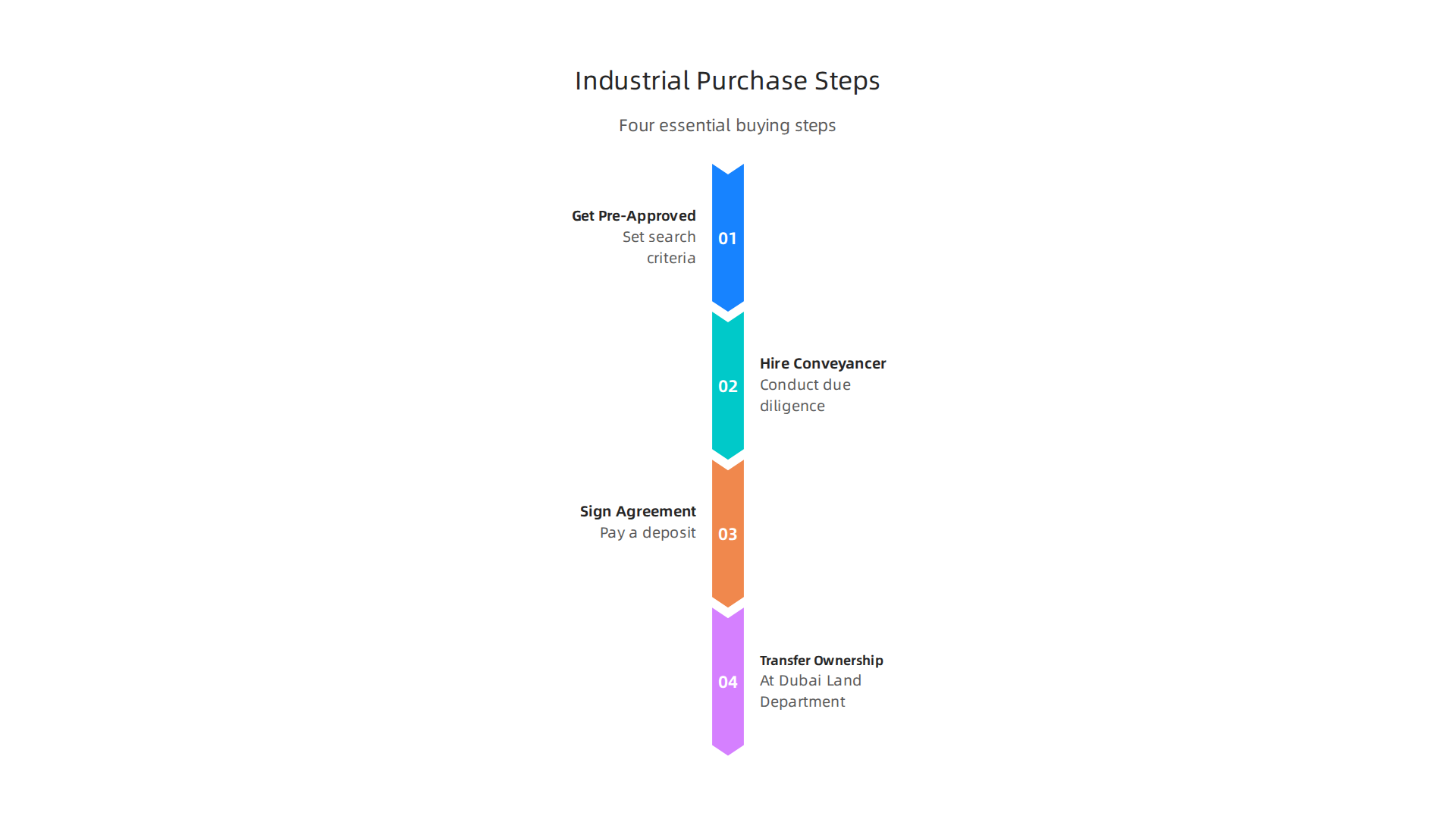
Step 1: Get Pre-Approved and Set Your Search Criteria
Before you start browsing any listings, talk to a lender. Get pre-approved for a commercial mortgage. This gives you a firm budget and shows sellers you are serious. Most banks in Dubai offer loans starting from AED 1 million, and you can borrow up to 70% of the property value (YouAEMortgages). Once you have that number in hand, define your search. What size warehouse do you need? What location works best for your business? Then start looking at commercial industrial real estate listings online or with a local agent. When you see for sale commercial real estate, check the rental history and compare prices. If you search for commercial property near me for sale, pay attention to access roads, loading docks, and zoning rules. The more specific you are, the faster you will find the right fit.
Step 2: Hire a Licensed Conveyancer for Due Diligence
You found a property that looks good. Now slow down. This is the most important step. Hire a licensed conveyancer or a real estate lawyer. They will run a full check on the property. They verify the title deed, confirm the seller actually owns it, and check if there are any debts or disputes tied to the property (800Homes). They also make sure the land use matches what you plan to do. A warehouse listed for storage might not be allowed for light manufacturing. Your conveyancer will review that. Do not skip this step. It saves you from expensive surprises later.
Step 3: Sign the Sale Agreement and Pay a Deposit
Once due diligence comes back clean, you and the seller sign a Memorandum of Understanding (MoU). This document outlines the price, payment schedule, handover date, and any conditions. You will pay a deposit, usually 10% of the purchase price (GuestReady). That deposit goes into an escrow account. Your money stays protected until all conditions are met. If the seller backs out, you get it back. If you back out without a valid reason, you could lose it. So be sure before you sign.
Step 4: Transfer Ownership at the Dubai Land Department
This is the final step. You go to the Dubai Land Department (DLD) with your conveyancer and the seller. You pay the 4% property registration fee plus a small administrative fee (Wise). The DLD updates the title deed to your name. The whole process takes a few hours. Once the deed is in your hand, you officially own the property. Congratulations.
For a deeper look at every stage of buying and leasing, check out our full guide on commercial real estate in Dubai: leasing and buying office and industrial property. It covers everything from market trends to legal tips.
Summary
This article explains why industrial real estate in Dubai is a top investment theme in 2026, driven by the city’s logistics hub role, rising e‑commerce demand, and government initiatives like Operation 300bn and the Dubai Industrial Strategy 2030. It outlines the main types of industrial property—warehouses, light and heavy manufacturing, cold storage, showrooms—and where to find them near ports, airports and key highways. You’ll learn how to evaluate listings with a focus on location, utility capacity, and zoning compliance, and why full legal due diligence and DLD registration are critical. The guide also covers financing options (commercial mortgages, Islamic finance, and funds), typical costs and LTVs, and a clear step‑by‑step buying process from pre‑approval to title transfer. Practical checklists and recommended free zones help investors and operators pick the right asset for their business plan.