Introduction
Thinking about investing in commercial property in the UAE? You might already know Dubai gets a lot of attention. But here is something many people miss. Abu Dhabi offers something different. It gives you high stability and long-term investment potential that is hard to find elsewhere.
The government has been pushing hard to grow industries beyond oil. These diversification initiatives are creating a strong foundation for the real estate market. And in 2026, that foundation is looking solid. According to the latest data, the UAE commercial real estate market is estimated at USD 54.17 billion in 2026. That is a clear sign of steady growth and demand.
So why does knowing the right developers matter? Because not all projects are built the same. Some developers have a track record of delivering on time. Others focus on premium finishes. A few specialize in mixed-use communities that blend office, retail, and residential spaces. When you understand who builds what, you can make smarter decisions with your money.

The 2026 landscape is full of fresh opportunities. Office spaces are seeing rising demand as businesses grow. Retail segments are adapting to new shopping habits. Industrial properties are expanding thanks to e-commerce and logistics needs. Megaprojects across the city are adding even more options for investors and business owners.
Whether you are looking for a new office for your company or a high-yield investment property, knowing the key players gives you an edge. It helps you avoid costly mistakes and find the right space faster.
As you explore your options, you might also want to compare what Dubai has to offer. For a complete view of the market there, check out our Dubai commercial real estate 2026 market guide.
And if you are ready to take the next step with expert guidance, you can get a FREE Dubai Real Estate Consultation to discuss your specific needs.
In the sections ahead, we will dive into the top real estate developers in Abu Dhabi and what makes each one worth your attention. Let us get started.
Abu Dhabi’s Commercial Real Estate Market: A Powerhouse in the Making
Abu Dhabi is not resting on its oil wealth. The city is actively building a new economy. And real estate sits right at the center of that plan. Instead of relying on one industry, the government is pushing growth across finance, tourism, technology, and manufacturing. This shift is creating steady demand for office towers, retail spaces, and industrial warehouses.
Two major plans guide this transformation. The Abu Dhabi Vision 2030 sets the long-term direction for economic diversification. The Ghadan 21 accelerator pumps money into projects that make the city more business-friendly. Together, these initiatives create a stable environment for investors. When the government backs a vision with real spending, the market follows.
So what does that mean for you in 2026? The numbers tell a promising story. Office rents in Abu Dhabi have jumped significantly. According to the latest market outlook, office rents are forecast to surge 20 percent in 2026 because of strong demand and limited supply. That is a powerful signal for anyone considering commercial property.
Residential capital values are also climbing. ValuStrat projects a 16 percent rise in 2026. Apartment values are expected to lead the way. This growth reflects a market that is balanced, not overheated. Supply is tight, with fewer new units coming online compared to previous years. When supply stays controlled and demand keeps rising, prices move in your favor.
Rental yields for commercial properties in the city remain attractive. Investors are seeing returns that outpace many other global markets. Add in government policies that welcome foreign investment, and you have a market designed for long-term growth.

Of course, not every opportunity is equal. Some areas and asset types perform better than others. That is why knowing the market inside out matters so much. Whether you are searching for a prime office location or a warehouse near transport routes, the right information changes everything.
If you are comparing options across the UAE, you might also want to look at neighboring markets. Our Sharjah commercial real estate 2026 guide covers a more budget-friendly alternative worth exploring.
The foundation here is strong. The master plans are clear. The demand is real. Abu Dhabi’s commercial market is not just growing. It is being built with purpose. And in 2026, that purpose is creating real chances for smart investors to get in at the right time.
Top Real Estate Developers in Abu Dhabi for Commercial Projects
Once you decide to invest in commercial property, the next big question is who builds it. The developer you choose shapes everything. Location, quality, timeline, and even long-term value all trace back to this one decision. In Abu Dhabi, a handful of developers stand out for commercial projects. Knowing their strengths helps you pick the right partner.
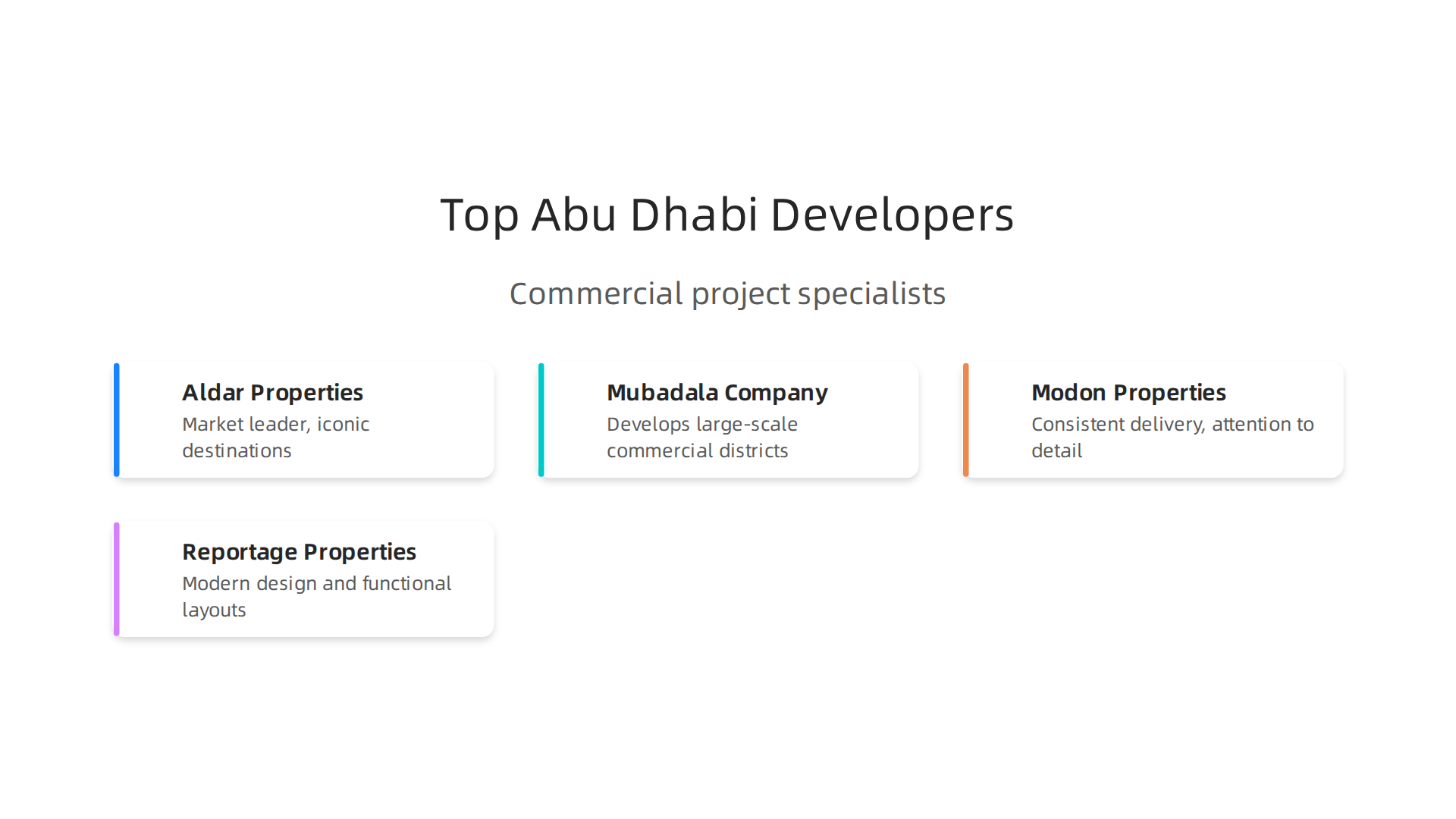
Aldar Properties: The Market Leader
Aldar Properties is the biggest and most trusted name in Abu Dhabi real estate. According to the Property Finder guide on Abu Dhabi developers, Aldar is known for well-planned communities and iconic destinations. When people think of real estate in Abu Dhabi, Aldar often comes to mind first. That reputation is earned through consistency.
For commercial investors, Aldar’s signature projects are Al Maryah Island and Yas Island. Al Maryah Island is the city’s financial hub. It houses the Abu Dhabi Global Market, top-tier office towers, and high-end retail. Yas Island mixes entertainment, business, and hospitality. If you want a prime commercial address with built-in foot traffic, Aldar delivers.
The company also benefits from government backing. Its projects align with Abu Dhabi Vision 2030 and Ghadan 21. That means stability and long-term planning. When a developer has this kind of scale and support, your investment is on solid ground.
Mubadala Investment Company: Building Commercial Districts
Mubadala is not a traditional developer. It is a sovereign wealth fund that develops large-scale commercial districts through its real estate arm. Its projects are often mixed-use and anchored by government or corporate tenants. This reduces vacancy risk for investors.
Mubadala’s portfolio includes areas like Masdar City, a hub for clean technology and innovation. Commercial spaces here attract companies focused on sustainability. If you target businesses that want green credentials, this is worth exploring.
Emerging Developers: Modon and Reportage
The market is not just for giants. Newer names are expanding their commercial portfolios. Modon Properties has a reputation for consistent delivery. Its projects like Tara Park on Reem Island show attention to detail and reliability. For commercial buyers looking at less saturated areas, Modon offers good options.
Reportage Properties is another rising name. It is building across residential and commercial segments. Its upcoming projects aim for modern design and functional layouts. If you prefer working with an agile developer, Reportage is one to watch.
When you evaluate any developer, look at their delivery history. Check reviews, visit completed projects, and talk to current tenants. This homework pays off. You can also use a property finder in Abu Dhabi to compare listings from multiple developers at once.
Need help taking the next step? Whether you are looking at offices, retail spaces, or warehouses, expert guidance saves time. If you are also considering opportunities in Dubai, you can connect with Ayaz Salman for a free consultation on buying, selling, or investing in Dubai property.
Navigating Abu Dhabi’s Regulatory Landscape for Commercial Real Estate
Choosing the right developer is only half the battle. Understanding the rules that govern your investment is just as important. Let’s break down the regulatory side of commercial real estate in Abu Dhabi.
Who Makes the Rules
Two main bodies oversee commercial property in the emirate. The Department of Municipalities and Transport handles planning and registration. The Abu Dhabi Real Estate Centre sets policies for developers and brokers. According to the latest information on UAE real estate laws and regulations 2026, these agencies define foreign ownership limits and enforce development standards. Knowing which agency regulates your project helps you avoid delays and surprises.
Free Zones and Foreign Ownership
Abu Dhabi offers specific free zones that simplify things for international investors. The Abu Dhabi Global Market is one example. It operates under English common law, which many foreign businesses find familiar. The UAE Government’s update on full foreign ownership of commercial companies shows that investors can now own 100% of businesses in certain sectors. This is a big shift from earlier rules. If you are buying commercial space in a free zone, you get more control and fewer restrictions.
Title Deed, Leases, and Escrow
Every commercial property purchase requires a title deed registration. This proves you own the asset. Lease regulations vary by zone, so check whether your lease is registered with the relevant authority. For off-plan projects, developers must use escrow accounts. These accounts protect your money until the project is delivered. The complete guide on buying property in Abu Dhabi as a foreigner walks through each step of the registration process.
Staying compliant means working with a lawyer or property consultant who knows local rules. It also means reading every contract carefully before signing.
If you want to understand how these regulations compare with Dubai’s system, check out this step-by-step guide to buying property in UAE for a broader picture of the legal landscape across the country.
Key Investment Zones and Free Zones in Abu Dhabi for Commercial Buyers
Now that you know the rules, let’s look at where you can actually buy. Abu Dhabi has several dedicated investment zones, each built for different types of businesses. Picking the right one can save you money and make your operations smoother.
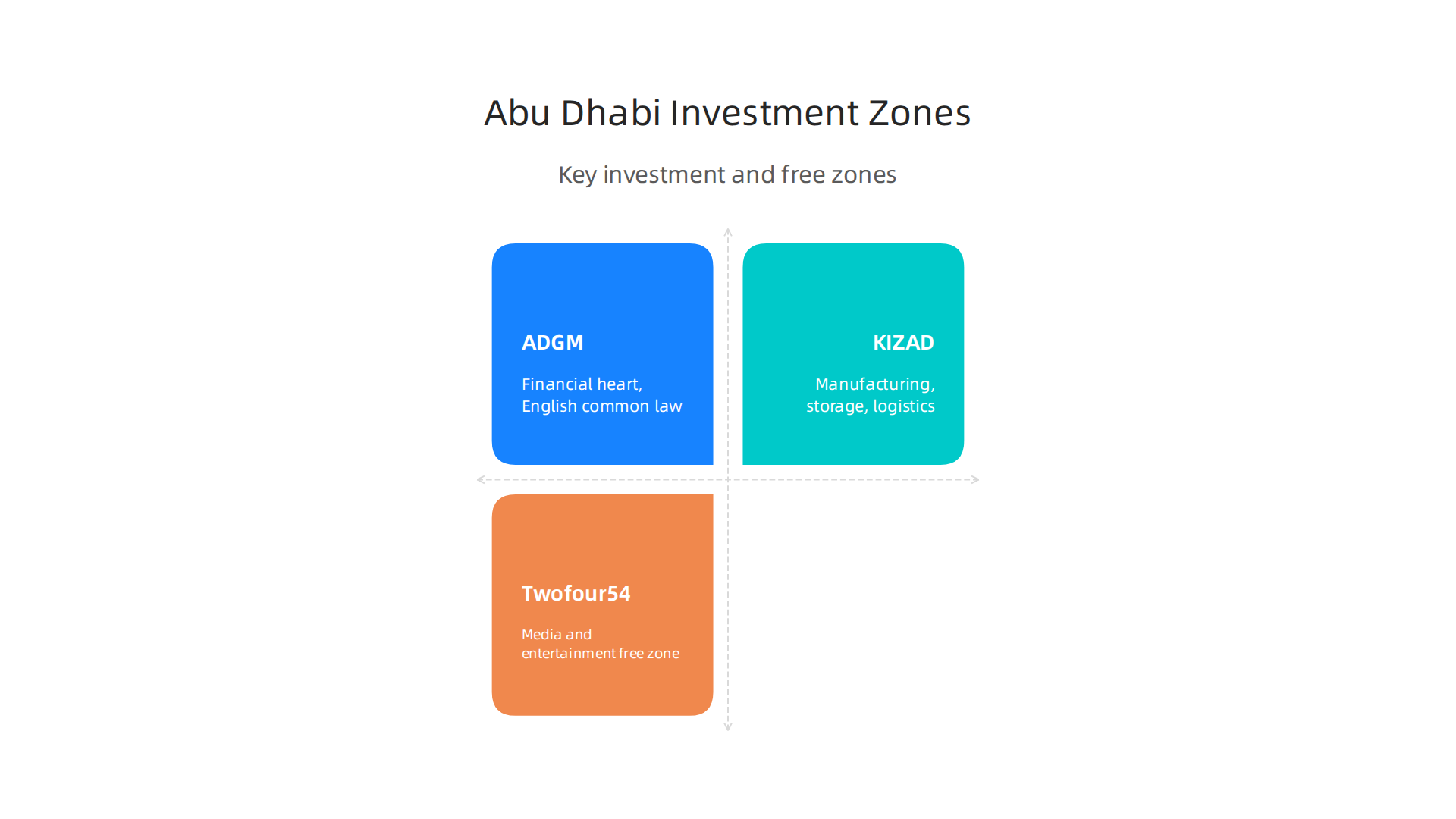
Abu Dhabi Global Market (ADGM)
ADGM is the financial heart of the capital. It operates under English common law, which feels familiar to many international companies. That legal setup makes contracts, dispute resolution, and compliance easier if you are used to Western systems.
The big advantage here is ownership. Foreign investors can hold 100% of their business in ADGM without needing a local partner. This aligns with the UAE Government’s update on full foreign ownership of commercial companies, which opened up many sectors to complete foreign control in 2026. ADGM is ideal for financial services, fintech firms, and professional consultancies.
Khalifa Industrial Zone Abu Dhabi (KIZAD)
If you need space for manufacturing, storage, or logistics, KIZAD is your best bet. It sits near Khalifa Port, giving you direct access to shipping routes. Plots here are large and designed for heavy industrial use.
Land prices in KIZAD are lower than in central Abu Dhabi or Dubai. That makes it attractive for businesses that need square footage without paying city premiums. You also get customs benefits and streamlined licensing within the zone.
Twofour54
Twofour54 is Abu Dhabi’s media and entertainment free zone. It targets creative businesses like film production, gaming, advertising, and digital content. The zone offers state-of-the-art studios, editing suites, and post-production facilities.
Companies here benefit from 100% foreign ownership and a cluster of talent from across the region. If you run a media or tech startup, this zone gives you the infrastructure and network to grow fast.
Each zone has its own registration process and fee structure. A good property finder abu dhabi tool or a local consultant can help you compare options side by side. And if you want to explore similar opportunities in Dubai, you can connect with an experienced agent through a FREE Dubai Real Estate Consultation to get personalized advice on the best zones for your business.
Commercial Property Types and Opportunities in Abu Dhabi
Once you know which zone fits your business, the next question is what type of property to buy. Abu Dhabi’s commercial market in 2026 offers three main categories, each with its own strengths and earning potential.
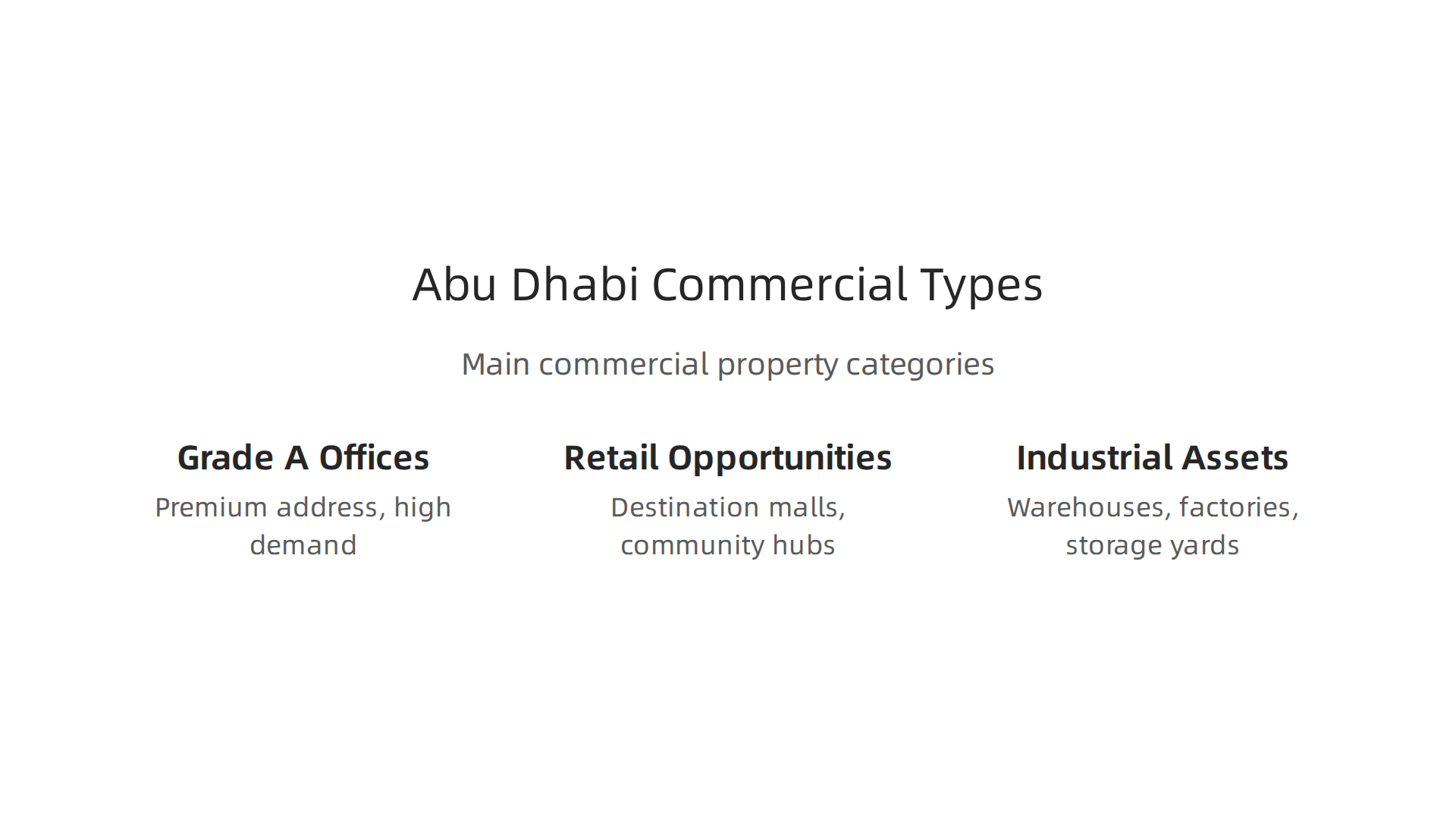
Grade A Office Spaces on Al Maryah and Al Reem Island
If your business needs a premium address, the office market here is hard to beat. Al Maryah Island and Al Reem Island are the top spots for Grade A office space. Demand is high, and that shows in the numbers. Office rents in Abu Dhabi rose 12% year over year through early 2026, with occupancy at 98%, according to the latest market data from CBRE. That kind of tight supply means your property is likely to hold its value well.
These buildings attract financial firms, consultancies, and tech companies. The buildings are new, energy-efficient, and come with top-tier amenities. If you buy here, you are competing for space with some of the biggest names in the region. That is a good position to be in as an owner.
Retail Opportunities in Destination Malls and Community Hubs
Retail in Abu Dhabi is changing. Big destination malls like Yas Mall and Al Wahda Mall continue to draw strong foot traffic. But there is also rising demand for smaller community retail spaces in residential neighborhoods.
If you are considering retail, look at what real estate developers in Abu Dhabi are building in mixed-use communities. Developers like Aldar and Bloom are adding retail components to almost every new residential project. That creates opportunities for corner shops, cafes, clinics, and service businesses. The key is choosing a location where the surrounding population is growing.
Industrial and Logistics Assets in KIZAD and ICAD
For hands-off returns and long leases, industrial property is worth a serious look. The Khalifa Industrial Zone Abu Dhabi (KIZAD) and the Industrial City of Abu Dhabi (ICAD) offer warehouses, factories, and storage yards at much lower per-square-foot costs than office or retail.
The UAE commercial real estate market is growing at a compound annual rate of 6.33% as of 2026, with industrial assets leading the charge. Warehousing near Khalifa Port is especially attractive because of direct access to shipping routes. Tenants in this segment tend to sign longer leases, which means more stable income for you.
If you are curious about how these property types compare with what Dubai offers, you can check out our breakdown of commercial property types in Dubai. It gives you a side-by-side view that may help you decide which emirate matches your goals better.
Each property type serves a different investor profile. Offices give you prestige and high rent per square foot. Retail gives you foot traffic and brand visibility. Industrial gives you stability and scale. The right choice depends on your budget and your risk comfort.
Market Trends and Forecasts for Abu Dhabi Commercial Real Estate in 2026
Now that you know the property types available, let’s look at the trends shaping Abu Dhabi’s commercial market in 2026. Three big forces are at work.
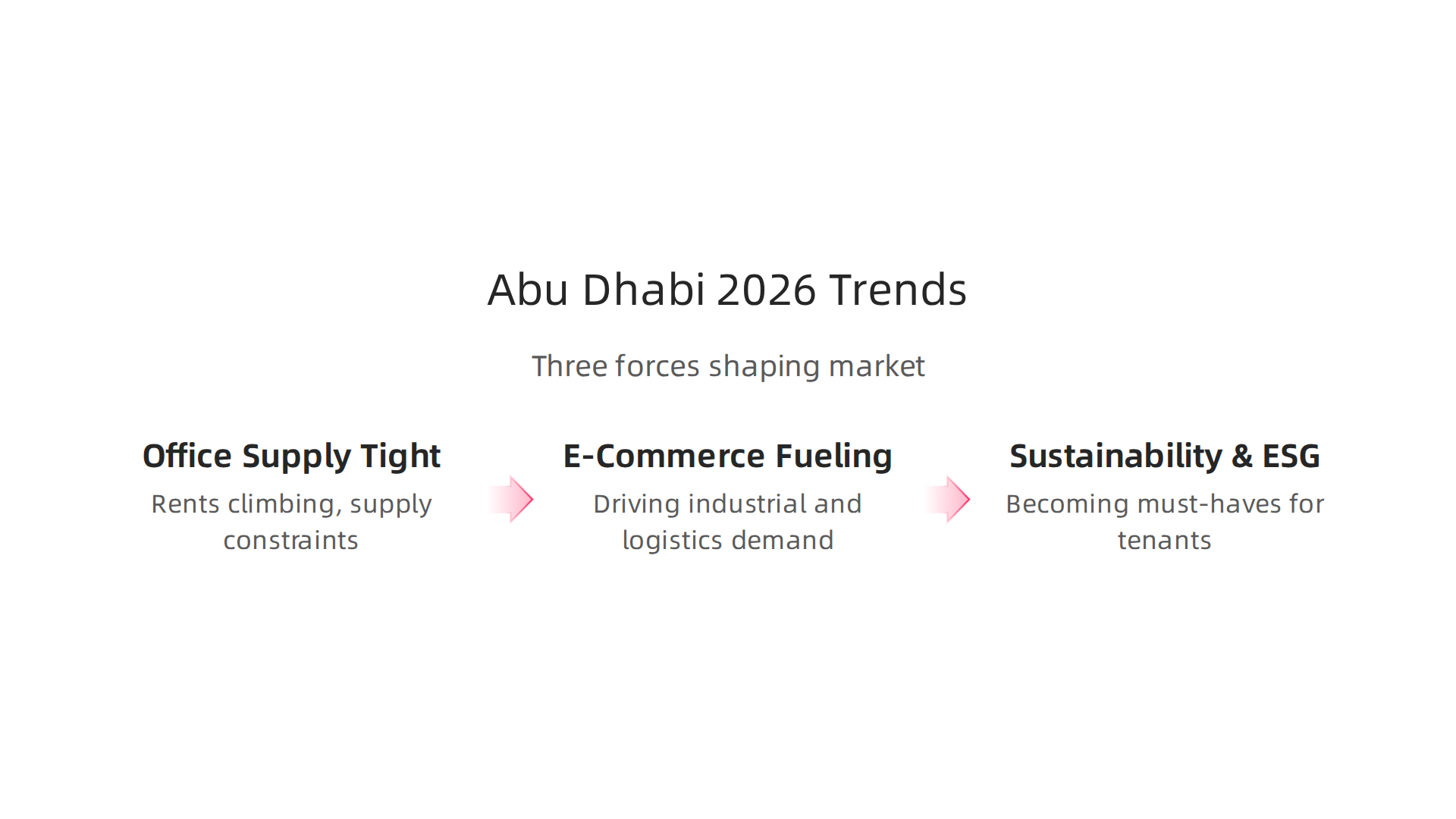
Office Supply Is Tight and Staying That Way
New office space is not coming to market fast enough. The result? Rents are climbing. According to the Abu Dhabi Real Estate Outlook 2026 from ValuStrat, office rents are forecast to rise 20% this year because of limited supply.

Prime locations on Al Maryah Island and Al Reem Island are already seeing this effect. If you own an office asset there, your rent per square foot should keep growing. This is not a short-term spike. Supply constraints are expected to last into 2027, which means steady appreciation for well-located offices.
E-Commerce Is Fueling Industrial and Logistics Demand
Online shopping in the UAE keeps setting new records. That means companies need warehouses and distribution hubs closer to where people live. This trend is called last-mile logistics, and it is driving strong demand for light industrial units in KIZAD and near Khalifa Port. The overall UAE Commercial Real Estate Market Size & Share Analysis from Mordor Intelligence projects the market to reach USD 73.09 billion by 2031, with industrial and logistics assets leading the charge.

If you are thinking about buying industrial property, you are tapping into a segment with long-term growth potential. For a closer look at how this sector works in the neighboring market, check out this insider guide to buying industrial property in Dubai.
Sustainability and ESG Are Becoming Must-Haves
Tenants are no longer just looking for square footage. They want buildings that are energy-efficient, smart, and environmentally friendly. This is called ESG compliance (Environmental, Social, and Governance), and it is becoming a key factor in leasing decisions. New projects in Abu Dhabi are built with green certifications from the start. The market is already shifting in that direction. Gulf News reports that Abu Dhabi property hit a AED 94 billion surge and the next major shift will reshape prices around lifestyle-led, sustainable communities.
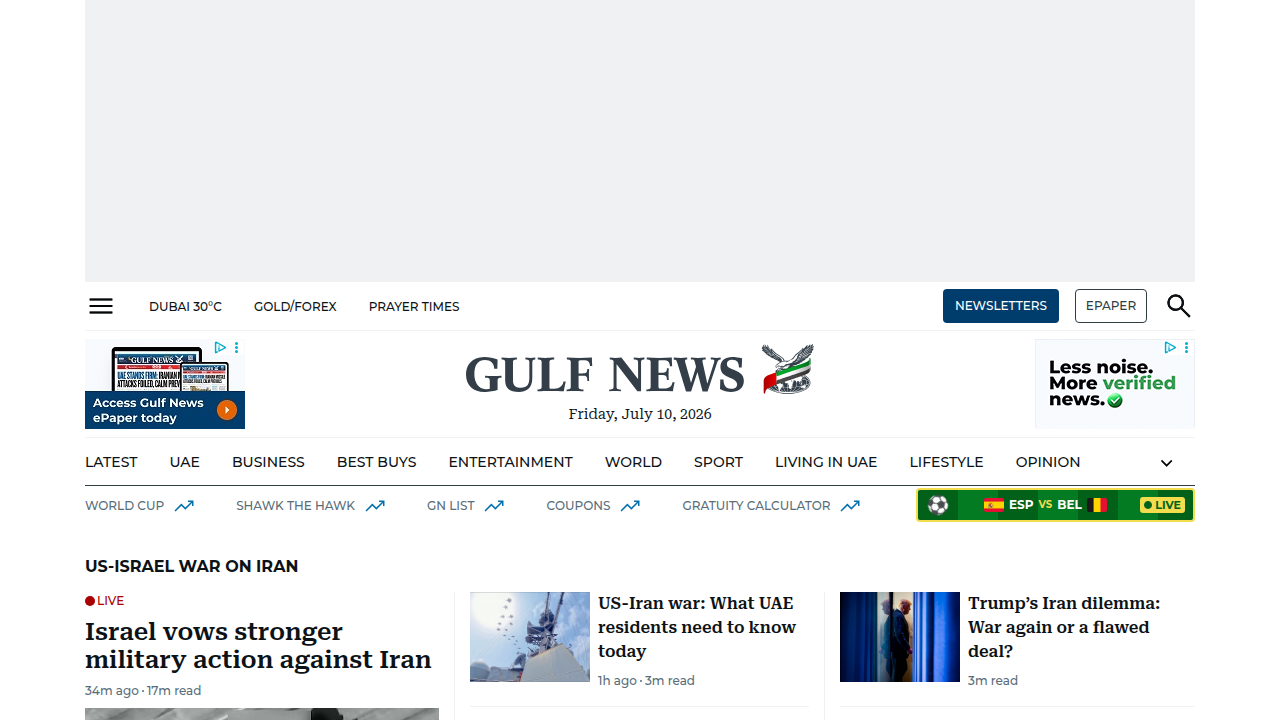
Buying a commercial property with strong ESG credentials now can help you attract premium tenants and future-proof your investment.
What These Trends Mean for You
The numbers point to a market that is healthy and moving forward. Office assets in prime spots offer reliable rental growth. Industrial properties give you exposure to the e-commerce boom. And buildings that meet sustainability standards will be easier to lease. Each trend supports a different kind of return.
If you want to explore how these opportunities fit your personal goals, it helps to talk through them with someone who knows the landscape. You can get a FREE Dubai Real Estate Consultation with Ayaz Salman to discuss your options. Whether you are focused on Abu Dhabi or considering Dubai as well, this is a no-cost way to ask questions and get clear direction.
Tips for Investing in Abu Dhabi Commercial Real Estate Successfully
Knowing the trends is one thing. Acting on them the right way is another. Here are three practical tips to help you invest in Abu Dhabi’s commercial market with confidence.
Do Your Homework on the Developer
Not all developers are the same. Some have a long track record of delivering on time. Others run into delays or legal issues. Before you put any money down, dig into the history of the real estate developers in Abu Dhabi you are considering. Check their past projects. Ask about timelines. Verify that all legal clearances are in place. This step matters more than the location or the price tag. A strong developer with a clean record means fewer headaches later. For context, the real estate Abu Dhabi office market is seeing strong demand for Grade A space, which tells you that quality matters. Savills noted that Abu Dhabi’s office market is demonstrating steady growth with high occupancy across several developments. That kind of demand only benefits properties built by trusted developers.
Leverage Local Expertise
Abu Dhabi has its own rules, zones, and market quirks. You can learn a lot from online research, but nothing beats talking to someone who works here every day. A licensed commercial real estate broker who knows the local landscape can save you months of guesswork. They know which areas are heating up, which developers have the best reputations, and how to negotiate terms that work for you. If you want to see how this works in a nearby market, this guide on working with a commercial real estate agent in Dubai explains the value a good agent brings. The same logic applies in Abu Dhabi. A good broker is worth every dirham.
Plan Your Exit from Day One
Before you buy, ask yourself: How will I sell this later? Not every property type in Abu Dhabi sells quickly. Some zones have more buyers than others. Prime office space on Al Maryah Island has strong liquidity. An industrial unit in a newer zone may take longer to sell. Understand this upfront so you are not caught off guard. According to CBRE, Abu Dhabi office occupancy reached 98% in Q1 2026, showing that Grade A offices move fast when you want to sell. But other asset classes may not have the same demand. Keep an eye on real estate news Abu Dhabi to track which segments are most active. Knowing your exit strategy now makes your investment decision clearer today.
Taking these three steps does not guarantee success, but it tilts the odds in your favor. Good due diligence, a great local partner, and a clear exit plan are the foundation of any smart commercial real estate move in Abu Dhabi.

Summary
This article explains why Abu Dhabi is an increasingly compelling market for commercial real estate in 2026, driven by government diversification plans, major masterplans like Vision 2030 and Ghadan 21, and rising demand across offices, retail and industrial sectors. It profiles leading developers—Aldar, Mubadala, Modon and Reportage—and shows how each serves different investor needs from prime offices on Al Maryah and Yas to mixed‑use and industrial zones. The guide breaks down key free zones such as ADGM, KIZAD and Twofour54, covers regulatory essentials like ownership rules, title deeds and escrow protections, and highlights market signals (office rents forecast +20%, tight supply, e‑commerce logistics growth and ESG demand). Practical advice on vetting developers, using local brokers and planning exit strategies helps investors reduce risk and act confidently. By the end you’ll know where to look, which developer types to target, which property classes match your goals, and the regulatory steps to complete a commercial purchase in Abu Dhabi.