

Introduction
Picture this: you have found the perfect office space in Dubai. The location is great. The price is fair. The potential for growth is huge. But when you start looking into how to pay for it, everything gets confusing fast. Different banks have different rules. Loan terms vary wildly. And the paperwork? It can feel endless.

This is the reality for many investors exploring financing for commercial real estate in Dubai. The market here offers some of the best returns in the world. Commercial properties in prime areas can deliver yields that residential properties just cannot match. But tapping into those returns requires more than just cash. It requires knowing exactly how the financing system works.
Here is the thing. Most investors start their search with good intentions. They check a few bank websites. They talk to a friend who bought a villa once. They assume getting a loan for commercial real estate works the same way as a home mortgage. It does not. Commercial property loans come with different interest rates on commercial real estate, different down payment requirements, and different approval processes. The rules also change depending on whether you are a UAE national or an expat.
And that is not all. The regulations around commercial property for sale lease agreements add another layer. You need to understand how leasehold versus freehold works for businesses. You need to know about service charges, visa eligibility, and the fine print in financing contracts.
The good news is this: you do not need to figure it all out alone. This guide gives you a clear, step-by-step roadmap to secure financing for commercial real estate in Dubai. We cover the types of loans available, what interest rates on commercial real estate you can expect, how banks evaluate your application, and how to avoid the common mistakes that slow down investors.
We also include the latest on Dubai real estate valuation so you know what your property is truly worth before you apply for funding.
To give you a head start, check out this overview of the different loan structures available today. The Types of Business Financing Options in UAE 2026 page from Inlex Partners breaks down everything from conventional mortgages to Islamic finance products like Murabaha.

It is a great place to see your options at a glance.
For a deeper look at how the whole process works from start to finish, you can also read this complete commercial real estate financing Dubai 2026 guide. It walks through each step of getting approved.
Now, let us get into the details so you can move forward with confidence.
FREE Dubai Real Estate Consultation
Understanding Commercial Property Financing Options in Dubai
When you are looking for financing for commercial real estate in Dubai, you have more than one path forward.
The right choice depends on your situation, your property type, and your long-term goals.
Conventional bank loans are the most common route. Banks like Emirates NBD and RAKBANK offer commercial mortgages for offices, warehouses, and retail units. They usually finance up to 60 to 70 percent of the property value. The interest rates on commercial real estate for these loans range from about 4 percent to 7.5 percent, depending on your risk profile and whether you are a UAE national or an expat. The loan term typically goes up to 15 years.
Islamic financing is another popular option, especially for investors who want Sharia-compliant structures. Products like Murabaha (cost-plus financing) and Ijara (lease-to-own) work differently from conventional loans. For example, the bank buys the property and sells it to you at a markup with a payment plan. Dubai Islamic Bank offers competitive profit rates and can finance up to 70 percent of the property value. You can check the details on the Commercial Property Finance from Dubai Islamic Bank page to see how these structures work.
Alternative lenders also exist, including private finance companies and niche funds. These can be useful if you need faster approval or have a less traditional income profile. But the rates are often higher, so compare carefully.
The option you pick affects everything from your monthly payments to your eligibility for future investments. To dive deeper into the approval process, explore this guide on how to secure commercial real estate loans in Dubai 2026. It walks through the exact steps lenders follow.
Bank Loans vs. Islamic Financing (Murabaha/Ijara)
Now that you know the main options, let’s compare the two most common paths: conventional bank loans and Islamic financing.
The biggest difference comes down to how each handles cost. A conventional loan charges interest, which is called Riba in Islamic law. Islamic products avoid interest entirely. Instead, they use profit-sharing or lease structures that are Sharia-compliant.
How Murabaha works. With Murabaha, the bank buys the commercial property you want. Then it sells the property to you at a markup, with the total cost broken into fixed payments. You know exactly what you will pay from day one. No surprise rate changes.
How Ijara works. Ijara is similar to leasing. The bank buys the property and leases it to you for a set period. You make regular lease payments. When the lease ends, ownership transfers to you. This structure can offer fixed profit rates that stay the same for the full term.
Both conventional and Islamic options in Dubai are competitive. Conventional loans currently offer interest rates between 4 percent and 7.5 percent, as mentioned earlier. Islamic financing often matches those profit rates closely. The right choice depends on your comfort with interest versus a Sharia-compliant structure. For a deeper look at the rates you can expect, check out this guide on commercial real estate loan interest rates. For a full overview of how conventional and Islamic structures compare side by side, the UAE business financing options guide breaks down each model clearly.
If you are trying to decide between bank loans and Islamic financing and want personal guidance, reach out for a FREE Dubai Real Estate Consultation with Ayaz Salman. A quick chat can help you match the right financing type to your investment goals.
Alternative Lenders and Joint Venture Structures
But bank loans and Islamic financing are not the only ways to fund a commercial property purchase. If you are an experienced investor with a solid track record, private lenders and family offices can offer more flexible terms. They often move faster than banks and may fund deals that traditional lenders pass on. Just know that their rates can be higher, and they usually expect a shorter repayment period.
Another smart path is a joint venture with a local developer. In a JV, you bring the land or the cash, and the developer brings the construction know-how and approvals. This can cut your upfront financing needs dramatically. But you need a watertight agreement. Get a lawyer who knows UAE property law to handle the legal structuring so your investment stays protected.
Crowdfunding platforms are also starting to appear in Dubai, but they are still rare for commercial real estate. Most crowdfunding deals focus on residential projects. If you want to go that route, do your homework on the platform first.
For a full picture of all the options, compare the commercial property financing support from UAE banks with what private lenders offer. And if you need help putting together a deal, talk to a local agent who can connect you with the right partners. Check out this guide on how to secure commercial financing in Dubai with confidence before you sign anything.
Eligibility and Documentation Requirements for Commercial Mortgages
Getting approved for financing for commercial real estate in Dubai starts with understanding what lenders look for.
Banks in the UAE typically offer a loan for commercial real estate with a loan-to-value ratio between 50% and 70%. That means you need to bring at least 30% to 50% as a down payment. For non-UAE nationals, the limits can be stricter, so check the latest UAE mortgage regulations for non-residents before you apply.
Lenders also care about two big factors: your credit history and the property’s cash flow. If the commercial space already has tenants paying rent, that steady income makes the loan less risky for the bank. A strong credit score shows you pay your bills on time. Both of these affect the interest rates on commercial real estate you get offered.
If you are a foreign investor, prepare for extra paperwork. Banks will ask for proof of non-resident status, a valid UAE residency visa or investor visa, and financial documents from your home country. Many lenders also want a clear business plan that shows how the property will generate income.
Here is the best way to speed up the process. Prepare a clean application with up to date financial statements, bank statements, and a copy of your passport and visa. The more organized you are, the faster the approval comes.
If you feel stuck, talking to an expert can save you time. Book a FREE Dubai Real Estate Consultation with Ayaz Salman to get personalized advice on your commercial property plans.
LTV Ratios, Down Payments, and Credit Score Requirements
Now let’s get into the numbers that actually matter for your application.
One big difference between residential and commercial loans is the loan-to-value ratio. For commercial property, LTVs usually sit between 60% and 70% for prime properties. That is lower than what you get for a home loan. The UAE LTV Rules 2026 show that the Central Bank sets different caps depending on who you are and what you are buying.
Here is what that means for your down payment. Since the bank covers less of the purchase price, you bring more cash upfront. Expect a down payment between 30% and 50% of the property value. The exact number depends on the type of property and whether you are a UAE resident or a foreign investor.
Your credit score plays a big role too. UAE residents typically need a minimum AECB score to qualify for a loan for commercial real estate. Each lender sets their own threshold, but a higher score usually means better terms and lower interest rates on commercial real estate.
If you want to see how commercial property values in specific areas affect these numbers, read our guide on finding commercial real estate in Sharjah for lower cost options that still meet lender requirements.
Document Checklist for Foreign and Expat Investors
Beyond knowing your LTV and credit score, you also need the right paperwork. For foreign investors, getting your documents in order is one of the most important steps in financing for commercial real estate in Dubai.
Here is what most banks in Dubai will ask for:
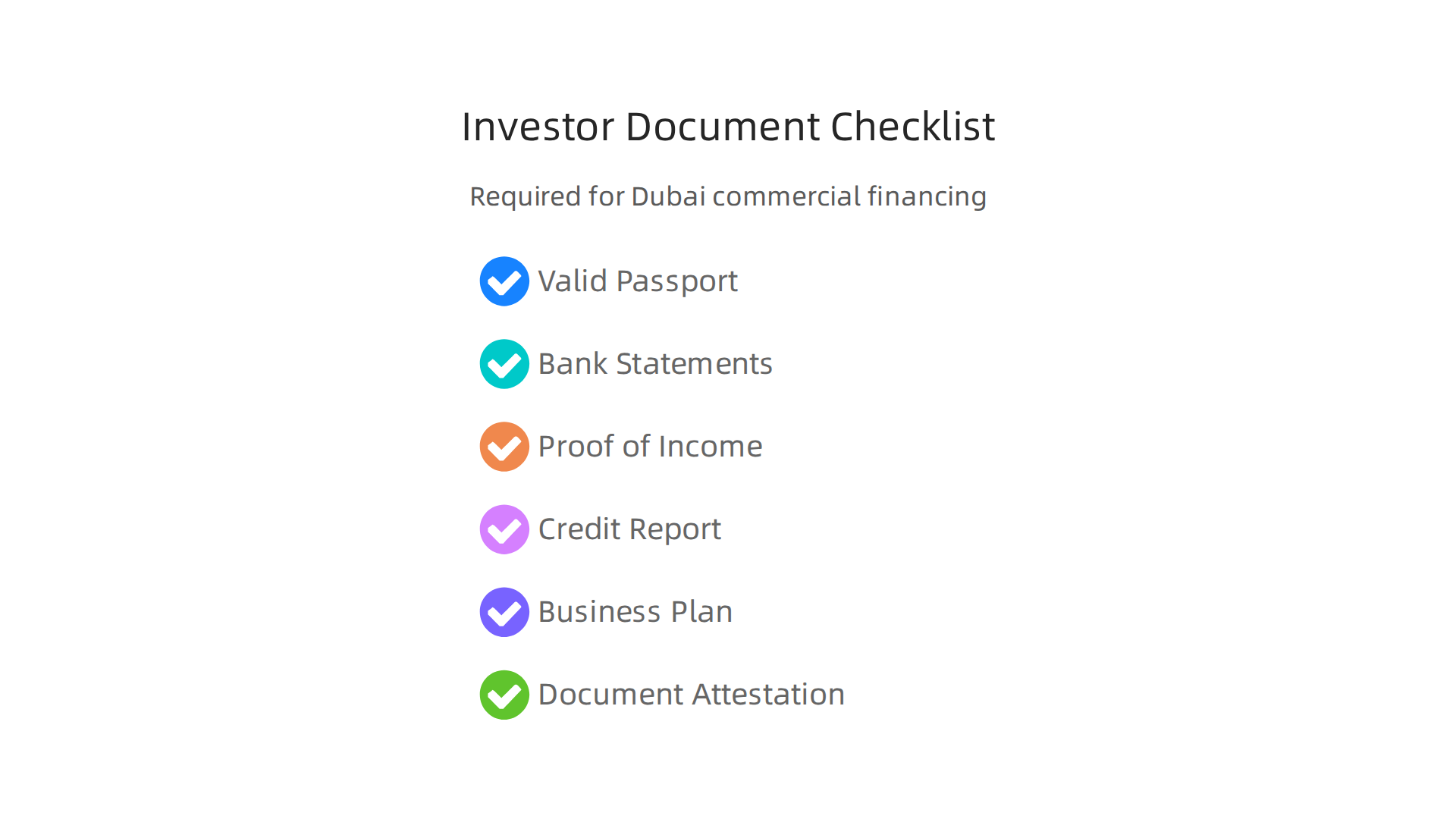
- A copy of your valid passport and UAE residence visa (if you have one)
- Bank statements from the last three to six months
- Proof of income from abroad such as salary certificates or business financials
- A recent credit report from your home country if available
One thing many first-time applicants miss is document attestation. Some papers need to be certified by your home country’s embassy before the bank accepts them. This can take weeks, so start the process early.
If you are applying for a loan for commercial real estate rather than residential property, some lenders also want to see a business plan. This document explains how you will use the space and generate revenue. A solid business plan can also help you negotiate better interest rates on commercial real estate.
The new UAE Mortgage Regulations outline exactly what foreign buyers need to provide. Checking these rules before you apply saves you time and stress.
For a complete walkthrough of the application process, read our guide on commercial real estate financing in Dubai 2026.
Need help organizing your documents? Get a FREE Dubai Real Estate Consultation with an expert who understands what foreign investors need.
Interest Rates, Fees, and Loan Structures in 2026
Now that your paperwork is ready, let us talk about money. Specifically, what you will actually pay for your loan.
In 2026, interest rates on commercial real estate in Dubai depend heavily on something called EIBOR. That stands for Emirates Interbank Offered Rate. It is the benchmark rate banks use when lending to each other. And that number flows directly into your loan.
As of mid 2026, the one month EIBOR rate sits around 3.75 percent. You can check the current EIBOR benchmark rate explained by HSBC UAE to see the latest numbers.

Most commercial lenders in Dubai add a spread on top of EIBOR. So if a bank offers you EIBOR plus 2.5 percent, your effective rate is roughly 6.25 percent.
But here is where many investors get surprised. The interest rate itself is only part of the story.
Banks also charge processing fees, valuation charges, and early settlement penalties. These extras can add 2 to 5 percent to your total loan cost. For a 1 million AED loan, that is an extra 20,000 to 50,000 AED in fees you did not plan for.
So when comparing offers, never look at just the headline rate. Always ask for the APR, or annual percentage rate. That number includes all the fees and gives you a true comparison between lenders.
Want to see how different rates stack up in real numbers? Our detailed guide on how to find the best commercial real estate loan interest rates in Dubai walks through current offers from top lenders and what they actually cost you.
Fixed vs. Variable Rates: Pros and Cons
Once you understand the fees, the next big choice is between a fixed rate and a variable rate. This decision shapes your monthly payments for years.
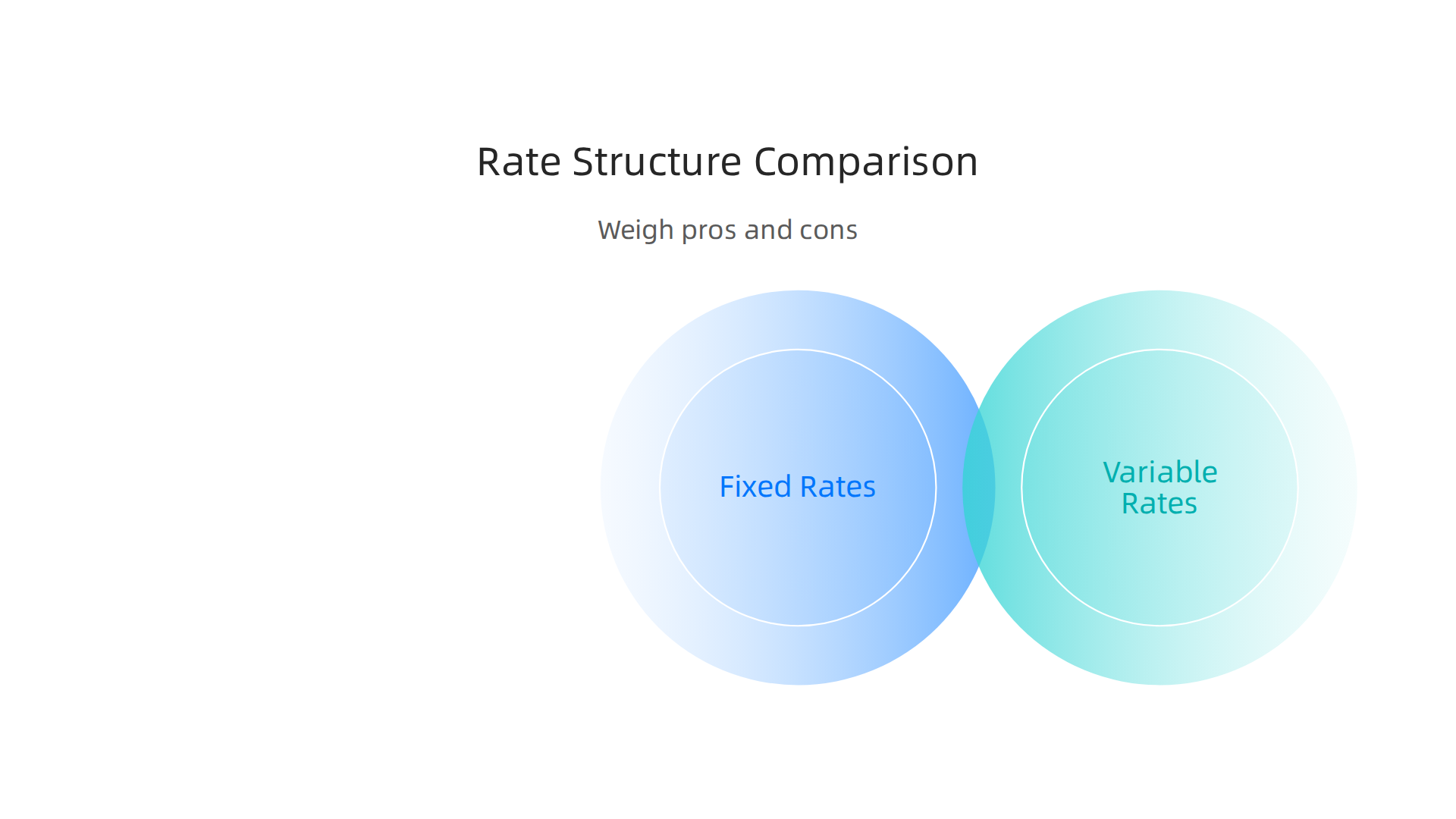
Fixed rates lock in your interest for a set period, usually 1 to 5 years. Your payment stays the same every month. That gives you peace of mind and makes budgeting easy. The trade-off? Fixed rates start higher than variable ones. You pay a premium for that certainty.
Variable rates move up and down with EIBOR. When EIBOR stays low, your rate can be much cheaper than a fixed option. But if EIBOR climbs, your payments rise too. That refinancing risk is real. You can check the latest numbers on the current EIBOR rates from the Central Bank of the UAE to see how much they can shift.
Many lenders in Dubai also offer hybrid structures. These start with a fixed rate for the first few years, then switch to a floating rate. It is a middle path that gives you initial stability and later flexibility.
Not sure which rate type fits your business plan? Get personalized guidance. Book a FREE Dubai Real Estate Consultation with an expert who can walk through your numbers. For a deeper look at how hybrid and variable loans work, read our guide on commercial real estate financing in Dubai.
Understanding Total Cost of Financing: Hidden Fees and Penalties
Now that you understand rate types, let’s talk about the total cost of financing for commercial real estate. Lenders quote attractive interest rates, but the real cost includes several fees hiding in the fine print.
Most banks charge an arrangement fee (often 1% of the loan amount), a valuation fee to appraise the property, and legal costs for document processing. These can add thousands to your upfront bill. Then there is the early settlement penalty – usually 1% to 3% of the outstanding balance. If you plan to pay off your loan early or refinance, this fee can hurt.
The best way to compare total cost is to look at the annual percentage rate (APR) across lenders. APR includes interest plus all mandatory fees, giving you a true apples-to-apples comparison. For example, current EIBOR rates from General EIBOR ADCB show the 1-month benchmark at 4.33%, but the APR on a variable loan could be much higher once fees are added.
To dig deeper into comparing loan offers across Dubai lenders, read our guide on how to find the best commercial real estate loan interest rates.
Legal and Regulatory Framework for Commercial Mortgages in Dubai
Before signing any loan agreement, you need to understand who runs the show. In Dubai, two main bodies control everything: the Dubai Land Department (DLD) and the Real Estate Regulatory Authority (RERA).

These government agencies make sure all property transactions follow the law.
Every mortgage must be registered with the DLD. The process involves title deed checks, document reviews, and fee payments. You can actually submit your mortgage registration application directly through their online system. The bank prepares the requirements, enters them into the system, and the DLD processes everything.
Here is what you will pay for registration:
| Fee Type | Amount |
|---|---|
| DLD Property Registration Fee | 4% of purchase price + AED 580 admin fee |
| Mortgage Registration Fee | 0.25% of loan amount + AED 290 |
These costs are set by the DLD and apply to every deal. The role of the Dubai Land Department in property transactions goes beyond just collecting fees. It keeps the official ownership records and makes sure each transfer is enforceable.
There is another important rule you should know. If you are buying an off-plan commercial property, the developer must use an escrow account. This protects your money. Your funds are only released as construction progresses, not all at once upfront.
Want to learn more about the full buying process covering legal rules and costs? Check out our complete guide on prices laws and best areas in Dubai.
This legal framework is designed to protect both buyers and lenders. Understanding it helps you avoid surprises during your financing journey. After all, the last thing you want is a legal roadblock right before closing your deal.
Buying, selling, renting, or investing in Dubai? Connect with Ayaz Salman for a FREE Dubai Real Estate Consultation. Get expert guidance on legal requirements and find the right financing for your commercial property.
The Role of RERA, DLD, and Mortgage Registration
RERA and the DLD work together to create a safe system for everyone involved in financing for commercial real estate. RERA focuses on the people side. It sets rules for real estate brokers so they operate honestly. It also makes sure developers use escrow accounts for off-plan projects. This protects your money from being spent on anything other than construction.
The DLD handles the paperwork side. Every loan for commercial property must be registered with the DLD. The process is straightforward. Your bank prepares the documents and submits everything through the online system. The DLD then records the mortgage in its official database.
This registration is important for two reasons. First, it creates a public record that shows who holds the loan on the property. Second, it gives the lender legal priority. If you ever default, the bank with the registered mortgage gets paid first from the sale. This is why lenders check the Dubai real estate valuation before approving your loan. They want to make sure the property is worth enough to cover what you borrow.
The cost for mortgage registration is 0.25% of your loan amount plus a small fee of AED 290. You pay this to the DLD when the mortgage is registered. These fees are set by the government and are the same for every deal. There is no room for negotiation. But knowing them upfront means no surprises at closing.
Escrow Accounts and Off-Plan Property Financing
Those upfront costs are worth it when you know your deposit is protected. Here is the key rule for off-plan deals. Every sale of a commercial property before construction is complete must use a RERA-regulated escrow account. This is not optional. It is the law.
Your money goes into a special account. The developer only gets paid after meeting specific progress milestones. A RERA inspector checks the work, and then the bank releases the funds. If the project stalls, your money stays in the escrow account, not in the developer’s pocket.
Getting a loan for commercial real estate off-plan works with this same system. Lenders check the developer’s past projects before saying yes. They also set up a payment schedule tied to construction progress. You pay in stages, not one lump sum.
Before you sign anything, verify two things. First, confirm the escrow account is registered with RERA. Second, check the developer’s track record. The rules on Real Estate Registration in UAE explain how this system works in practice.
For a deeper look at what lenders require and how rates work, read this full guide on commercial real estate financing in Dubai for 2026. And if you want expert help navigating an off-plan purchase, book a FREE Dubai Real Estate Consultation today.
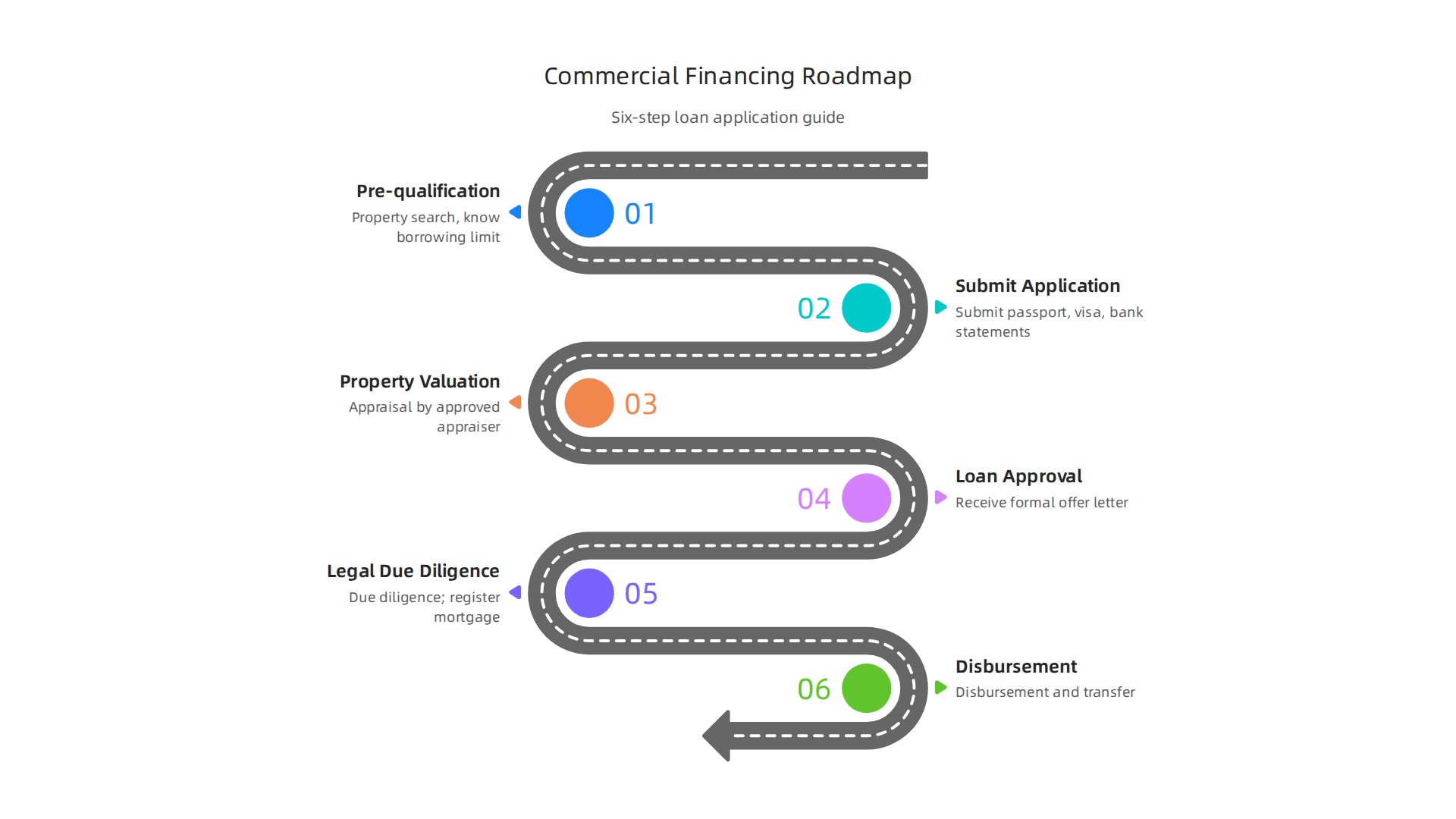
Step-by-Step Process to Secure Commercial Financing in Dubai
Getting a loan for commercial real estate in Dubai does not have to feel overwhelming. The process follows a clear path, and knowing each step before you start makes everything smoother.
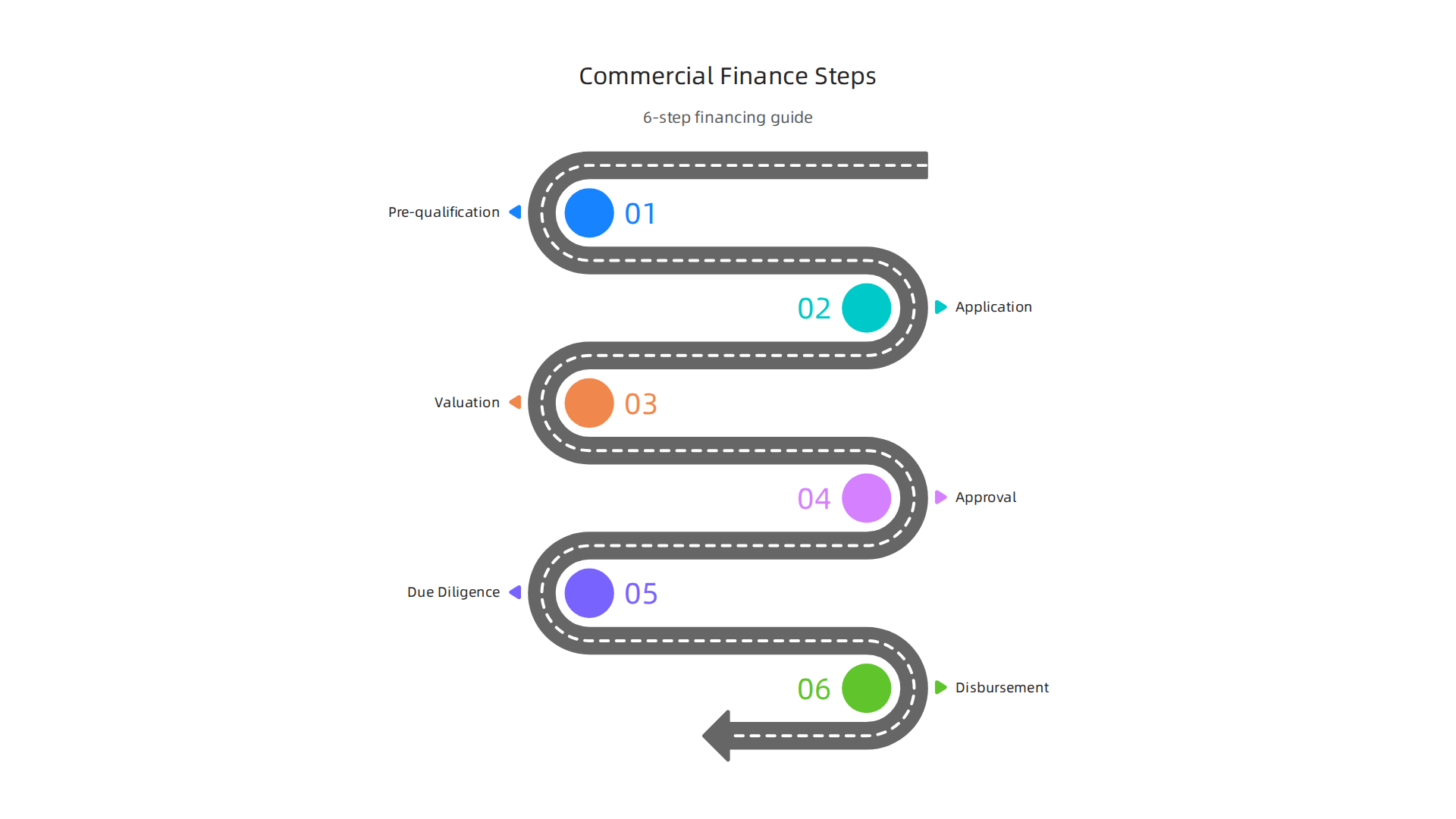
Step 1: Pre-qualification and property search
Start by getting pre-approved. A lender checks your income, credit history, and existing debts to tell you how much you can borrow. This step is usually free and valid for up to 90 days. Read this guide on Mortgage Pre-Approval in Dubai: Step-by-Step Guide (2026) to see what documents you need ready.
Step 2: Submit your application with documents
Once you find a property you like, submit your full application. Banks ask for your passport, visa, bank statements, and company trade license if you are a business owner. The lender then checks everything closely.
Step 3: Property valuation by a lender-approved appraiser
The bank sends an appraiser to inspect the property. This confirms the Dubai real estate valuation matches the purchase price. If the valuation comes in lower than expected, your loan amount drops.
Step 4: Loan approval and offer letter
If everything looks good, the bank issues a formal offer letter. This document spells out the interest rates on commercial real estate, the repayment term, and any fees. Read it carefully before signing.
Step 5: Legal due diligence and mortgage registration at DLD
Your lawyer checks the title deed and confirms no outstanding debts on the property. Then the mortgage gets registered with the Dubai Land Department. This step protects both you and the lender.
Step 6: Disbursement and transfer
The bank releases the funds directly to the seller. You take ownership, and your loan repayment schedule begins. Learn more about the full process in this guide on commercial real estate financing in Dubai 2026 your step by step guide to loans rates and approval.
Pre-Approval and Property Valuation
Getting pre-approved for financing for commercial real estate is one of the smartest moves you can make. It tells you exactly how much you can borrow before you start shopping. No guesswork, no wasted time.
The process is simple. A lender checks your income, existing debts, and credit history. Within about a week, they tell you your borrowing limit. Pre-approval is usually free and stays valid for up to 90 days. That gives you plenty of time to find the right property.
Having pre-approval also strengthens your position when negotiating. Sellers know you are serious and ready to move fast.
Once you find a property, the lender orders a professional valuation. A bank-approved surveyor inspects the property to confirm the Dubai real estate valuation matches the price you agreed on. You typically pay for this report yourself.
Why does the valuation matter so much? It directly affects your loan for commercial real estate. If the valuation comes in lower than the purchase price, the bank reduces the amount they will lend you. You would need to bring more cash to the table to cover the gap.
Make sure the property you choose fits the lender’s criteria before you commit. Some properties do not qualify for a standard commercial mortgage in the UAE depending on their location, age, or intended use.
Need personal guidance on your next step? Connect with Ayaz Salman for a FREE Dubai Real Estate Consultation to discuss your financing options and find the best property for your needs.
For more insight on loan costs, check this guide to best commercial real estate loan interest rates so you know what to expect before applying.
Closing the Deal: Transfer Fees, Registration, and Disbursement
You have pre-approval. You found the right property. The valuation checks out. Now comes the final stretch.
The closing process has a few fixed costs you need to budget for. First, the Dubai Land Department (DLD) charges a transfer fee of 4% of the purchase price for freehold properties. This is payable at the time of ownership transfer.
Next comes mortgage registration. The bank charges a fee of 0.25% of your loan amount, plus small administrative charges. This fee registers the bank’s interest in the property as security for your loan.
Once you sign the mortgage agreement and all fees are paid, the lender disburses the funds directly to the seller or developer. Your ownership is officially registered with the DLD.
The whole closing process from signing to disbursement typically takes a few business days. Having all your documents ready upfront helps avoid delays. For a full walkthrough of what happens at each stage, check this guide on the mortgage process in Dubai.
Need a clearer picture of your total loan costs before closing? Read this breakdown of commercial property financing Dubai 2026 to compare lender terms side by side.
Summary
This guide explains how to secure financing for commercial real estate in Dubai, covering the main loan types, eligibility rules, costs and the step-by-step approval process. It compares conventional bank mortgages and Sharia‑compliant products like Murabaha and Ijara, and outlines alternative funding such as private lenders and joint ventures. You will learn realistic LTV and down‑payment expectations for residents and non‑residents, which documents banks require, and how EIBOR affects rates and APR. The article also breaks down hidden fees, mortgage registration with the Dubai Land Department, escrow protections for off‑plan purchases, and practical tips for speeding approval. After reading, you’ll know how to prepare a strong application, compare offers properly, and avoid the common pitfalls that delay or increase the cost of commercial financing in Dubai.