
Introduction
Dubai’s commercial real estate market is on fire. In 2025, commercial transaction value jumped 61% year on year, far outpacing residential growth. That is according to the latest data from the market. And the momentum has not stopped. In Q1 2026 alone, commercial sales hit AED 37.9 billion, up 32% from the same period last year.
But here is the thing. Even with all this activity, finding the right commercial real estate financing in Dubai can feel like solving a puzzle with missing pieces. Information is scattered across different websites. The regulatory environment is complex. And the rules change depending on whether you are buying an office, a retail unit, or a warehouse.
Many investors and business owners end up delaying their decisions because they simply cannot see the full picture.

They wonder: Should I go for a conventional loan? What about Islamic finance options? How do commercial real estate loan interest rates compare right now?
The truth is, understanding the full spectrum of finance for commercial real estate is critical. From traditional bank loans to Sharia-compliant structures, each option has its own requirements, timelines, and costs. Without a clear roadmap, you could waste months or even choose the wrong product for your situation.
That is exactly why we created this guide.
We have put together a step-by-step roadmap, backed by current market data and expert insights, to streamline your financing journey. Whether you are looking at business commercial property for sale or browsing industrial commercial real estate listings, this guide will help you move forward with confidence.
For a deeper dive into the specific loan products and lenders available right now, check out our insider guide to commercial property financing in Dubai.
And if you want personalized help to match the right financing to your specific property goals, you can connect with a local expert through a FREE Dubai Real Estate Consultation. No obligation, just practical advice.
Understanding Commercial Real Estate Financing in Dubai
So what exactly is commercial real estate financing? Simply put, it is the money you borrow to buy a business property instead of a home. Think of it like this. When you buy a house, you get a residential mortgage. When you buy an office, a shop, or a warehouse, you get commercial real estate financing. The rules are different, and they matter a lot.
In Dubai, the difference is big. Residential loans let you borrow up to 80% of the property value if you are a UAE national. For expats, it is around 75%. But with commercial real estate financing, banks are more careful. They usually lend only 60% to 65% of the value. That means you need a larger down payment. According to one guide on loan types for investors, commercial loans require a down payment of 30% to 40%, with interest rates between 4% and 7%. Residential mortgages, on the other hand, start at 3%.
Why the difference? Commercial properties are riskier for banks. If a business fails, the property may sit empty. So lenders ask for more money upfront and charge higher rates. Understanding this upfront can save you from surprises later.
What Types of Commercial Property Can You Buy?
Dubai’s commercial market is not just one thing. It includes several property types, and each comes with its own financing rules and return potential.
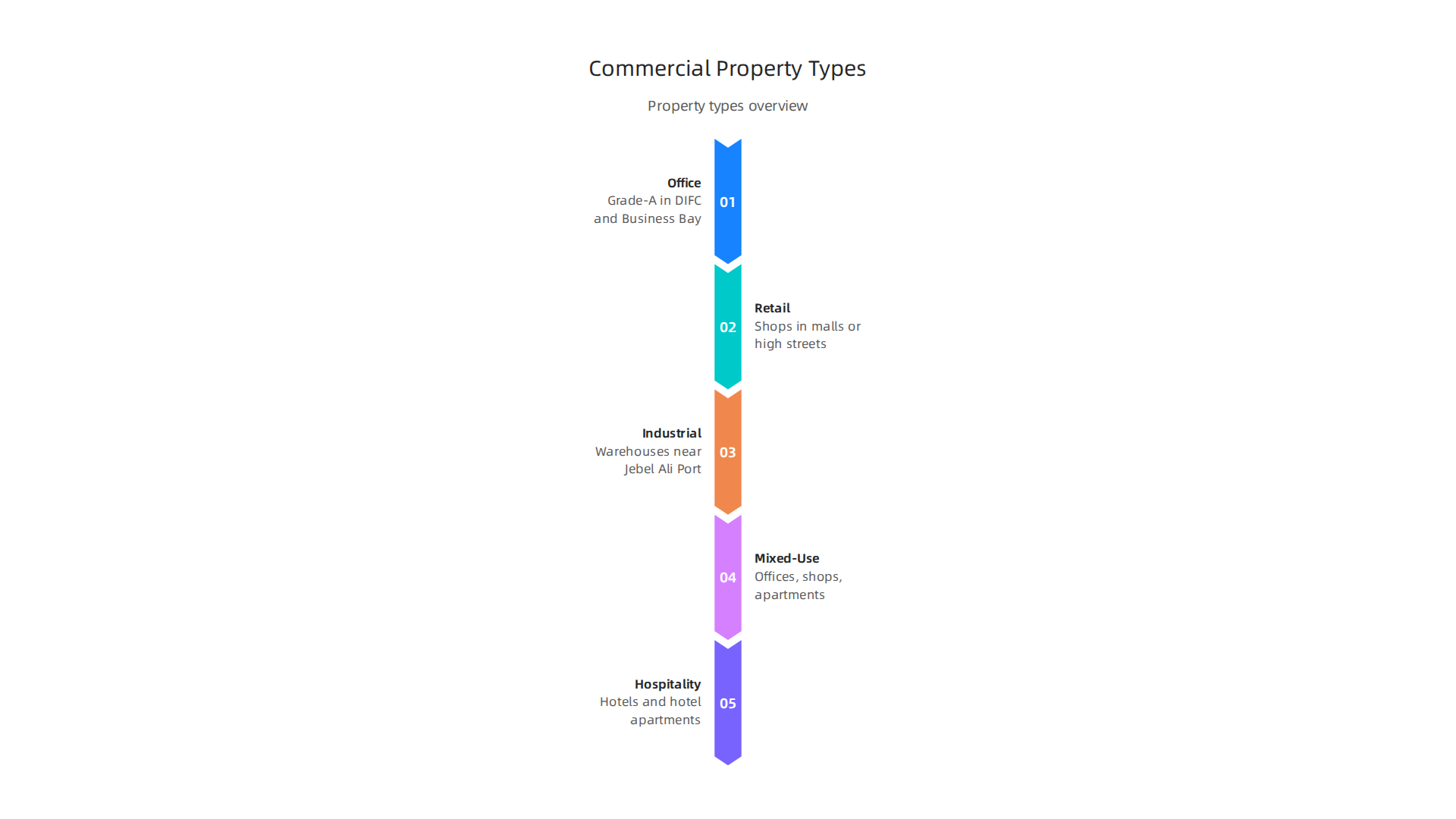
Here is a quick breakdown:
| Property Type | What It Includes | Typical Annual Yield |
|---|---|---|
| Office | Grade-A spaces in DIFC or Business Bay | 5% to 6% |
| Retail | Shops in malls or on high streets | 6% to 8% |
| Industrial | Warehouses near Jebel Ali Port or Al Quoz | 7% to 9% |
| Mixed-Use | Buildings with offices, shops, and apartments | 6% to 8% |
| Hospitality | Hotels and hotel apartments | Varies widely |
These yields are higher than what you would get from a residential property in most global cities. That is why more investors are looking at finance for commercial real estate as a way to grow their money.
If you want to explore these options in more detail, check out our guide on the different types of commercial property in Dubai. It breaks down each category with real examples.
What Is Driving the Dubai Commercial Market in 2026?
Three big forces are pushing the market forward right now.

First, the Expo City legacy. The 2020 Expo site has turned into a permanent business hub. It is attracting global companies and creating demand for office and retail space. The government is backing this with major spending, including AED 12.8 billion for commercial expansions.
Second, SME growth is booming. Dubai added over 6,500 new firms recently, and many need workspace. This is driving demand for smaller offices and flexible retail units.
Third, strong investor confidence. According to the 2025 UAE real estate market report from Property Finder, commercial transaction value jumped 61% year on year, outpacing residential growth. Prices also rose 8% for primary commercial property and 20% for secondary commercial property in 2025. That kind of price growth gets investors’ attention.
The market is not slowing down. In Q1 2026 alone, commercial sales hit AED 37.9 billion, up 32% from the same period last year, as noted in the Engel & Völkers commercial market report for Q1 2026.
So the question is not whether to invest. It is how to find the right financing for your specific property type. That is what we will cover next.
Top Commercial Real Estate Financing Options Available in 2026
You now know the market is moving fast. The next step is picking the right financing route. In 2026, you have several solid options for getting the money you need. Each works differently for different property types and investor profiles.
Let us break them down.
Conventional Bank Loans: Fixed vs. Floating
This is the most common path. Banks in Dubai offer commercial real estate financing through either fixed-rate or floating-rate loans.
With a fixed-rate loan, your interest stays the same for an initial period, usually 2 to 5 years. This gives you predictable monthly payments. Rates for the fixed period in early 2026 ran between 4.2% and 5.2%, based on data from the UAE mortgage market.
A floating-rate loan changes with the market. It is tied to the Emirates Interbank Offered Rate (EIBOR). When EIBOR goes up, your rate goes up. When it drops, you pay less. Most variable rate commercial loans in 2026 are pricing between 5.5% and 6.4% depending on the bank and your profile.
For commercial property, banks lend around 60% to 65% of the value. Loan terms run from 10 to 15 years, sometimes up to 20. You need to be ready with a down payment of 30% to 40%.
You can check the latest EIBOR rates from the Central Bank of the UAE to see where rates stand today.
Islamic Finance Instruments
If you prefer Sharia-compliant options, Dubai has strong alternatives. These are not loans in the traditional sense. Instead, they use asset-based structures.
- Murabaha (cost-plus sale): The bank buys the property and sells it to you at a markup. You pay in installments. No interest involved. This is the most common Islamic option for finance for commercial real estate.
- Ijara (leasing): The bank buys the property and leases it to you. You pay rent for a fixed term. At the end, you may have the option to buy the property. This works well for offices and warehouses.
- Musharaka (partnership): The bank and you co-own the property. You gradually buy out the bank’s share over time. This is useful for larger investments where you want to share risk.
Many major UAE banks offer these structures. They follow the same LTV limits as conventional loans but avoid interest charges.
Alternative Sources: Private Equity, Mezzanine, and Joint Ventures
For bigger or off-plan projects, bank loans may not be enough. That is when alternative financing comes in.
Private equity firms pool money from investors and put it directly into commercial real estate. They take an ownership stake and share the profits. This works for large office towers or mixed-use developments.
Mezzanine finance sits between a bank loan and equity. It is a secondary loan that fills the gap between the bank’s 60% LTV and the 100% you need. The catch? Higher interest rates, often 10% to 15%, because it is riskier for the lender.
Joint ventures (JVs) let you team up with a developer or another investor. You bring the property or the cash, they bring expertise or additional funds. JVs are common for hotel and hospitality projects in Dubai.
These options require more due diligence. You will want a clear agreement and a trusted advisor.
If all of this feels like a lot to manage on your own, you do not have to. Our complete guide on commercial property financing in Dubai walks you through lenders, rates, and application steps in plain language.
Need personalized help? FREE Dubai Real Estate Consultation — connect with Ayaz Salman to talk about your specific project and find the right financing path.
Eligibility Criteria and Documentation for a Dubai Commercial Mortgage
Knowing the loan options is a great start. Now you need to know if you qualify and what paperwork to bring. Banks in Dubai look closely at your business finances when reviewing commercial real estate financing applications.
The process is stricter than getting a home loan. Lenders want proof that your business can handle the payments.
Down Payment and Financial Health
The biggest hurdle is usually the down payment. For a commercial real estate loan, most banks require between 30% and 40% of the property value upfront. This matches the typical loan-to-value ratio of 60% to 70% for commercial mortgages.
Banks also check your Debt Service Coverage Ratio (DSCR). This is a simple calculation that compares your business income to your debt payments. A DSCR of 1.25 or higher is usually the minimum. It shows the bank that you have a healthy cushion for monthly payments.
Before applying, it helps to understand the requirements for commercial property investment financing. Knowing these rules lets you prepare your finances well in advance.
Documentation Checklist
Getting your paperwork in order is half the battle.

Here is the checklist you need for finance for commercial real estate:
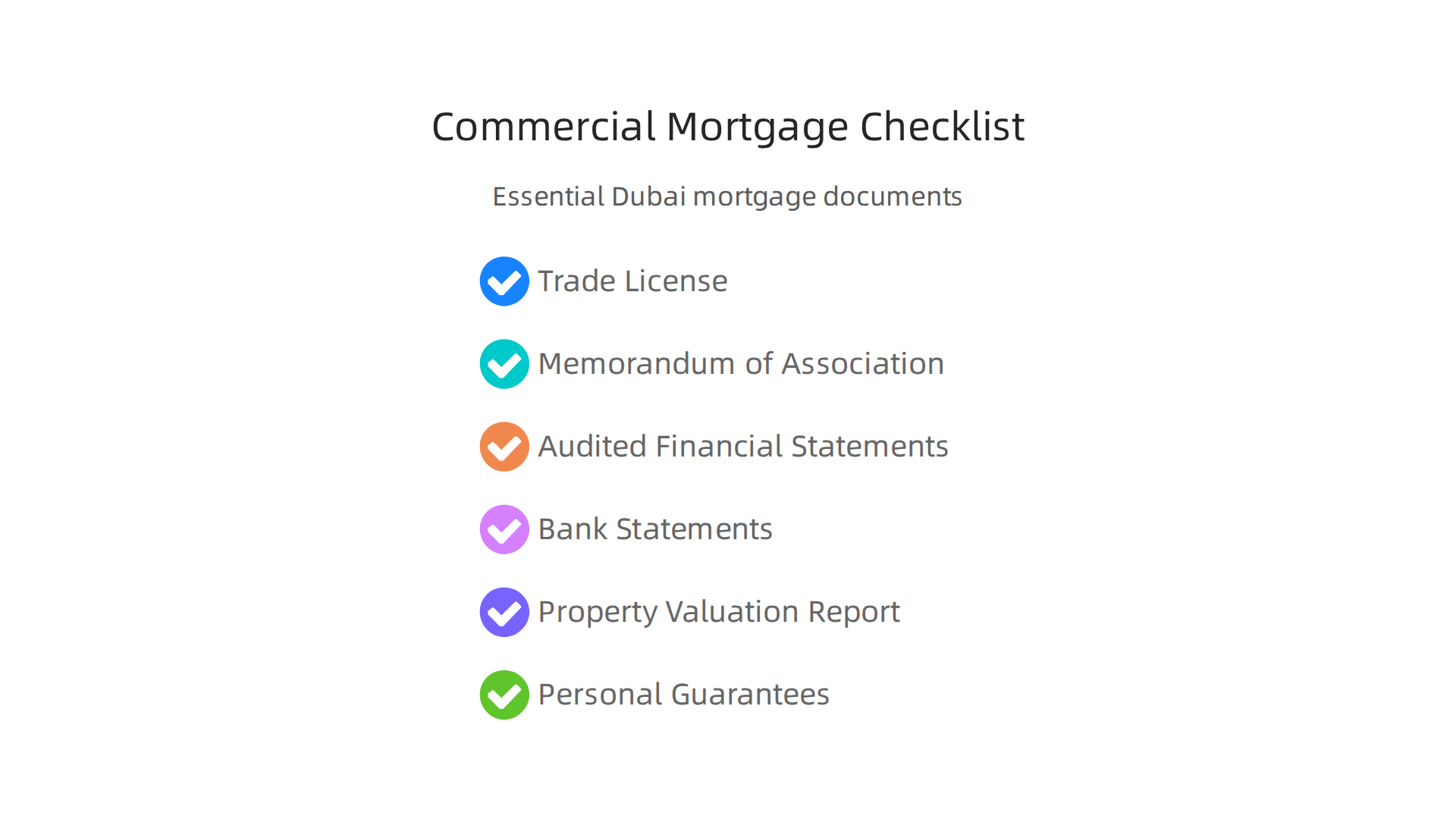
- Trade License: A valid copy showing your registered business activity.
- Memorandum of Association (MOA): This outlines your company’s ownership structure.
- Audited Financial Statements: Most lenders want to see the last 2 years.
- Bank Statements: The last 6 to 12 months for your business accounts.
- Property Valuation Report: An official assessment of the property’s market value.
- Personal Guarantees: Owners often need to sign a personal guarantee to back the loan.
For a full breakdown, review the complete list of documents needed for a UAE commercial mortgage. Having these ready shows lenders you are serious.
If you are shopping around, browsing current industrial commercial real estate listings can give you a realistic idea of market prices. This helps you calculate exactly how much you need to borrow.
Special Programs for SMEs and Free Zone Companies
Smaller businesses are not left out. Programs like Riyada from Emirates NBD offer tailored commercial real estate financing solutions for SMEs with more flexible terms.
Free zone companies can also get financing. Banks usually ask for a copy of the free zone lease agreement and a valid free zone trade license. These documents prove your business is operating legally within the zone.
For a complete walkthrough, check out this detailed guide to securing commercial real estate loans. It covers how to match your business profile with the right lender and get your application approved.
The Commercial Loan Application Process: Step-by-Step
Now that you understand the requirements, let’s walk through the actual application process for your commercial real estate financing. The journey from application to funding typically follows three main stages.
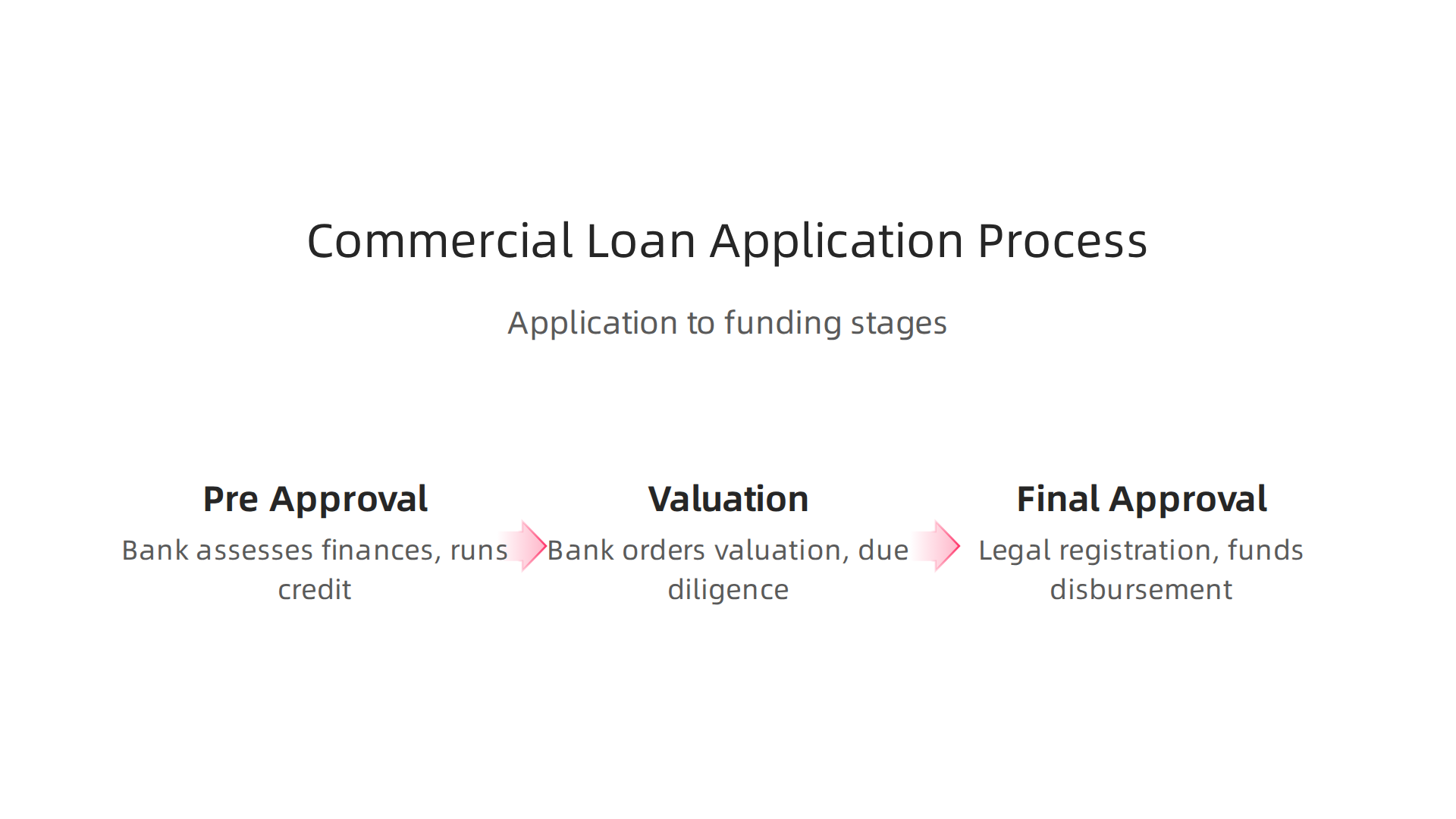
Stage 1: Pre-Approval and Financial Assessment
This is where the bank checks if you are a good candidate. You submit your initial documents and the lender runs a credit check. They review your business cash flow, existing debts, and overall financial health.
The goal here is to get an indicative offer. This is a letter from the bank saying they are likely to approve a certain loan amount based on your finances. It is not a final commitment, but it tells you how much you can afford.
During this stage, banks look at your Debt Service Coverage Ratio and your credit history. They want to make sure your business can handle the monthly payments for commercial real estate financing.
An important detail: commercial mortgages in the UAE often have shorter terms and higher rates than home loans. The process is similar but more strict, as noted in a guide to Mortgage for commercial properties in the UAE.
Stage 2: Property Valuation and Due Diligence
Once you have a pre-approval, you find a property and the bank orders a valuation. They use a Dubai Land Department approved valuer to assess the property’s market value.
This step is critical because the loan amount is based on the lower of the purchase price or the appraised value. If the valuation comes in lower than expected, you may need a larger down payment.
Banks also check the property for environmental issues and legal standing. They verify that the title deed is clean and that the property is suitable for your intended use. This due diligence protects both you and the lender.
Stage 3: Final Approval, Legal Registration, and Disbursement
After the valuation passes, the bank issues a final approval letter. This is the official offer with the exact loan amount, interest rate, and repayment terms.
Next comes the legal part. Your lawyer or the bank’s legal team prepares the mortgage deed. You sign this at the Dubai Land Department or through a trustee office. The mortgage is then registered, and the bank pays the seller the funds.
The entire process from pre-approval to disbursement can take a few weeks to a couple of months. Being prepared with the right documents speeds things up.
For a deeper look at finding the right lender and navigating rates, check out this guide to securing commercial real estate loans. And if you want personalized help, consider a FREE Dubai Real Estate Consultation with an expert who can walk you through every step.
Fees, Interest Rates, and Repayment Terms: What to Expect
Understanding the full cost of your commercial real estate financing means looking past the monthly payment. Upfront fees, interest rates, and repayment rules all affect your total expense. Here is what to expect.
Upfront Fees
Banks charge several fees before they release the funds. The biggest is the processing fee — this usually runs 0.5% to 1% of the loan amount. Then you have the valuation fee for the property appraisal, legal fees for the mortgage deed, and registration fees with the Dubai Land Department. These costs add up quickly, so ask your lender for a complete fee schedule before you apply.
Interest Rate Structures
Most commercial real estate loan interest rates in the UAE are variable. They are calculated as a fixed margin plus the Emirates Interbank Offered Rate, or EIBOR. For example, if your margin is 1.5% and the 3-month EIBOR is 4.2%, your total rate is 5.7%. You can check the latest EIBOR rates from the UAE Central Bank to see current levels.
Some lenders offer a fixed-rate period for the first 2 to 5 years. During that time your rate stays the same, which helps with budgeting. After the fixed period ends, the rate switches to variable.
Overall, commercial real estate financing rates tend to be higher than residential mortgage rates. The risk for the bank is greater with business properties. For a broader look at options, see this comparing mortgage and home loan rates in Dubai comparison.
Repayment Terms and Penalties
Loan terms for commercial properties usually range from 5 to 20 years. Shorter terms mean higher monthly payments but less interest over time. Longer terms lower the payment but cost more in total interest.
Amortization schedules spread the repayment over the loan period. Some loans have a balloon payment at the end, where a large chunk of the principal is due all at once. Make sure you understand the amortization before signing.
Prepayment penalties are also common. If you pay off the loan early, the bank may charge a fee. UAE Central Bank rules cap this at 1% of the outstanding balance or three months’ interest, whichever is lower, with a maximum of AED 10,000. For details, check out UAE mortgage products including prepayment penalty caps.
Knowing these costs upfront helps you compare lenders and choose the right finance for commercial real estate for your business. For a deeper dive into rates and lenders, read our guide on commercial property financing Dubai insider guide.
Legal Framework and Regulatory Considerations in Dubai
Securing commercial real estate financing in Dubai means working within a clear legal system. The Dubai Land Department (DLD) oversees all property transactions. Understanding the rules protects your investment and helps you get the best finance for commercial real estate.
Dubai Land Department Rules
Every commercial property purchase involving financing requires DLD registration. The process includes registering the mortgage, the title deed, and meeting off-plan regulations if you buy before construction is complete.
The key costs are set by law. You pay a 4% transfer fee on the purchase price. For mortgage registration, the DLD charges 0.25% of the loan amount plus a small admin fee. There are also registration fees for the title deed and other admin costs. You can find details in the complete 2026 guide to DLD fees in Dubai from Engel & Völkers.
Off-plan purchases have extra rules. Developers must register projects with the DLD and use an escrow account to protect buyer funds. This is important if your financing involves buying off-plan commercial space.
Recent Legal Updates
Amendments like Law No. 19 of 2020 strengthened investor rights. These changes improved transparency in property transactions and clarified dispute resolution processes. For financing, the updates made it easier for lenders to secure their position, which can lead to better loan terms for borrowers.
Free Zone vs Mainland Rules
Dubai has both mainland and free zone areas. In free zones like JAFZA and DIFC, foreign investors can own commercial property outright. Ownership laws differ from mainland rules, where freehold is limited to designated areas.
Lending criteria also vary. Some free zones require specific approvals from the free zone authority before a lender can register a mortgage. A good rule is to work with someone who knows both systems. Consider hiring a solicitor for commercial property lease in Dubai before signing anything.

Understanding these legal factors upfront saves time and money. If you are ready to move forward, get a FREE Dubai Real Estate Consultation to discuss your options with an expert who knows the local market inside out.
Expert Tips for a Successful Commercial Real Estate Financing Experience
Now that you understand the legal rules, let’s talk about practical steps to make your commercial real estate financing go smoothly. These tips come from working with many investors who have secured finance for commercial real estate in Dubai.
Build a Strong Financial Profile First
Lenders in Dubai want to see that you are a safe bet. Before you apply for a loan, clean up your financial records. Make sure your audit statements are up to date and accurate. Pay down any existing debt you can. This lowers your debt-to-income ratio and makes you look more reliable.
Also, prepare a solid business plan. Explain how you will use the property and how it will generate income. Banks like to see a clear path to repayment. The stronger your profile, the better your chances of getting maximum financing. For example, banks in Dubai typically finance up to 60% for expats and 60-65% for UAE nationals, as noted in an overview of commercial property finance from Prime Rate Hub. A clean profile helps you get closer to those maximum numbers.
Work with a Specialist Broker
A general mortgage broker may not know the ins and outs of commercial deals in Dubai. You want someone who specializes in commercial real estate financing here. They understand the different requirements for free zone versus mainland properties. They also know which lenders are most active in the commercial market right now.
A good broker can prepare your application so it meets the bank’s criteria the first time. This saves you from rejections and delays. If you do not already have a broker, you can read more about commercial property financing in Dubai 2026 to find a guide on what to look for.
Negotiate the Loan Terms
Do not accept the first offer a bank gives you. There is room to negotiate on several things:
- Flexible prepayment options – Some banks let you pay off the loan early without a big penalty. This is useful if your business does well and you want to clear the debt faster.
- Rate lock periods – Interest rates can change. Ask if you can lock in a rate for a set time while you finalize the purchase.
- Bundling services – You may be able to bundle your business bank account, insurance, or other services with the loan. This can sometimes reduce the interest rate or fees.
Take your time to compare offers from at least two or three lenders. Each bank has different appetites for commercial deals. A specialist broker can help you shop around.
Getting your commercial real estate loan interest rates right makes a big difference to your monthly payments and overall profit. Put these tips into action, and you will be in a much stronger position when you sit down with a lender.
Summary
This guide explains how commercial real estate financing works in Dubai in 2026 and gives a practical roadmap to secure the right loan. It reviews why commercial lending differs from residential mortgages, current market drivers and yields across offices, retail, industrial and mixed-use assets. The article walks through the main financing routes—conventional fixed or floating loans, Sharia-compliant structures, mezzanine and joint-venture options—plus typical loan-to-value, down-payment and DSCR requirements. You’ll get a clear checklist of required documents, a three-stage application timeline (pre-approval, valuation and final registration), and a breakdown of fees, EIBOR-linked rates and prepayment rules. It also covers legal and DLD rules, special considerations for free zones and SMEs, and practical tips for negotiating terms and working with a specialist broker. After reading, you’ll know which financing paths match your deal, how to prepare your application, and what to watch for to avoid costly surprises.