

Introduction: Why Getting the Right Interest Rate on a Commercial Loan Matters
Picture this. You have found the perfect commercial space in Dubai. Maybe it is a retail unit in a busy neighborhood or an office with a view. The deal looks good. But then you start looking at financing, and everything gets confusing. One bank offers one rate. Another lender talks about hidden fees. You are not sure who to trust.

This is exactly where most investors get stuck in 2026.
The Dubai commercial property market is still moving fast. Great opportunities pop up every week. But the difference between a profitable investment and a money-losing one often comes down to one thing. The interest rates on commercial real estate loans you lock in.
Here is the problem. Most high net worth investors and business owners struggle to compare the offers they receive. Every lender seems to have a different rate. Some use EIBOR plus a margin. Others give you a fixed number for a few years. And then there are the processing fees, valuation fees, and registration costs that nobody mentions upfront. It is hard to know what a "good deal" really looks like.
That is where this guide comes in.
We will walk you through the different types of financing for commercial real estate available in Dubai. You will learn how lenders decide on commercial real estate loan interest rates. And most importantly, you will get clear steps to find the most competitive commercial real estate loan interest rate for your situation.
Think of this as your roadmap. By the end, you will know exactly what questions to ask and where to look for the best terms. No more guessing. No more confusing spreadsheets.
Ready to make sense of Dubai commercial financing? Let us start with the basics.
What Are Commercial Real Estate Loans and How Do They Work?
A commercial real estate loan is simply money you borrow to buy a property that you plan to use for business or investment. Think office buildings, retail shops, warehouses, or industrial units. This is different from a home loan. With a home loan, you buy a place to live. With a commercial loan, you buy a place to run a business or earn rental income.
In Dubai, lenders offer several types. The most common are owner-occupier loans (you use the property for your own business) and investment loans (you rent the property out to others). Some banks also provide development financing for new construction projects. And for those who prefer Sharia-compliant options, Islamic financing structures like Ijara and Murabaha are available too. You can learn more about the different types and requirements in this guide to commercial mortgages in UAE.
Now let us talk about how interest rates work on these loans. In Dubai, most commercial real estate loans come with a variable interest rate. That means the rate changes over time based on a benchmark called EIBOR (the Emirates Interbank Offered Rate). Your total rate is usually EIBOR plus a fixed margin set by the bank. Fixed rates are less common for commercial properties in the UAE, but some lenders offer a hybrid option. With a hybrid loan, you lock in a fixed rate for the first few years, and then it switches to a variable rate. Your final interest rate will depend on your business profile, the property type, and the loan amount.
You also need to understand loan-to-value (LTV) ratios. This is the percentage of the property’s value the bank is willing to lend. For commercial properties in the UAE, LTV ratios typically range from 60% to 80%. That means you need a down payment of 20% to 40% of the purchase price. For example, if a property is worth AED 2 million, you may need to put down AED 400,000 to AED 800,000. The repayment term for commercial mortgages usually runs between 5 and 15 years, though some lenders stretch up to 20 years. As explained in this overview of commercial mortgages in the UAE, fixed rates are rare for these loans, so be prepared for rates that move with the market.
If you want to understand how these terms apply to actual properties and lenders, check out this detailed breakdown of commercial real estate financing loan options for the Dubai market.
Once you know the basics of loan structures and LTV, the next step is figuring out which lender offers the best terms for your specific situation. Talking to an expert can save you a lot of guesswork. If you are ready to explore your financing options, you can connect with Ayaz Salman for a free consultation to get personalized advice on commercial property financing in Dubai.
Types of Commercial Real Estate Loans Available in Dubai
Now that you understand how commercial loans work, it’s time to look at the actual options you can choose from. Dubai’s market offers several loan types, each built for a different purpose. Picking the right one can save you money and make your project run smoother.

Here are the main categories you will come across.
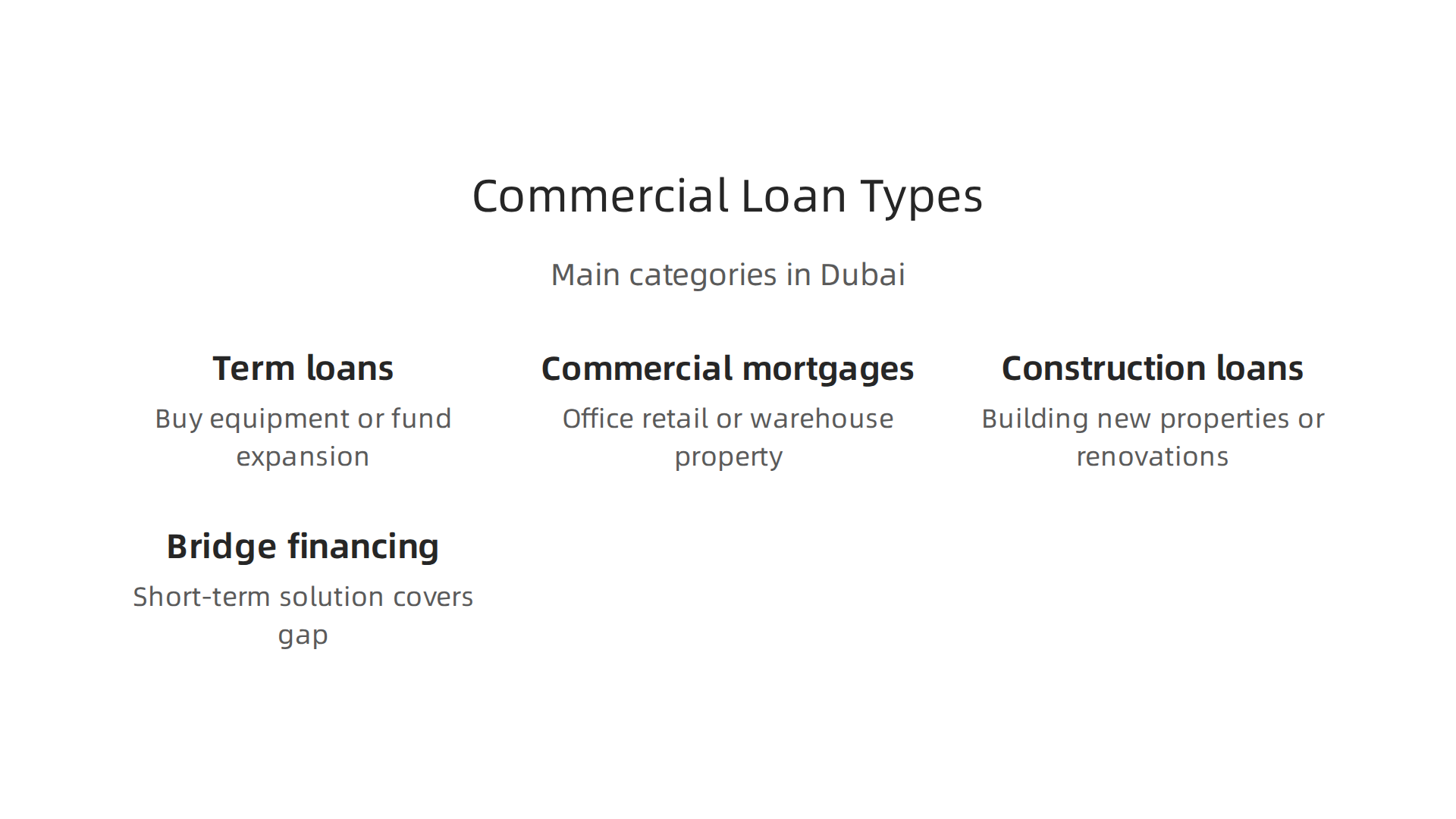
Term loans are straightforward. You borrow a lump sum for a set period, usually 3 to 10 years, and pay it back with interest. Businesses often use these to buy equipment or fund expansion. Interest rates on term loans typically range from 4% to 8%, depending on your business profile and the lender.
Commercial mortgages are the most common option for buying property like an office, retail space, or warehouse. Within this group you have owner-occupier mortgages (you use the property for your own business) and investment mortgages (you rent it out). Lenders look at your business income and the property’s rental potential. As noted in this overview of types of loans for real estate investors in Dubai, interest rates for commercial mortgages generally fall between 4% and 7%.
Construction loans (or development financing) are for building new properties or doing major renovations. The money is released in stages as the project hits milestones. Because these loans carry more risk, interest rates can be higher, and you will need a larger down payment.
Bridge financing is a short-term solution. It covers the gap between buying a new property and selling an old one, or it helps you grab a quick opportunity. Bridge loans usually last 6 to 12 months and come with interest rates from 5% to 8%.
The right choice depends on your goal. If you want to buy a finished office for your business, a commercial mortgage works. If you are building from scratch, look at a construction loan. For a quick property flip, bridge financing may be your best bet.
To see how each loan type matches different property scenarios, check out this detailed guide on commercial real estate loans in Dubai 2026. It breaks down what each lender offers and how to qualify.
Term Loans for Commercial Property Purchase
When you buy an income-generating property like an office building or a retail unit, a term loan is often the simplest path. You borrow a fixed amount and repay it over a set period, typically 5 to 15 years. The interest rates on commercial real estate loans can be either fixed or variable. In Dubai, variable rates are often tied to the Emirates Interbank Offered Rate (EIBOR). That means your rate moves with the market.
For a clear picture of current ranges, check out the latest data on types of business financing in UAE. Term loans for commercial property usually have interest rates between 4% and 8%, depending on your business profile and the lender.
Before you apply, it helps to understand the full process from start to finish. This step-by-step guide on commercial real estate financing in Dubai walks you through what documents you need and how to compare offers.
Getting the right loan can feel overwhelming. If you want personalized help, connect with an expert who knows the market. Get your FREE Dubai Real Estate Consultation today and talk to Ayaz Salman.
Standard Commercial Mortgages
Standard commercial mortgages work a lot like the home loan you might already know. You borrow a lump sum and pay it back in monthly installments. The big difference? The property is used for business, not living.
For prime properties in good areas, lenders usually offer a loan-to-value (LTV) ratio of 60% to 70%. That means you need a down payment of 30% to 40%. The repayment term can stretch up to 25 years in theory. But in practice, most lenders in Dubai cap it at around 15 years. This shorter term means higher monthly payments, but you build equity faster. For a detailed breakdown of what banks offer, check out this overview of commercial mortgage options in the UAE.
Because the interest rates on commercial real estate loans for these mortgages usually fall between 4% and 7%, your monthly cost can be predictable if you lock in a fixed rate. If you want to compare different lenders and terms, this insider guide to commercial property financing in Dubai can help you find the best match for your budget.
Construction and Development Loans
If you are building from scratch or doing a major renovation, a construction or development loan might be what you need. This is short-term financing, not a standard mortgage. The lender releases money in stages as the project hits milestones like pouring the foundation or completing the frame.
During the building phase, you usually pay interest only. That keeps your monthly costs low while nothing is generating income yet. Once construction finishes, the loan often converts into a permanent mortgage with regular principal-and-interest payments.
Because the bank takes on more risk, the commercial real estate loan interest rate for these loans tends to be higher. Expect rates around 2% to 3% above what you would pay for a standard commercial mortgage. That means you could be looking at 6% to 10% depending on your profile and the project scope. For a clearer picture of how these compare to other loan types, check out this overview of development financing options in the UAE.
If you are planning a build and need guidance on rates and lender requirements, getting expert help early saves time. A good agent can walk you through the whole process. For a full breakdown of what lenders look for, read this guide to commercial real estate loans in Dubai. And if you want personal advice on your specific project, reach out for a FREE Dubai Real Estate Consultation to talk through your options with someone who knows the market.
Key Factors Influencing Interest Rates on Commercial Real Estate Loans
So what actually determines the rate you get? It is not a random number pulled out of thin air. Lenders look at three main areas when setting interest rates on commercial real estate loans: the big economic picture, the property itself, and you as the borrower.
Let’s break each one down.
Macroeconomic Factors: What the Economy Is Doing
The overall economy sets the floor for rates. In the UAE, the Emirates InterBank Offer Rate (EIBOR) is the main benchmark. When EIBOR goes up, variable-rate loans get more expensive. The Central Bank of the UAE also plays a big role by setting monetary policy. If inflation is high, the central bank may push rates higher to cool things down. On the other hand, if the economy slows, rates might drop to encourage borrowing. These macroeconomic forces affect all commercial real estate loan interest rates across the board. For a deeper look at how EIBOR and central bank policy shape mortgage rates in Dubai, check out this guide on average mortgage rates in Dubai.
Property-Specific Factors: Location and Condition Matter
The property you choose has a big say in your rate. Lenders see properties in prime Dubai locations like Downtown or Dubai Marina as lower risk, so they often offer better rates. The type of property matters too. An office tower with strong occupancy and long-term tenants is safer than a half-empty retail space. Also, the loan-to-value (LTV) ratio counts. If you borrow a high percentage of the property’s value, the bank sees more risk and charges a higher rate. A thorough property valuation is key before applying for any loan for commercial real estate.
Borrower Profile: Your Track Record Speaks Loudest
Finally, lenders look hard at you as the borrower. Your credit score is a big deal. In the UAE, a score of 680 or above is considered good. Anything below 620 makes it tough to get a decent rate. Your relationship with the bank matters too. If you already bank there and have a history of on-time payments, you may get a discount. And the more equity you bring to the table (a larger down payment), the lower your risk and your rate. This is a major reason why financing for commercial real estate can vary so much from one investor to the next.
All three of these factors work together. To really understand where you stand, it helps to talk to an expert who can match your profile to the right lender. If you want personal advice on your situation, reach out for a FREE Dubai Real Estate Consultation and get clarity on what rates you can expect.
Current Interest Rate Trends for Commercial Real Estate in Dubai (2026)
Now that you know what drives rates, let’s look at where they actually stand in 2026. The good news? Things have settled down quite a bit.
Most commercial real estate loan interest rates in Dubai today fall between 4% and 8%, depending on the loan type and risk profile. Standard commercial property loans from banks typically range from 4% to 7%, according to Types of Loans for Real Estate Investors in Dubai. Bridge loans and private financing sit at the higher end, with some short-term options reaching 8% or more. Meanwhile, if you are a non-resident investor, you can expect rates from about 4.55% to 5.5% for a standard mortgage, as explained in this How to Finance Real Estate in Dubai in 2026 overview.
If you compare these numbers to where we were a few years ago, the picture is much calmer. After the rapid rate hikes of 2022 and 2023, the market has stabilized through 2025 and into 2026. Lenders have stopped raising rates every quarter. Instead, they are competing more aggressively for good borrowers. That competition is starting to push rates down slightly, especially for well-qualified buyers with strong down payments.
Looking ahead, the outlook is fairly steady. Most experts expect interest rates on commercial real estate loans to stay in the same range through the rest of 2026, with minor downward pressure as more banks enter the market. If you are shopping for a loan for commercial real estate, right now is a fairly balanced time to lock in a rate.
For a broader look at what is happening across the market, check out this Dubai commercial real estate 2026 market guide for investors. It covers what is driving demand and where the best opportunities are this year.
The key takeaway: rates are reasonable, stable, and likely to stay that way for a while. That makes now a solid time to move forward with your investment plans.
How to Compare Lenders and Loan Offers for the Best Rates
So you are ready to move forward. The next step is figuring out which lender and loan offer actually works best for you. Here is the thing: the commercial real estate loan interest rate is only one piece of the puzzle. If you focus on it alone, you might miss bigger costs hiding elsewhere.
Start by comparing these four things across every offer you get:
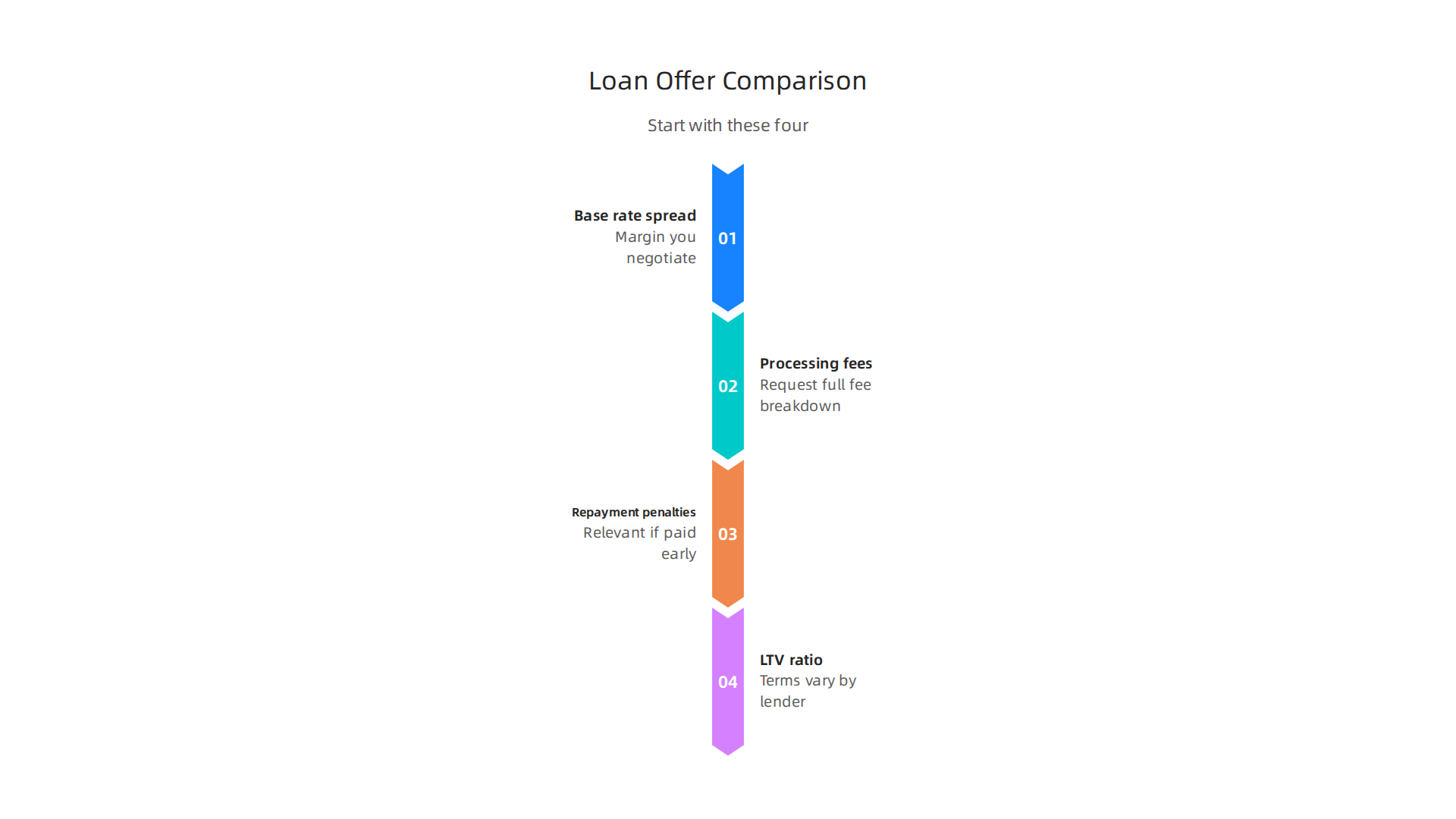
- Base rate plus spread. Most lenders advertise a rate like EIBOR plus a margin. The margin is what you negotiate. A low headline rate with a big margin might not be your best deal.
- Processing and valuation fees. Banks charge for paperwork, property valuation, and registration. These fees can add up fast. Always ask for a full fee breakdown before signing anything.
- Early repayment penalties. Some lenders charge a heavy fee if you pay off your loan early. If you plan to sell the property or refinance within a few years, this penalty matters a lot.
- Loan-to-value ratio. In Dubai, commercial property loans typically require a 30% to 40% down payment, as noted in this guide to commercial mortgage eligibility in the UAE. Some lenders may offer slightly better LTV terms, so it pays to check.
Do not accept the first offer you get. Getting quotes from at least three different lenders gives you negotiating power. Each lender has a different risk appetite. One might offer you better terms simply because they want more commercial loans on their books this quarter.
This is where working with someone who knows the local banking scene can save you real money.

A good advisor helps you compare offers side by side and spots things you might miss. They also know which banks are more flexible for non-residents or newer businesses.
If you want expert guidance tailored to your situation, reach out for a FREE Dubai Real Estate Consultation. It connects you directly with an experienced professional who can walk you through lender options.
For a deeper look at the full financing process from application to approval, check out this complete guide on commercial real estate financing in Dubai 2026.
Regulatory Considerations and the Application Process in Dubai
Now that you know what to compare, it helps to understand the rules and steps that come next. Dubai has clear regulations that shape how lenders set interest rates on commercial real estate loans and what you need to qualify.
The Two Main Regulators
The Dubai Land Department (DLD) oversees all property transactions and registrations in the emirate. Every commercial mortgage must be registered with the DLD to be legally valid.
The Central Bank of the UAE sets the big-picture rules for all lenders in the country. It caps loan-to-value ratios, limits debt burden ratios, and defines the minimum equity you must bring. These rules directly influence the commercial real estate loans interest rates that banks offer because they control the lender’s risk exposure across the board. The latest mortgage regulations from the Central Bank clearly outline these borrower protections and LTV caps.
Documents You Will Need
Getting your paperwork in order early saves a lot of time. Lenders typically ask for:
- Financial statements: Usually the last two years of audited accounts for your business
- Property title deed: A copy of the current title deed for the commercial space you are buying
- Net Operating Income (NOI) statement: This shows the actual or projected income the property generates, which helps the bank assess the loan
- Valid trade license and Memorandum of Association (MOA)
- Personal documents: Passport, UAE residency visa, and Emirates ID for all shareholders
- Existing lease agreements: If the property is already rented out
A detailed eligibility checklist for commercial mortgages in the UAE can help you confirm exactly what your specific lender will require.
The Application Timeline
Do not expect a quick weekend closing. The commercial mortgage process in Dubai usually takes 4 to 8 weeks from your application to the final disbursement of funds. Here is how it typically flows:
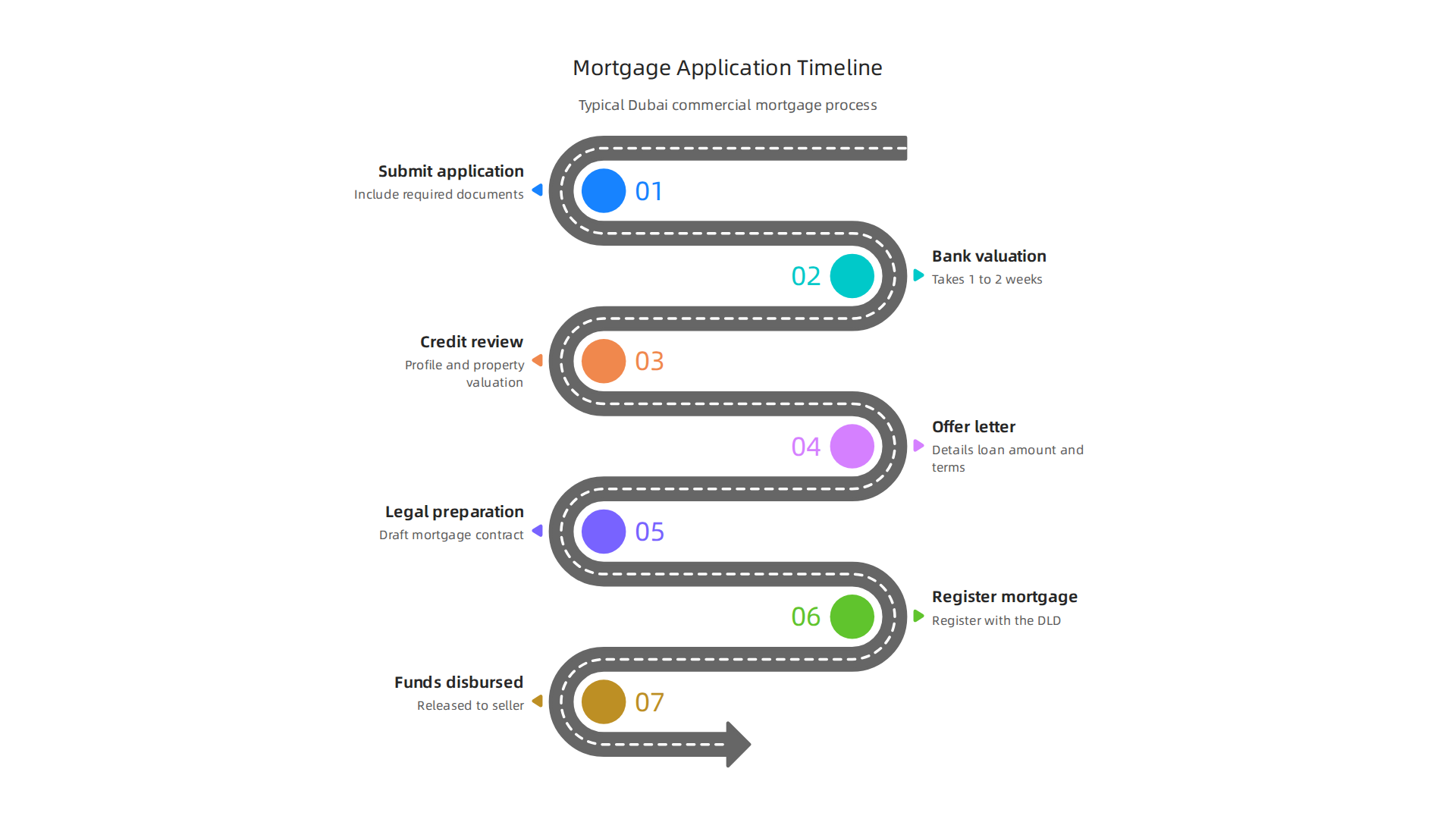
- Submit your application along with all the required documents
- The bank orders an independent property valuation (this takes 1 to 2 weeks)
- The bank’s credit team reviews your profile and the valuation
- You receive an offer letter outlining the loan amount, margin, and terms
- Once you sign, the bank’s legal team prepares the mortgage contract
- The mortgage is registered with the DLD
- Funds are disbursed to the seller
This whole process is easier when you know the exact steps in advance. Check out this complete step-by-step guide to securing commercial real estate financing in Dubai 2026 that walks you through the entire journey from application to getting the keys.
Actionable Tips to Secure Lower Interest Rates on Commercial Loans
You now know the process. But how do you actually get a better rate? Here are three practical strategies that can help you lower the commercial real estate loan interest rate on your next deal.
1. Strengthen Your Financial Profile Before You Apply
Lenders in Dubai look closely at your financial health. A clean credit history with a score above 680 puts you in a stronger position. Banks also check your debt-to-income ratio and how much equity you can bring. The more you put down, the less risk for the lender.
If you can bring a higher down payment, you show the bank you are serious. This often leads to a lower interest rates on commercial real estate loans offer. Make sure your business financials are clean and organized. A detailed guide on the top factors for commercial real estate loan rates explains exactly how borrower profile affects your final rate.
2. Time Your Application Strategically
Interest rates in Dubai are tied to EIBOR, the Emirates Interbank Offered Rate. When EIBOR is low, variable rates become more attractive. But you need to think about where rates are heading next.
If you believe rates will stay flat or drop, a variable rate linked to EIBOR makes sense. If you want stability, a fixed rate is better even if it starts higher. The average mortgage rates for commercial properties in Dubai sit above 6% in 2026, so locking in a fixed rate when the market dips can save you thousands over the loan term.
3. Work with an Experienced Consultant
This is the step many investors skip. A good commercial mortgage broker knows which banks offer the best rates for your specific situation. They also know how to negotiate terms beyond just the interest rate, like prepayment penalties and loan duration.
A consultant brings leverage. They can present your deal to multiple lenders and get competing offers. You can then pick the best one. For a full breakdown of what to negotiate and how, reading the commercial property financing strategies in Dubai can give you a clearer picture of what is possible.
Taking these steps does not guarantee the lowest rate every time. But they stack the odds in your favor. And that is what smart investing is all about.
Ready to move forward with your commercial property purchase? Having an expert on your side makes a real difference. Reach out for a FREE Dubai Real Estate Consultation to discuss your financing options directly with someone who knows the Dubai market inside out.
Summary
This guide explains how commercial real estate loan interest rates in Dubai are set and how to find the most competitive financing for offices, retail, warehouses and development projects. It covers the main loan types—term loans, commercial mortgages, construction and bridge financing—how rates are typically structured (EIBOR plus a margin or rare fixed/hybrid options), and realistic rate ranges in 2026. You will learn what lenders look at (macroeconomics, property quality, and your borrower profile), typical loan-to-value expectations, and the documents and timeline for an application. The article also shows how to compare offers beyond the headline rate by checking fees, prepayment penalties and LTV terms, plus practical steps to lower your rate through stronger financials, timing and working with a broker. By the end you’ll know which questions to ask banks, how to read offer letters, and where to go for expert help to secure better commercial financing in Dubai.