

Introduction
Dubai is one of those places that just keeps pulling people in. Every year, more investors, families, and entrepreneurs look at this city and think, "I want a piece of that." And honestly, it makes sense. The lifestyle is incredible. The tax-free ownership is a huge draw. And the rental yields? Some of the best in the world.
But here is the thing about learning how buy a house in Dubai. The process can feel like a maze. You want to buy property in Dubai for foreigners and you quickly realize the rules are different from what you are used to. There is fragmented information everywhere. Legal steps you did not expect. Hidden costs that pop up at the worst times.
Sound familiar?
If you are looking at dubai real estate properties online right now, you probably feel a mix of excitement and confusion.

That is totally normal. The Dubai market moves fast, and the paperwork can catch you off guard if you are not prepared.
Here is the good news. This guide breaks everything down into simple steps. No confusing jargon. No missing pieces. Just a clear plan to help you buy property in Dubai for foreigners without the headaches.
We will cover how to understand the market, find the right neighborhood, work with the right people, handle the legal side, and even manage your property after you buy. Everything you need in one place.
If you are serious about taking that next step, you might want to start by looking at our complete guide on how to buy a house in Dubai step by step. It walks you through each stage with practical advice.
And if you prefer a more personal touch, you can always reach out for a FREE Dubai Real Estate Consultation. Ayaz Salman can answer your specific questions and help you move forward with confidence.
Let us get into the first big decision you will make. Where should you actually buy?
Understanding Dubai’s Real Estate Landscape: Freehold vs Leasehold
Before you can figure out how buy a house in Dubai, you need to know one critical thing. Not every part of the city is open to foreign buyers. Dubai splits its property market into two main types: freehold zones and leasehold areas.
The difference matters a lot.
Freehold is the gold standard.
A freehold area is a designated zone where foreign nationals can buy property with full ownership rights. That means you own the land and the building. No time limit. No restrictions. The UAE government officially confirms that foreign ownership is permitted only in these designated freehold zones.
Some of the most popular freehold communities for expats and international investors include:
- Dubai Marina – waterfront apartments with amazing views
- Downtown Dubai – home of the Burj Khalifa and Dubai Mall
- Palm Jumeirah – iconic beachfront villas and apartments
- Arabian Ranches – spacious family villas with green spaces
- Jumeirah Village Circle – affordable homes close to the action
These areas are where most people go when they want to buy property in Dubai for foreigners. They offer strong rental returns, modern lifestyles, and full legal protection.
Leasehold is the other option.
With leasehold, you buy the right to use the property for a fixed period. Usually 99 years. But you do not own the land underneath. This can work well in certain areas where freehold is not available, but it is less common for international buyers.
When you start browsing dubai real estate properties online, always check whether the neighborhood is freehold first. It will save you time and headaches down the road.
For a complete list of all approved freehold areas in Dubai, check out this detailed guide from Property Finder.
Want to know which neighborhood fits your specific budget and lifestyle? Reach out for a FREE Dubai Real Estate Consultation. Ayaz Salman can walk you through the best options for your situation.
Now that you know the different areas, let us talk about how to find and evaluate the right property.
Legal Framework: Laws Every Foreign Buyer Must Know in 2026
Now that you understand the difference between freehold and leasehold, let us talk about the legal side of things. You have probably already searched how buy a house online, and you might have seen confusing legal terms. Don’t worry. The rules are actually straightforward once you break them down.
Dubai’s property market is heavily regulated by two key authorities: the Dubai Land Department (DLD) and the Real Estate Regulatory Agency (RERA).
RERA is the watchdog that makes sure developers and agents follow the rules. They handle everything from project registrations to dispute resolution. This agency is a big reason why buying a home in Dubai feels safer than in many other markets. For a deep dive into the full set of regulations, check out this guide on Dubai real estate laws in 2026.
Full foreign ownership is your right in freehold zones.
Since 2002, Dubai has allowed foreign nationals to own property outright in designated freehold areas. According to Pearlshire, foreign buyers can buy, sell, and lease property without any special permission. No government approval is needed before you purchase. You simply register the property with the DLD after the deal is done. This makes how buy house in Dubai much simpler than in many other countries.
But here is the thing. If you look at dubai real estate properties outside freehold zones, you need to check with the DLD first. Afridi & Angell confirms that in non-freehold areas, foreigners must ask the DLD whether ownership is allowed.
Strata law and service charges matter more than you think.
When you buy property in dubai for foreigners, especially in apartments or villas within a community, you enter into a shared ownership structure. The Strata Law governs common areas like pools, gyms, and gardens. Every owner pays service charges to cover maintenance. The owners association (OA) has a say in how the building or community is run. Make sure you review the service charge budget before signing anything. These fees can vary a lot between buildings.
Want to see the full step by step? Read our complete guide on how to buy a house in Dubai for a detailed walkthrough.
Feeling overwhelmed by the legal details? That is totally normal. Let an expert handle the paperwork so you can focus on finding your dream home. Contact Ayaz Salman for a FREE Dubai Real Estate Consultation today.
Financing Your Purchase: Mortgages and Down Payments for Expats
So you have found the perfect dubai real estate properties and you know the legal rules. Now comes the big question: how do you pay for it? Unless you have cash ready, you will need a mortgage. The good news is that expats can get home loans in Dubai.

But the process is a little different than what you might be used to back home.
First, do you qualify for a mortgage as an expat?
Most banks in Dubai want to see three things: a stable income, a minimum salary, and a valid residency visa. According to Property Finder, you typically need to earn at least AED 15,000 to AED 20,000 per month to qualify for a home loan. Some banks are flexible, but having a steady job with a reputable company helps a lot. If you are self-employed, expect to show two to three years of audited financials.
Interest rates in 2026: fixed vs variable
Right now, fixed interest rates for expats usually land between 4.9% and 5.8%, depending on your loan term and the bank you choose. Variable rates are often linked to the EIBOR (Emirates Interbank Offered Rate) plus a margin. For example, HSBC offers a variable rate of 3-Month EIBOR plus a spread that works out to around 5.09% for a 4-year loan. Fixed rates give you stability. Variable rates can go down if EIBOR drops, but they can also rise. Talk to your bank about which option fits your risk comfort.
Loan-to-value ratio: how much can you borrow?
The central bank sets the rules. For your first residential property worth up to AED 5 million, expats can borrow up to 80% of the property value. That means you need a down payment of at least 20%. If the property is worth more than AED 5 million, the maximum loan drops to 70%, so your down payment jumps to 30%. Always factor in extra costs like registration fees (4% of the property price) and agent commissions.
Why pre-approval matters
Do not start house hunting without a pre-approval letter. A pre-approval tells you exactly how much the bank is willing to lend you. It also shows sellers you are a serious buyer. In a competitive market, that can make the difference between getting the property or losing it. Getting pre-approved is quick, usually takes a few days, and it locks in your interest rate for a period.
Want a complete walkthrough? Read our detailed guide on how to buy property in UAE in 2026 for the full step-by-step process.
Feeling unsure about your mortgage options? You do not have to figure it out alone. Let an expert guide you through the numbers. Contact Ayaz Salman for a FREE Dubai Real Estate Consultation today.
The Step-by-Step Buying Process: From Offer to Handover
Once your mortgage is ready, the buying process really kicks off. Many first timers wonder how buy a house in Dubai actually works. Here are the five main steps from offer to handover. Expect the whole thing to take 4 to 8 weeks.
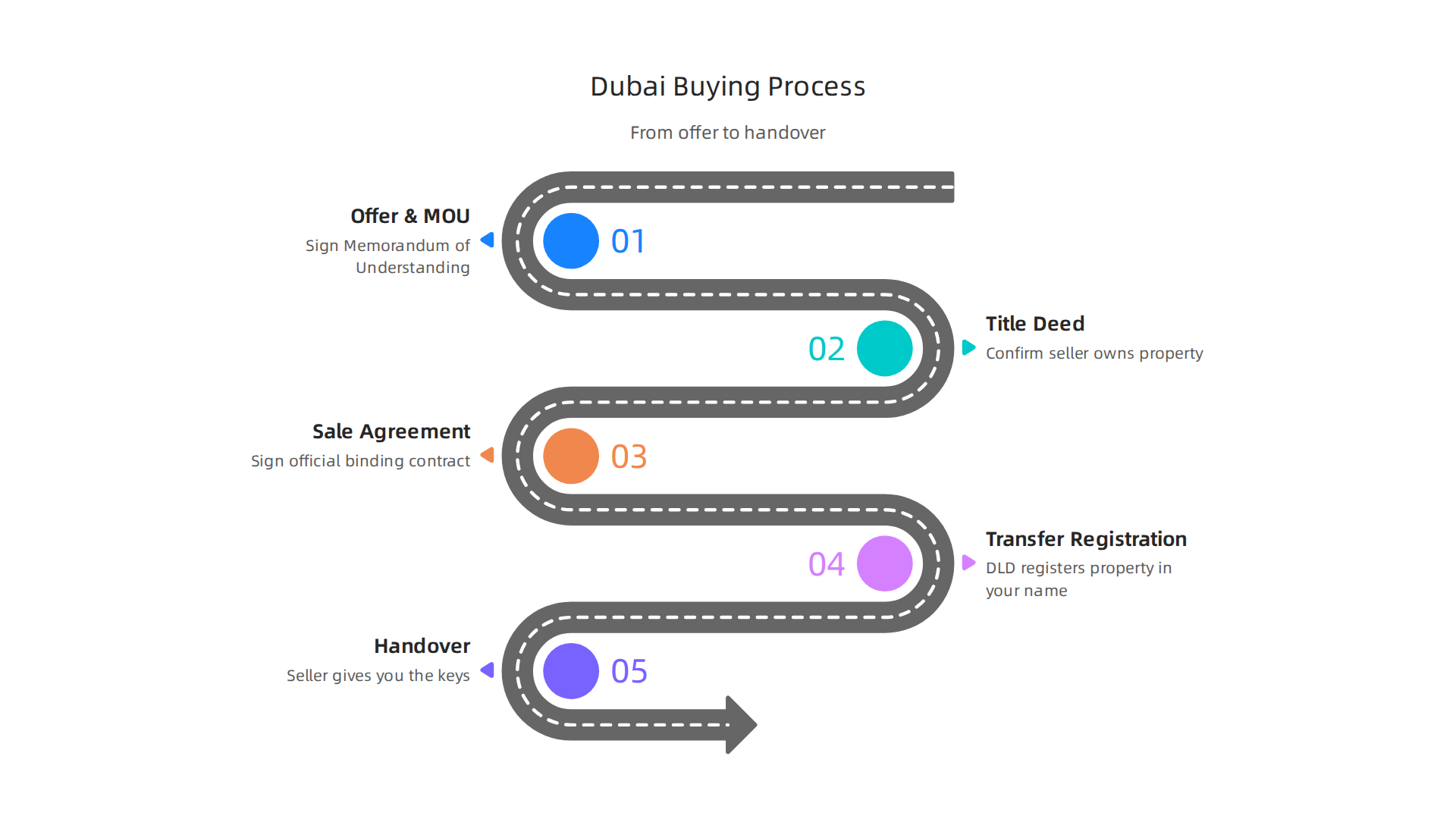
Step 1: Offer and Memorandum of Understanding (MOU). When you find a property you like, your agent submits an offer. If the seller accepts, you both sign an MOU. This document locks in the price, the payment schedule, and the handover date. According to Property Finder’s guide on the legal procedures, this is the starting point of the formal process.
Step 2: Title Deed Check. Before moving forward, you need to confirm the seller owns the property and that there are no debts or disputes attached to it. Your lawyer or conveyancer handles this check with the Dubai Land Department.
Step 3: Sale Agreement. Once the title is clean, you sign the official sale agreement. This is the binding contract. It includes all the terms from the MOU plus the transfer date. You will pay the deposit, usually around 10 percent of the purchase price, at this stage.
Step 4: Transfer and Registration. On transfer day, you pay the remaining balance. The Dubai Land Department registers the property in your name. You also pay the 4 percent registration fee plus admin charges. This step takes one day if everything is prepared.
Step 5: Handover. The seller gives you the keys and any documents like maintenance manuals or warranty cards. If you bought an off-plan property from a developer, the handover may happen after completion and a final inspection.
Who helps you along the way? Your real estate agent guides you through showings and negotiations. A lawyer or conveyancer handles the legal checks and paperwork. Some buyers skip a lawyer and rely on the agent and the Dubai Land Department, but having your own legal help can protect you, especially if you want to buy property in dubai for foreigners and are unfamiliar with local rules.
Want a deeper walkthrough? Read our complete step-by-step guide on how to buy property in UAE in 2026 for every detail.
Feeling overwhelmed? You do not have to manage this process alone. An experienced professional can save you time and stress. Contact Ayaz Salman for a FREE Dubai Real Estate Consultation today.
Step 1: Initial Offer and Memorandum of Understanding
So you have found the perfect apartment in Dubai Marina or a villa in the Palm. Now comes the real question: how do you actually make it yours? The answer starts with a formal offer.
You must make your offer through a registered real estate agent. This is not a suggestion, it is a rule from the Dubai Land Department. Your agent submits the offer to the seller’s agent. Negotiation happens quickly here. You discuss the final price, the payment schedule, and the handover date. This is where knowing current mortgage rates in Dubai for expats can help you set a realistic budget.
Once both sides agree, you sign a document called the Memorandum of Understanding (MOU) . According to Property Finder’s overview of the legal procedures, this is the official starting point of the buying process. The MOU locks in everything: the agreed price, the payment timeline, and the date you will get the keys.
You also pay the initial deposit at this stage. Expect to put down 10 percent of the purchase price. This money does not go directly to the seller. It goes into an escrow account held by the broker. This protects both you and the seller. If something goes wrong, the deposit stays safe.
If you are wondering how buy house in Dubai as a foreigner, this step is the same for everyone. Having a trusted agent by your side makes a big difference. They guide you through the MOU terms and make sure your deposit is protected.
Want to understand the full timeline before you make an offer? Read our complete guide on how to buy property in UAE in 2026 to see what comes next.
Ready to move forward with your offer? Get expert help to avoid costly mistakes. Contact Ayaz Salman for a FREE Dubai Real Estate Consultation today.
Step 2: Title Deed Check and Sale Agreement
The MOU is signed and your deposit is safe. Now comes the part where you make sure the property is really yours to buy.
You need to do a title deed check. This means verifying that the seller actually owns the property and there are no loans or legal issues attached to it. You can do this through the Dubai REST app or the DLD portal. It is a simple process that takes just a few minutes. Skipping this step can cost you big later. If you are learning how buy a house in Dubai, this check protects you from hidden problems.
Once the title deed is clean, your agent will draft the official sale agreement known as Form F. This document spells out everything: the final price, payment schedule, handover date, and any conditions both sides agreed on. According to Property Finder’s guide on the legal procedures to buy property in Dubai, this is the contract that gets registered with the Dubai Land Department.
The sale agreement must be notarized at a DLD office or through an authorized typing center. There is a small legal fee for this, usually a few hundred dirhams. Your agent or lawyer can handle the paperwork. This step makes everything official.
For buy property in Dubai for foreigners, these rules are the same. The DLD makes it easy for anyone to check dubai real estate properties online. You do not need to be an expert.
Want to see the full picture before you sign anything? Read our step by step guide on buying a house in Dubai in 2026 for more details on the legal process.
Not sure about the paperwork? Get expert help to avoid delays. Connect with Ayaz Salman for a FREE Dubai Real Estate Consultation today.
Breaking Down the Costs: Hidden Fees and Taxes
You found your dream property. The price tag looks good. But here is the truth most first-time buyers miss.
The listed price is not what you actually pay.
If you want to how buy a house without surprises, you need to know every single fee before you commit. Let me break them down simply.
The DLD Transfer Fee (Your Biggest Extra Cost)
The Dubai Land Department charges a 4% transfer fee on the purchase price. This is the big one. On a AED 1 million property, that is AED 40,000 right there. You also pay a small administrative charge on top. According to Bayut’s detailed breakdown of total costs for buying property in Dubai, this fee is standard and applies to every transaction.
Agent Commission and Legal Fees
Your real estate agent gets paid too. The standard commission is 2% of the purchase price plus 5% VAT. So on that same AED 1 million property, you pay around AED 21,000 to your agent. You might also hire a lawyer for contract review and notarization. Legal fees vary but expect AED 5,000 to AED 15,000 depending on complexity.
Registration and Trustee Fees
When you register the property in your name, the DLD charges a registration fee. For dubai real estate properties valued above AED 500,000, the fee is AED 4,000 plus 5% VAT. For properties under AED 500,000, it is AED 2,000 plus VAT. This is confirmed by Engel & Voelkers’ guide on costs of buying property in Dubai. A trustee office also handles the transfer paperwork and charges a small fee, usually AED 2,000 to AED 4,000.
Other Ancillary Costs
Do not forget the valuation fee if you need a mortgage. Banks require a property valuation that costs around AED 2,500 to AED 3,500. You also pay for the No Objection Certificate (NOC) from the developer, which can be AED 500 to AED 5,000. Add in service charges if you buy an apartment in a building with common areas.
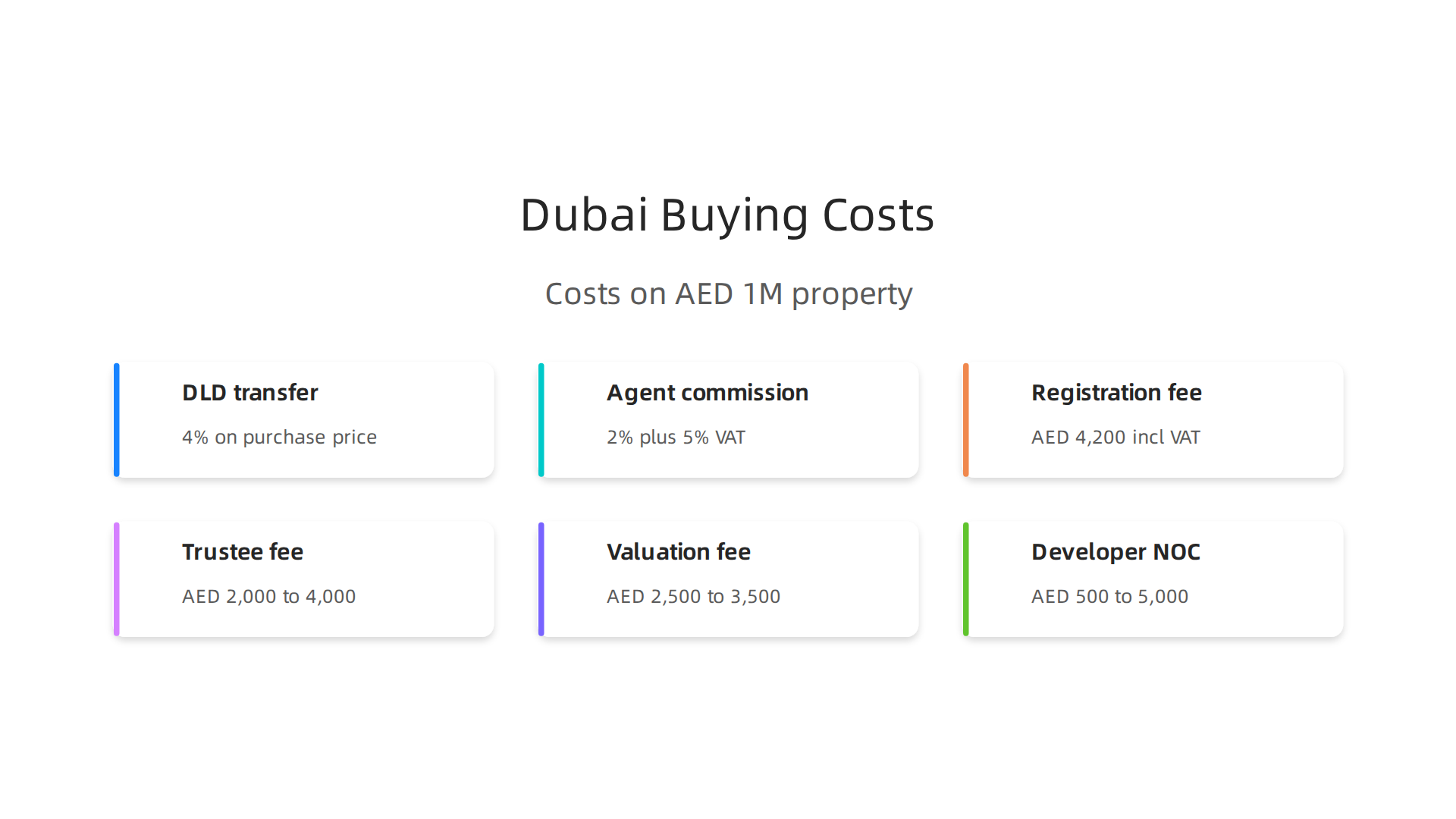
Here is a quick summary of the main costs on a AED 1 million property:
| Fee Type | Estimated Amount |
|---|---|
| DLD transfer fee (4%) | AED 40,000 |
| Agent commission (2% + VAT) | AED 21,000 |
| Registration fee | AED 4,200 (incl. VAT) |
| Trustee fee | AED 2,000 to AED 4,000 |
| Valuation fee (if financing) | AED 3,000 |
| NOC from developer | AED 500 to AED 5,000 |
Total extra costs: roughly AED 70,000 to AED 77,000 on top of the purchase price.
For those who want to buy property in Dubai for foreigners, these fees are exactly the same. There are no extra charges for non-residents. In fact, compared to cities like London where total costs can reach 8% to 15%, Dubai is actually quite affordable according to Gaia Realty’s comparison of Dubai property prices vs global cities.
A good agent helps you avoid unnecessary costs. Read our article on how a commercial real estate agent in Dubai saves you money and headaches to see how expert guidance keeps your budget on track.
Still not sure if you have missed any hidden costs? Get a clear picture before you sign anything. Connect with Ayaz Salman for a FREE Dubai Real Estate Consultation today.
Due Diligence: How to Verify a Property’s Legal Status
You know the costs now. But here is the thing. Even if the price is right, the property itself might have problems hiding under the surface.
So how do you avoid buying a place with legal issues attached to it?
You do your homework. And it starts with a few simple checks.
Check the Title Deed on Dubai REST
The most important step is verifying who owns the property and whether anything is holding it back. Dubai has a system called the Dubai REST app. You can use it to check the title deed, confirm the owner’s identity, and see if there are any loans, liens, or court orders attached to the property.
You want a clean title. Nothing less.
Verify Ejari and the RERA Rental Index
If the property you want to how buy a house is currently rented out, you need to know the tenancy status. The Ejari system tracks all rental contracts in Dubai. It tells you who is living there, how much rent they pay, and when the lease expires.
According to Driven Properties’ guide on Dubai real estate laws in 2026, buyers must check Ejari records to avoid surprises about existing tenants. You also want to run the property through the RERA rental index to see if the current rent is above or below market average. This matters if you are buying an investment property.
For those looking to buy property in Dubai for foreigners, these checks are exactly the same. Dubai does not treat foreign buyers differently when it comes to legal verification. As Pearlshire explains in their legal guide for foreign buyers, the process is open and transparent for everyone.
Do a Physical Property Inspection
Paperwork is only half the story. You need to see the property with your own eyes.
Walk through every room. Check for water damage, cracks in the walls, faulty wiring, and signs of mold. Look at the age of the air conditioning unit. Ask about maintenance history. If the seller or agent seems shy about you seeing the property, that is a red flag.
A thorough inspection can save you thousands in future repairs.
Want to go deeper on the full buying process? Our complete guide on how to buy a house in Dubai in 2026 covers every step from search to handover.
Still unsure about what to look for? Let an expert guide you. Connect with Ayaz Salman for a FREE Dubai Real Estate Consultation to verify any property before you commit.
Off-Plan vs Ready Property: Pros and Cons for Investors
You have checked the legal status and verified everything. Now comes the big decision. Should you buy off-plan or choose a property that is already built?
This choice shapes your entire investment. Each option has clear upsides and real downsides.
Let me break them down so you can decide what fits your goals.
The Case for Off-Plan Properties
Off-plan means buying a property before it is finished. You sign a contract based on the developer’s plans and renderings.
The good parts:
- Lower entry prices. Developers often sell off-plan at a discount compared to completed units in the same area.
- Flexible payment plans. You can spread payments over months or even years during construction.
- Capital appreciation potential. If the market goes up while the building is being built, your property value increases before you even move in.
The risks you need to know:
- Project delays. Some developers finish late. Sometimes very late.
- Developer reputation matters a lot. A bad developer can leave you stuck.
- Market fluctuations. If the market drops before completion, your investment could lose value on paper.
The Case for Ready Properties
A ready property means you can take possession right away. What you see is what you get.
The good parts:
- Immediate rental income. You can find a tenant the day you take ownership.
- Known quality. You inspect the actual unit, not a brochure.
- Possession speed. You close the deal and get the keys in weeks, not years.
What to watch for:
- Higher purchase price compared to off-plan in the same area.
- Less room for negotiation on payment terms.
If you want to buy property in Dubai for foreigners, both options are available. Foreign buyers have full access to freehold areas like Dubai Marina, Palm Jumeirah, and Downtown Dubai. According to the UAE government’s official guide on expatriate property ownership, the rules are clear and open to everyone.
Many top off-plan projects are in these same popular freehold zones. Engel & Voelkers lists top freehold areas where you can invest, whether you go off-plan or ready.
Need a full walkthrough of the buying journey? Check out our complete guide on how to buy property in UAE in 2026.
Still unsure which route is right for you? Let an expert help you compare your options. Connect with Ayaz Salman for a FREE Dubai Real Estate Consultation to discuss off-plan and ready properties that match your budget and timeline.
Post-Purchase Essentials: Visas, Insurance, and Property Management
You have chosen your property and closed the deal. That is a big win. But owning your home is just the start. A few key steps will protect your investment and unlock extra benefits.

First, the UAE Golden Visa. If your property is worth AED 2 million or more, you may qualify for a long-term residency visa. This visa lets you live, work, and study in the UAE without a sponsor. Many people choose to buy property in Dubai for foreigners specifically to get this visa. Check the official rules and talk to a real estate expert to confirm your eligibility.
Next, home insurance. If you took a mortgage, insurance is mandatory. It protects the bank’s investment. Even if you paid cash, you should still get insurance. A fire, flood, or structural issue could cost you a lot. Make this part of your budget from day one.
Finally, property management services. If you do not live in Dubai full time, you need someone to look after your place. A good property manager finds tenants, collects rent, arranges repairs, and deals with paperwork. This is how you keep your rental income steady without daily headaches. Many investors use management companies to optimize their dubai real estate properties.
These steps are part of the real cost of owning property. To understand all the fees involved, check this detailed guide on the total cost of buying property in Dubai.
If you want a step by step walkthrough on how buy a house in Dubai and handle everything after purchase, read our full guide on how to buy a house in Dubai in 2026.
Still unsure about the visa process or which insurance to choose? Let an expert guide you. Get your FREE Dubai Real Estate Consultation with Ayaz Salman today.
Summary
This guide explains how foreign buyers can confidently purchase property in Dubai by breaking the process into clear, practical steps. It covers the crucial difference between freehold and leasehold areas, the legal framework enforced by the Dubai Land Department and RERA, and the step‑by‑step buying process from offer and MOU through title checks, sale agreement, transfer and handover. You’ll also get a straight breakdown of financing options for expats, typical mortgage requirements and interest rates, and a transparent list of extra costs and fees to budget for. The article compares off‑plan and ready properties, outlines essential due diligence checks, and explains post‑purchase needs like visas, insurance and property management so you can protect your investment and start earning rental income or move in with confidence.