Introduction: The Pivot Year for Dubai Commercial Real Estate
Think back to early 2020 for a moment. Dubai’s commercial real estate market was moving at full speed. Grade A office spaces in prime districts like DIFC and Downtown were almost completely full. Rents were climbing. Big companies were signing long leases. Everything looked stable and strong.
Then came the pandemic. And everything changed, almost overnight.
What happened next was not just a temporary dip. It was a complete reshuffle of how businesses in Dubai think about office space, retail locations, and warehouses. Some sectors struggled. Others found new life. And the trends that started during that period are still shaping the market today, all the way through to 2026.
Here is the thing. Before 2020, you could predict the commercial real estate 2020 outlook pretty easily by looking at last year’s numbers. After 2020, that stopped working. The market did not just bounce back. It transformed. Remote work changed how companies lease space. E-commerce explosion changed demand for warehouses. New visa rules brought in fresh waves of investors.
According to a recent report from Savills, Dubai’s office market continues to demonstrate strong fundamentals with prime office occupancy costs ranking 8th globally. That growth did not happen by accident. It has roots in how the market adapted during that critical year.
So why does this matter for you right now in 2026? Because understanding that inflection point gives you the context you need. If you are an investor looking at opportunities, a business owner searching for the right lease, or a landlord trying to set fair terms, knowing how the market shifted in 2020 helps you make smarter decisions today.

This guide walks through what really happened during that pivot year, how the market has evolved since, and what it all means for your next move in Dubai’s commercial real estate scene. We will cover the data, the trends, and the practical steps you can take right now.
If you are just starting your search, you might want to check out our complete guide to commercial real estate in Dubai 2026 to get a full picture of what is available.
And if you are ready to take action, feel free to connect for a FREE Dubai Real Estate Consultation with someone who knows the market inside and out.
The Pre-Pandemic Landscape: Dubai CRE Before 2020
To really understand how much things changed, you need a clear picture of where Dubai stood before everything shifted.
In the years leading up to 2020, Dubai’s economy was humming along nicely. The city was in full preparation mode for Expo 2020. That meant massive infrastructure projects, new roads, expanded metro lines, and a surge in foreign investment. According to the Dubai Land Department, total real estate transactions in 2018 hit AED 398 billion, with commercial properties making up 68% of that total value. That tells you just how dominant the commercial sector was at the time.
Prime office spaces in places like DIFC, Downtown Dubai, and Sheikh Zayed Road were almost completely full. Grade A office occupancy sat above 90% across most premium districts. Landlords had the upper hand. Rents were climbing steadily, and tenants often had to compete for the best spaces. If you wanted a corner office in DIFC with a view, you needed to move fast and be ready to pay a premium.
The investment side was just as active. Regional buyers from Saudi Arabia, Kuwait, and Qatar were putting money into Dubai commercial property. International investors from Europe and Asia were also in the game, especially in free zones where foreign ownership rules made things easy. Business setup in areas like DMCC, JLT, and Dubai Silicon Oasis was growing fast.
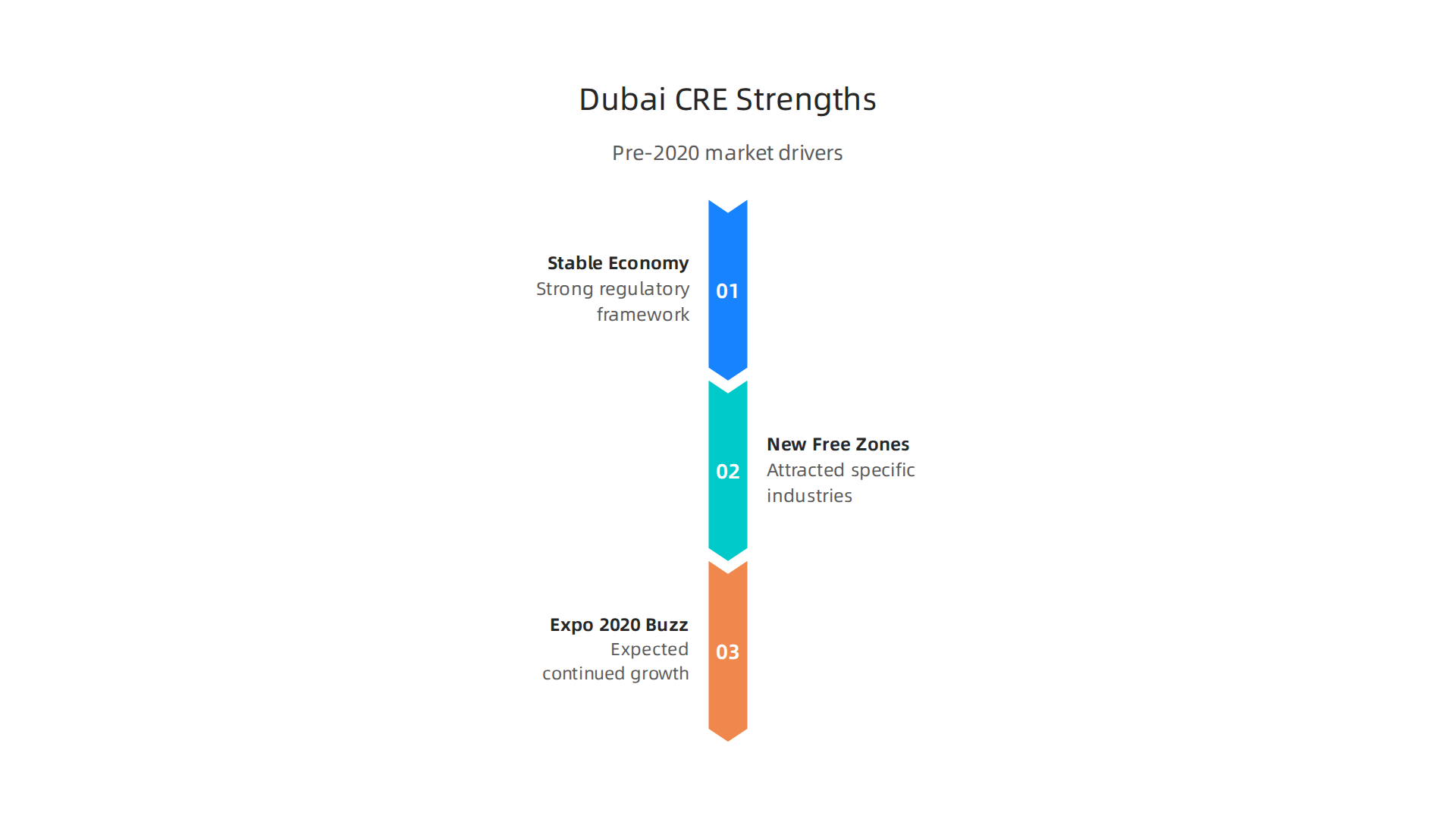
A few things made this period special. First, the UAE’s stable economy and strong regulatory framework gave investors confidence. Second, the government was actively creating new free zones to attract specific industries. Third, the Expo 2020 buzz meant everyone expected continued growth for years to come.
But here is the thing about markets at their peak. They often hide the cracks underneath. And those cracks would become very visible very soon.
If you want to understand how the leasing process worked during that time and how it has changed since, our guide on how to buy or lease commercial property in Dubai covers the full picture step by step.
The 2020 Inflection Point: Pandemic Impact on Dubai CRE
Then 2020 arrived. And it hit hard.
The COVID-19 pandemic struck Dubai’s commercial real estate sector like a shockwave. Flight restrictions grounded business travel. Remote work mandates emptied office towers almost overnight. Retail stores locked their doors with no clear reopening date.
The numbers tell the story clearly. According to the Knight Frank Q3 2020 market report, prime office rents in Dubai fell 4.7% in the year to Q3 2020, while Grade A rents dropped 6.1% and citywide rents declined 7.7% over the same period. Market-wide vacancy reached 18.7% by Q2 2020.
Retail took an even harder blow. Shopping center footfall dropped by up to 30% as early as March 2020, with the economic impact of the COVID-19 pandemic spreading across every continent.
But the government did not sit still. Dubai South and other free zones quickly introduced rent relief programs, flexible payment plans, and waived fees for small businesses.

These measures gave tenants breathing room when cash flow had dried up.
If you were navigating this market as a business owner or investor, you needed clear guidance. Understanding how different commercial property types in Dubai reacted to the shock made a real difference in your next move.
For personalized help working through your options in today’s market, get a FREE Dubai Real Estate Consultation with Ayaz Salman to discuss your next step.
Immediate Effects: Vacancies and Rental Drops
The numbers hit hard and fast for commercial real estate 2020 in Dubai. Office towers in DIFC and Sheikh Zayed Road saw vacancy rates climb from around 12% to over 20% by mid-year. Tenants gave back space or walked away from leases entirely. Rents followed the same downward spiral.
Retail took an even bigger punch. Mall foot traffic crashed by more than 50% in Q2 2020, according to information on the Economic impact of the COVID-19 pandemic. Stores that relied on window shoppers and tourist traffic suddenly had no one coming through the doors. Many landlords had no choice but to renegotiate rents just to keep the lights on.
But here is the twist. The industrial sector proved to be the strong player. Warehouses and logistics hubs saw steady demand as e-commerce boomed. People stuck at home ordered everything online. That shift, covered in reports about Dubai real estate post-COVID, meant industrial real estate held up much better than offices or retail.
Understanding which property types weathered the storm best can shape your strategy today. Check out this guide on the main commercial property types in Dubai to see how the market has shifted since 2020.
Sector Divergence: Retail vs. Logistics vs. Office
Not all commercial real estate 2020 suffered equally. The pandemic actually split the market into clear winners and losers.
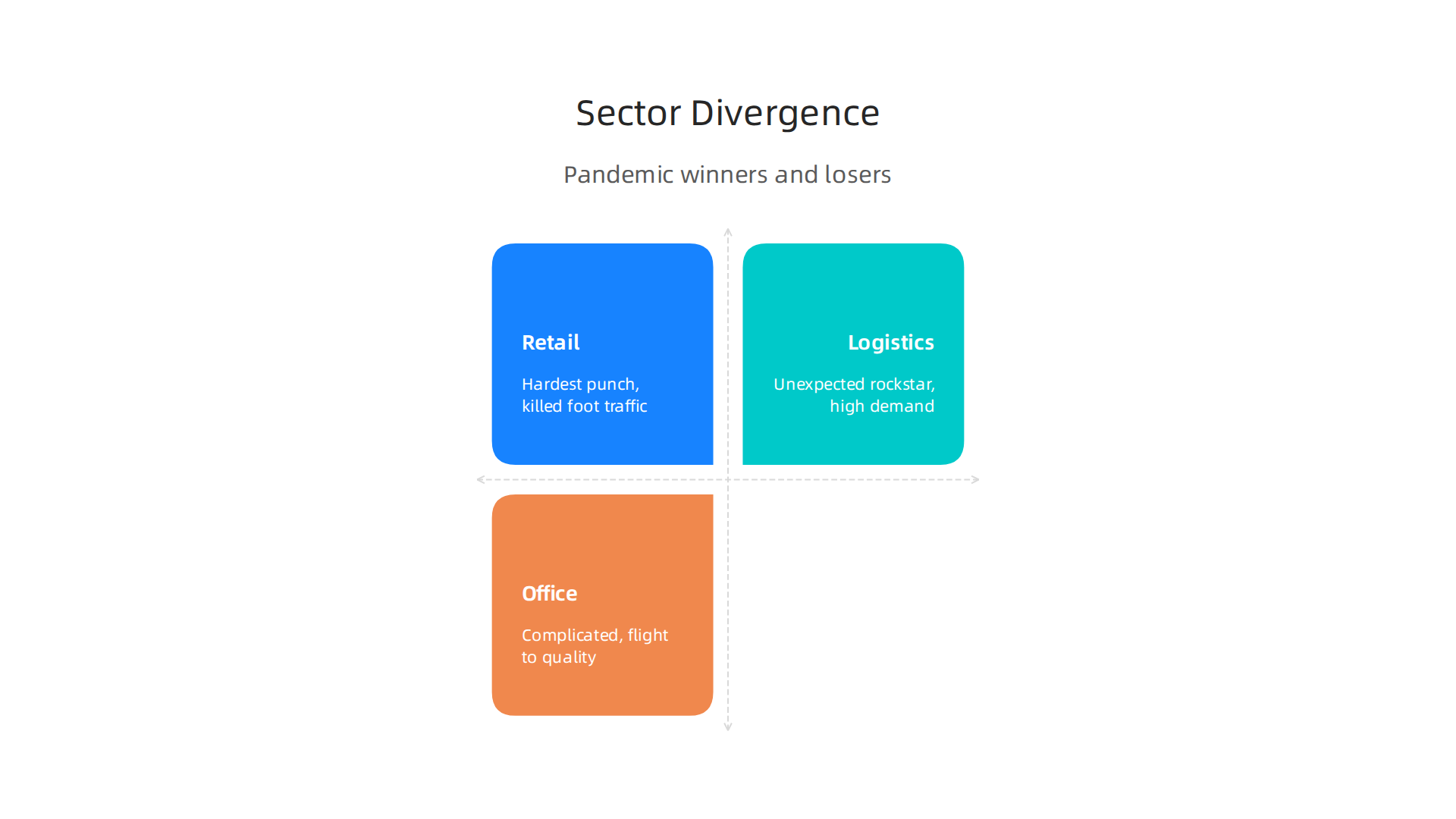
Retail took the hardest punch. Lockdowns and fear of crowds killed foot traffic. Shopping malls felt empty for months. Even after restrictions eased, people stayed cautious. The habit of eating out and browsing stores just vanished. Many retail landlords saw tenants walk away or demand huge rent cuts just to survive.
On the flip side, logistics became the unexpected rockstar of commercial real estate Dubai. E-commerce exploded. People ordered everything from groceries to home gyms online. Warehouses and distribution centers suddenly became the most wanted spaces. If you owned industrial property in 2020, you likely had a pretty steady year.
The office sector had a more complicated story. Sure, many companies sent staff home. But here is the interesting part. A clear trend called flight to quality emerged. Tenants with expiring leases did not just renew cheaply. Instead, many moved to better buildings with modern layouts and better air quality. They used the downturn to upgrade. Meanwhile, older low-grade offices struggled with rising vacancy. Reports on how COVID-19 changed demand for office space show that hybrid work became permanent for many firms.
The lesson is clear. In a crisis, location matters less than property type. If you are thinking about the market today, understanding these differences matters more than ever. Get clarity on your next move with a FREE Dubai Real Estate Consultation.
Post-2020 Recovery and Structural Shifts (2021-2025)
By 2021, Dubai’s commercial real estate market had already turned around. The city reopened fast, and the long-awaited Expo 2020 finally opened its doors. That single event brought billions in investment and millions of visitors. It gave the whole economy a massive boost.
Government programs like the Dubai Economic Agenda D33 added more momentum. The plan aimed to double the city’s economy. New business hubs expanded, and the Expo site became Expo City, a permanent home for commerce and innovation. International investors who had held back in 2020 started coming back in big numbers.
The pandemic also changed how companies use office space. Flexible workspaces and hybrid schedules became standard. Tenants wanted shorter leases and better amenities. Landlords who adapted to these new needs did well.
According to reports on the Dubai commercial property market boom, Grade A office demand hit record levels by 2025. Prime office rents in top areas like DIFC and Downtown Dubai pushed past pre-pandemic highs by 2024. But not every area saw the same gains. Older buildings in secondary neighborhoods still faced higher vacancy rates.
This recovery shows that Dubai’s market can bounce back faster than almost any other city. If you want to learn from this cycle, check out this Dubai commercial real estate 2026 market guide for investors to see where the smart money is heading next.
The Flight to Quality and Flexible Spaces
As the market came back to life, tenant expectations had shifted for good. Companies no longer wanted just any office. They wanted great offices with modern amenities, premium locations, and flexible layouts. This trend, known as the flight to quality, pushed demand toward top-tier buildings while older spaces sat empty.
The numbers tell the story clearly. The share of flexible workspace in Dubai’s total office stock grew from just 5% in 2020 to over 12% by 2025.

Businesses wanted shorter leases and room to grow or shrink quickly. Coworking memberships, serviced offices, and hybrid-ready floor plans became the standard, not the exception.
Landlords had to change their approach to keep up. Many started offering shorter lease terms and fit-out allowances to attract quality tenants. Those who resisted these changes saw their vacancy rates climb. As noted in the analysis of what history tells us about Dubai property recovery, the post-2020 rebound was faster than earlier cycles thanks to strong policy support and global investor demand.
If you are weighing your options in this shifting market, understanding these trends helps. Take some time to explore commercial property types in Dubai to see which spaces match the current demand.
Ready to move forward? Book a FREE Dubai Real Estate Consultation with Ayaz Salman and get expert guidance on finding your next commercial space.
Government Initiatives and Regulatory Changes
The lockdowns of 2020 hit hard, but the Dubai government did not waste time. They rolled out a series of smart policy changes that helped the market get back on its feet fast.
One of the biggest moves was allowing 100 percent foreign ownership in key sectors.
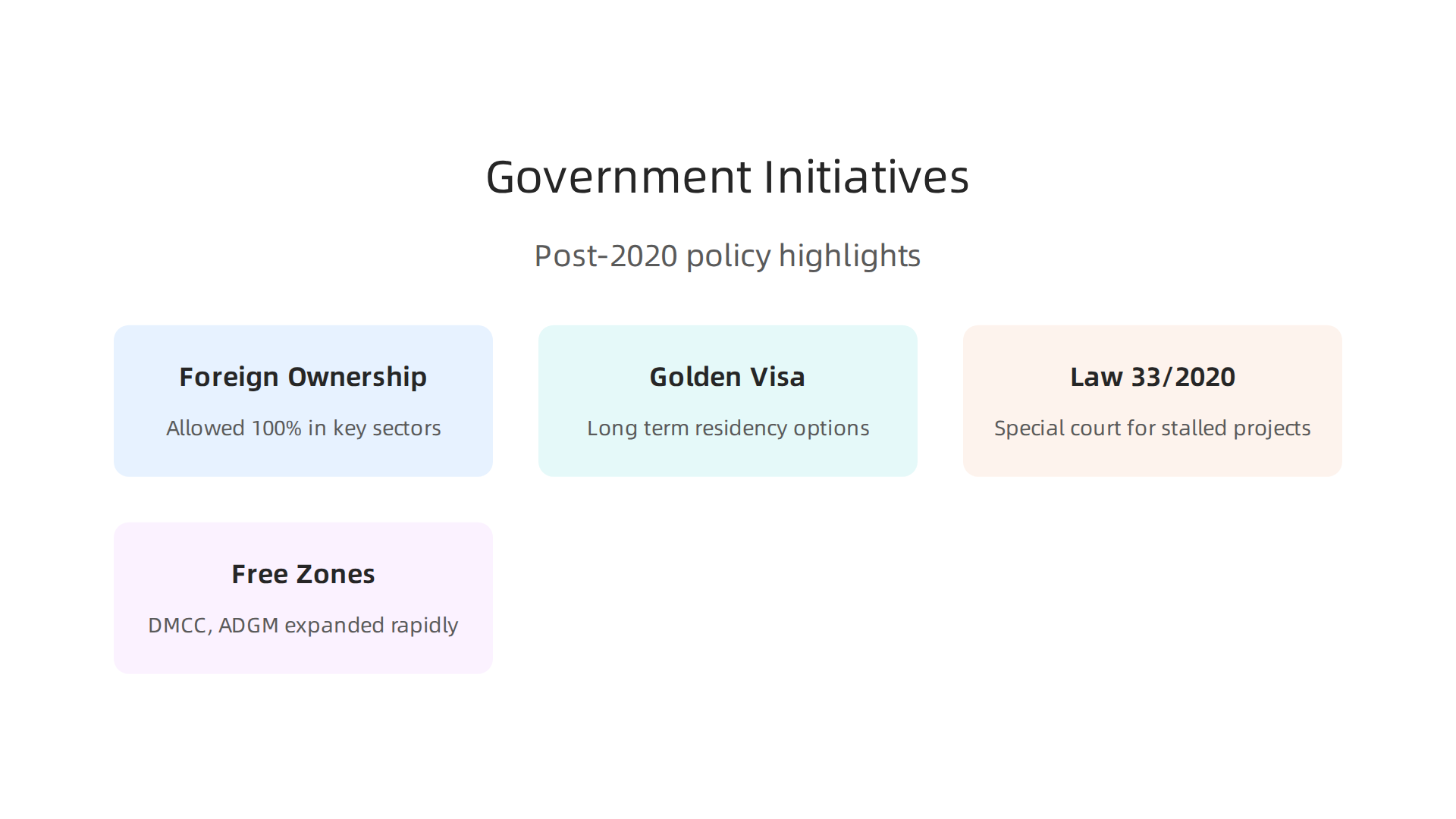
Before this, most foreign investors needed a local partner. This single change opened the door for global capital. The government also introduced long term residency options like the Golden Visa. These programs gave investors the stability to plan for the long haul. You can read more about these shifts in the latest UAE visa reforms and foreign ownership updates.
The government also passed new laws to protect buyers and speed up project completion. For example, Law No. 33 of 2020 created a special court to handle stalled or cancelled property projects. This gave investors a clear way to recover their money, which built lasting trust in the market.
Free zones like DMCC and ADGM expanded rapidly too. They offered tax breaks and full ownership, which attracted big multinational companies. These companies needed office space, which drove demand in the commercial real estate dubai sector.
The commercial real estate 2020 recovery was not an accident. It was the direct result of these well timed government actions. If you want to understand how these laws affect your buying power today, check out this guide to buying property in Dubai for the current rules and clear steps.
Investment Trends and Capital Flows in Dubai CRE
The government policies you just read about did more than just stabilize the market. They triggered a wave of investment that reshaped the commercial real estate 2020 landscape and beyond. Money started moving fast.
By 2023, investment volumes were already higher than before the pandemic. The UAE commercial real estate market was valued at $24.6 billion in 2024 and is on track to reach $45.68 billion by 2030, according to the latest UAE $45+ Bn Commercial Real Estate Markets report. That is serious growth.
Where did all this capital come from? International investors from the UK, India, and Gulf states led the charge. They saw Dubai as a safe place to park money with good returns. Rental transactions made up 67 percent of the UAE commercial real estate market in 2025. Big investors like pension funds love the predictable cash flow from office and logistics properties.
Here is what happened with yields. Prime office spaces and logistics warehouses saw their yields compress. This means property prices went up, so the annual return percentage got a bit smaller. Everyone wanted these safe assets, so demand pushed prices higher. Retail properties told a different story. They offered higher yields because buyers saw them as more risky.
For you as an investor, the choice comes down to your goals. Want steady, reliable income? Logistics and prime office space are your friends. OK with taking on more risk for a bigger potential payday? Retail might fit.
If you are looking at the Dubai market and want to know which path is right for you, here is a smart next step. Claim a FREE Dubai Real Estate Consultation with Ayaz Salman. No pressure, just clear answers about where to put your money.
Still doing your homework? This Dubai commercial real estate 2026 market guide for investors breaks down the numbers and neighborhoods in plain language.
Yield Trends and Capital Sources (2020-2025)
That wave of investment we just talked about pushed yields in different directions depending on the property type. Here is how the numbers shook out from the commercial real estate 2020 starting point to today.
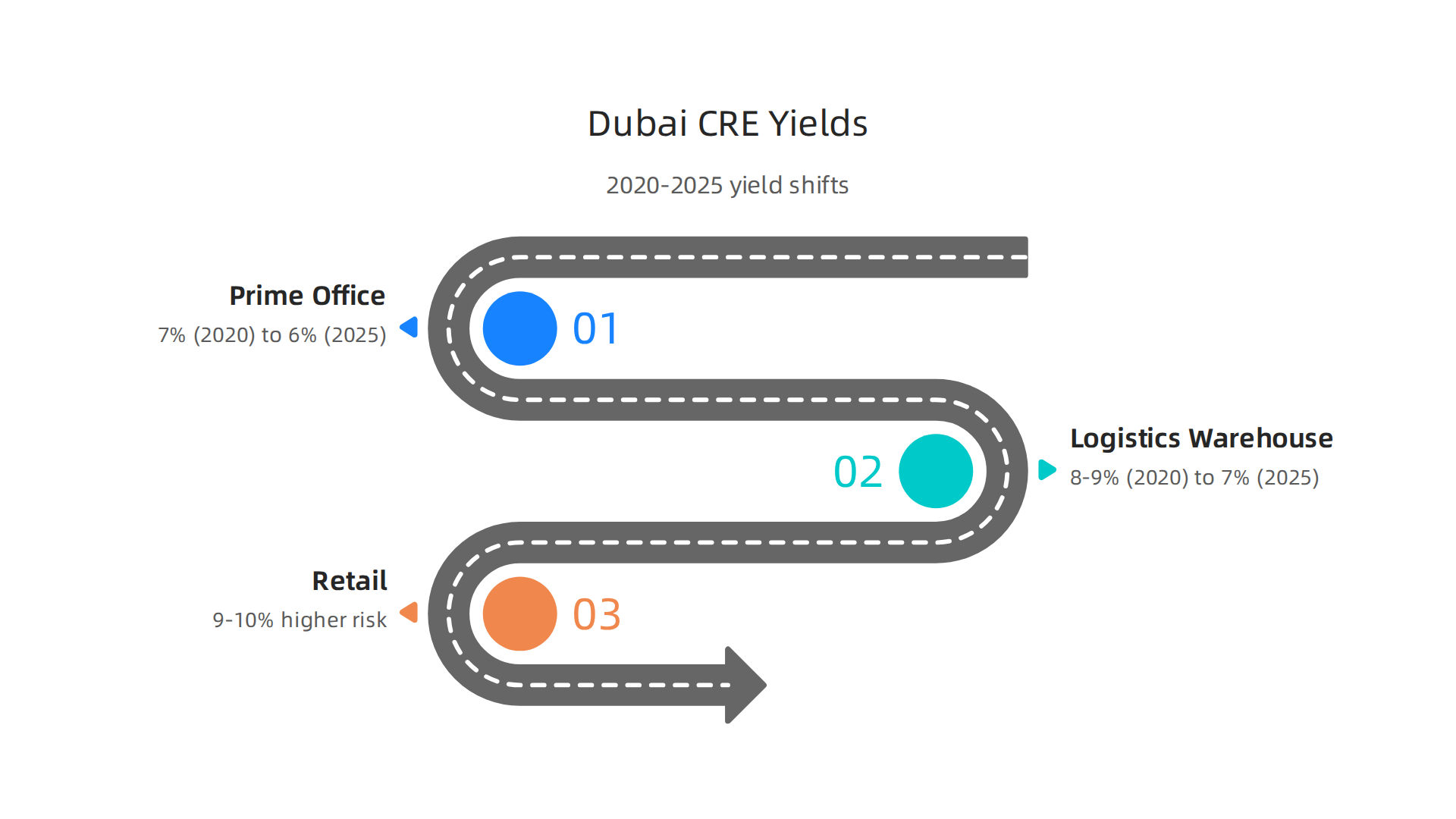
Prime office spaces in DIFC and Sheikh Zayed Road became the safe choice. Yields dropped from about 7 percent in 2020 to roughly 6 percent by 2025. More buyers chasing the same buildings drove prices up, which squeezed the yearly return. Pension funds and big institutions love this stability.
Logistics and warehouse properties saw an even sharper tightening. Yields fell from the 8 to 9 percent range down to around 7 percent. The boom in e-commerce made distribution centers a hot commodity. Everyone wanted space near Jebel Ali and Dubai South.
Retail spaces stayed on the sidelines. Yields sat at 9 to 10 percent, much higher than offices or logistics. That higher number comes with a catch. Investors see retail as riskier after the pandemic shift to online shopping. So the bigger potential return is really a reward for taking on more uncertainty.
These yield trends match what the UAE Commercial Real Estate Market Size & Share Analysis shows about rental transactions making up 67 percent of the market in 2025. That predictable cash flow is exactly what attracts capital from global funds.
If you want to understand which property type fits your return goals, start by looking at the big categories first. This guide to commercial property types in Dubai breaks down each option in plain terms.
Current Outlook for 2026: Demand Drivers and Challenges
So where does that leave us today? The commercial real estate 2026 picture in Dubai looks strong, but it is becoming a market of winners and losers depending on the property type.
The big drivers are easy to spot. Dubai keeps adding people and businesses. The economy keeps growing. And that fuels demand across the board. According to the Dubai Property Prices Forecast 2026, the office sector is expected to lead again this year, with capital values and rents both rising by about 15 percent. That is thanks to a serious shortage of Grade A space in prime areas like DIFC and Sheikh Zayed Road.
But not all offices will feel that boost. Secondary stock with older finishes and less flexible layouts may struggle to keep tenants. The flight to quality is real.
Logistics and industrial assets are set to outperform again. Warehouse space near Jebel Ali and Dubai South stays in high demand as e-commerce keeps growing. Retail is a mixed story. Prime malls and dining districts are holding value, but secondary retail spaces face a slower recovery.
Here is the thing to remember. Dubai’s commercial real estate market is becoming more segmented in 2026. A high-end office in a prime location will perform very differently from a mid-tier retail unit in an older area. That is why getting expert guidance matters more than ever.
If you are thinking about investing or leasing this year, it helps to talk to someone who knows the local market inside and out. Get a FREE Dubai Real Estate Consultation to figure out which property type fits your goals best.
And if you are comparing different areas, this practical guide to commercial real estate financing in Dubai walks through loan options and rates to help you budget properly.
Regulatory Impact on 2026 Outlook
Government policies continue to shape the commercial real estate 2026 landscape in meaningful ways. New regulations from the Dubai Land Department and RERA are making the market more transparent and safer for both investors and tenants.
One big change is the updated rental framework. The Smart Rental Index, which uses Ejari data and AI to set fair rental values, is now active. This means rent increases are capped based on real market data, making lease costs more predictable for businesses. The property.ae notes that in 2025 new 2025 Real Estate Regulatory Changes introduced rent increase limits of 5 to 10 percent depending on the RERA index.
The corporate tax introduced in 2023 has not scared away investors. Free zone exemptions remain a strong draw for companies setting up in Dubai. And long-term visa programs like the Golden Visa keep attracting foreign capital and talent. The Golden Visa now requires a property worth AED 2 million, and cryptocurrency holdings alone do not count.
Recent legal changes also trace back to Law No. 19 of 2020, which gave the DLD more power to challenge sales on the interim register. This added an extra layer of investor protection.
All these rules point in one direction. The government wants a stable, trusted market. That is good news for anyone looking at commercial real estate in Dubai right now.

If you would like to talk through how these regulations affect your next move, book a FREE Dubai Real Estate Consultation with an expert who knows the local rules inside out.
Summary
This article explains how 2020 became the turning point for Dubai’s commercial real estate and why its effects still shape the market in 2026. It reviews the pre‑pandemic boom, the shock of COVID‑19 with sharp rent falls and rising vacancies, and the divergent sector responses—retail struggled, logistics surged, and offices saw a flight to higher‑quality space. The piece then traces the recovery from 2021 to 2025 driven by Expo 2020, regulatory reforms (like 100% foreign ownership and visa changes), and renewed capital inflows that compressed yields in prime assets. You’ll also get practical insight into current 2026 demand drivers, financing and leasing considerations, and how to evaluate which property type fits your investment or leasing goals. After reading, you will understand the data and trends behind today’s opportunities and know which questions to ask when buying, leasing, or financing commercial property in Dubai.